

350
8 ALLOCHTHONOUS SEDIMENTS
==
2o., \
>'15" O
U
5,,|
0.1
\
-\
15 % clay
Wackes
Arenites
!
I
u
OI
0.2
0.5
0.4
.5
Grain size (mm)
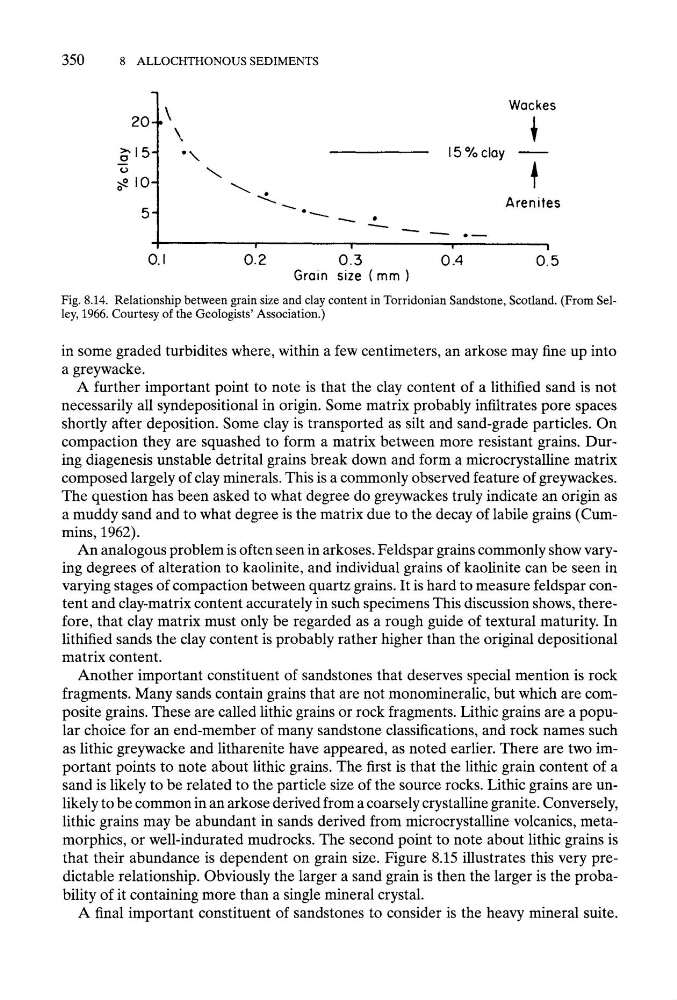
Fig. 8.14. Relationship between grain size and clay content in Torridonian Sandstone, Scotland. (From Selley, 1966. Courtesy of the Geologists' Association.)
in some graded turbidites where, within a few centimeters, an arkose may fine up into
a greywacke.
A further important point to note is that the clay content of a lithified sand is not
necessarily all syndepositional in origin. Some matrix probably infiltrates pore spaces
shortly after deposition. Some clay is transported as silt and sand-grade particles. On
compaction they are squashed to form a matrix between more resistant grains. During diagenesis unstable detrital grains break down and form a microcrystalline matrix
composed largely of clay minerals. This is a commonly observed feature of greywackes.
The question has been asked to what degree do greywackes truly indicate an origin as
a muddy sand and to what degree is the matrix due to the decay of labile grains (Cummins, 1962).
An analogous problem is often seen in arkoses. Feldspar grains commonly show varying degrees of alteration to kaolinite, and individual grains of kaolinite can be seen in
varying stages of compaction between quartz grains. It is hard to measure feldspar content and clay-matrix content accurately in such specimens This discussion shows, therefore, that clay matrix must only be regarded as a rough guide of textural maturity. In
lithified sands the clay content is probably rather higher than the original depositional
matrix content.
Another important constituent of sandstones that deserves special mention is rock
fragments. Many sands contain grains that are not monomineralic, but which are composite grains. These are called lithic grains or rock fragments. Lithic grains are a popular choice for an end-member of many sandstone classifications, and rock names such
as lithic greywacke and litharenite have appeared, as noted earlier. There are two important points to note about lithic grains. The first is that the lithic grain content of a
sand is likely to be related to the particle size of the source rocks. Lithic grains are unlikely to be common in an arkose derived from a coarsely crystalline granite. Conversely,
lithic grains may be abundant in sands derived from microcrystalline volcanics, metamorphics, or well-indurated mudrocks. The second point to note about lithic grains is
that their abundance is dependent on grain size. Figure 8.15 illustrates this very predictable relationship. Obviously the larger a sand grain is then the larger is the probability of it containing more than a single mineral crystal.
A final important constituent of sandstones to consider is the heavy mineral suite.
8 ALLOCHTHONOUS SEDIMENTS
==
2o., \
>'15" O
U
5,,|
0.1
\
-\
15 % clay
Wackes
Arenites
!
I
u
OI
0.2
0.5
0.4
.5
Grain size (mm)
Fig. 8.14. Relationship between grain size and clay content in Torridonian Sandstone, Scotland. (From Selley, 1966. Courtesy of the Geologists' Association.)
in some graded turbidites where, within a few centimeters, an arkose may fine up into
a greywacke.
A further important point to note is that the clay content of a lithified sand is not
necessarily all syndepositional in origin. Some matrix probably infiltrates pore spaces
shortly after deposition. Some clay is transported as silt and sand-grade particles. On
compaction they are squashed to form a matrix between more resistant grains. During diagenesis unstable detrital grains break down and form a microcrystalline matrix
composed largely of clay minerals. This is a commonly observed feature of greywackes.
The question has been asked to what degree do greywackes truly indicate an origin as
a muddy sand and to what degree is the matrix due to the decay of labile grains (Cummins, 1962).
An analogous problem is often seen in arkoses. Feldspar grains commonly show varying degrees of alteration to kaolinite, and individual grains of kaolinite can be seen in
varying stages of compaction between quartz grains. It is hard to measure feldspar content and clay-matrix content accurately in such specimens This discussion shows, therefore, that clay matrix must only be regarded as a rough guide of textural maturity. In
lithified sands the clay content is probably rather higher than the original depositional
matrix content.
Another important constituent of sandstones that deserves special mention is rock
fragments. Many sands contain grains that are not monomineralic, but which are composite grains. These are called lithic grains or rock fragments. Lithic grains are a popular choice for an end-member of many sandstone classifications, and rock names such
as lithic greywacke and litharenite have appeared, as noted earlier. There are two important points to note about lithic grains. The first is that the lithic grain content of a
sand is likely to be related to the particle size of the source rocks. Lithic grains are unlikely to be common in an arkose derived from a coarsely crystalline granite. Conversely,
lithic grains may be abundant in sands derived from microcrystalline volcanics, metamorphics, or well-indurated mudrocks. The second point to note about lithic grains is
that their abundance is dependent on grain size. Figure 8.15 illustrates this very predictable relationship. Obviously the larger a sand grain is then the larger is the probability of it containing more than a single mineral crystal.
A final important constituent of sandstones to consider is the heavy mineral suite.