

8.5 SANDSTONES
349
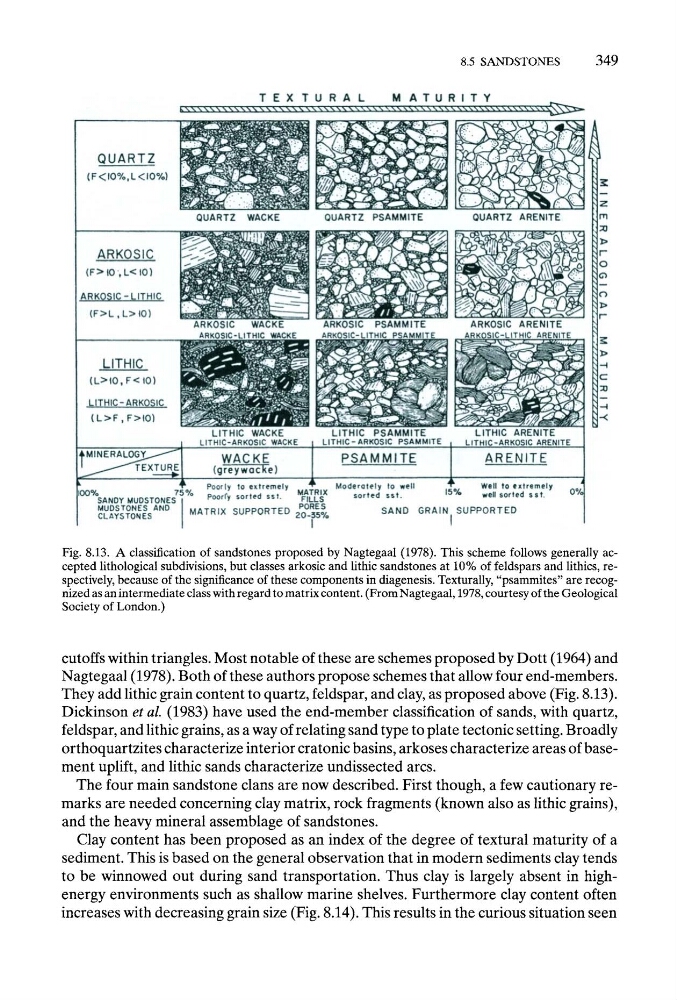
Fig. 8.13. A classification of sandstones proposed by Nagtegaal (1978). This scheme follows generally accepted lithological subdivisions, but classes arkosic and lithic sandstones at 10% of feldspars and lithics, respectively, because of the significance of these components in diagenesis. Texturally, "psammites" are recognized as an intermediate class with regard to matrix content. (From Nagtegaal, 1978, courtesy of the Geological
Society of London.)
cutoffs within triangles. Most notable of these are schemes proposed by Dott (1964) and
Nagtegaal (1978). Both of these authors propose schemes that allow four end-members.
They add lithic grain content to quartz, feldspar, and clay, as proposed above (Fig. 8.13).
Dickinson et al. (1983) have used the end-member classification of sands, with quartz,
feldspar, and lithic grains, as a way of relating sand type to plate tectonic setting. Broadly
orthoquartzites characterize interior cratonic basins, arkoses characterize areas of basement uplift, and lithic sands characterize undissected arcs.
The four main sandstone clans are now described. First though, a few cautionary remarks are needed concerning clay matrix, rock fragments (known also as lithic grains),
and the heavy mineral assemblage of sandstones.
Clay content has been proposed as an index of the degree of textural maturity of a
sediment. This is based on the general observation that in modern sediments clay tends
to be winnowed out during sand transportation. Thus clay is largely absent in highenergy environments such as shallow marine shelves. Furthermore clay content often
increases with decreasing grain size (Fig. 8.14). This results in the curious situation seen
349
Fig. 8.13. A classification of sandstones proposed by Nagtegaal (1978). This scheme follows generally accepted lithological subdivisions, but classes arkosic and lithic sandstones at 10% of feldspars and lithics, respectively, because of the significance of these components in diagenesis. Texturally, "psammites" are recognized as an intermediate class with regard to matrix content. (From Nagtegaal, 1978, courtesy of the Geological
Society of London.)
cutoffs within triangles. Most notable of these are schemes proposed by Dott (1964) and
Nagtegaal (1978). Both of these authors propose schemes that allow four end-members.
They add lithic grain content to quartz, feldspar, and clay, as proposed above (Fig. 8.13).
Dickinson et al. (1983) have used the end-member classification of sands, with quartz,
feldspar, and lithic grains, as a way of relating sand type to plate tectonic setting. Broadly
orthoquartzites characterize interior cratonic basins, arkoses characterize areas of basement uplift, and lithic sands characterize undissected arcs.
The four main sandstone clans are now described. First though, a few cautionary remarks are needed concerning clay matrix, rock fragments (known also as lithic grains),
and the heavy mineral assemblage of sandstones.
Clay content has been proposed as an index of the degree of textural maturity of a
sediment. This is based on the general observation that in modern sediments clay tends
to be winnowed out during sand transportation. Thus clay is largely absent in highenergy environments such as shallow marine shelves. Furthermore clay content often
increases with decreasing grain size (Fig. 8.14). This results in the curious situation seen