

2.3 WEATHERING
25
2.3 WEATHERING
Weathering, as already defined, includes the processes that break down rock at the
earth's surface to produce discrete sediment particles. Weathering may be classified
into chemical, physical, and biological processes. Chemical processes lead essentially to
the destruction of rock by solution. Physical processes cause mechanical fracture of the
rock. Biological weathering is due to organic processes. These include both biochemical
solution, brought about largely by the action of bacteria, and humic acids derived from
rotting organic matter, as well as physical fracturing of rock such as may be caused by
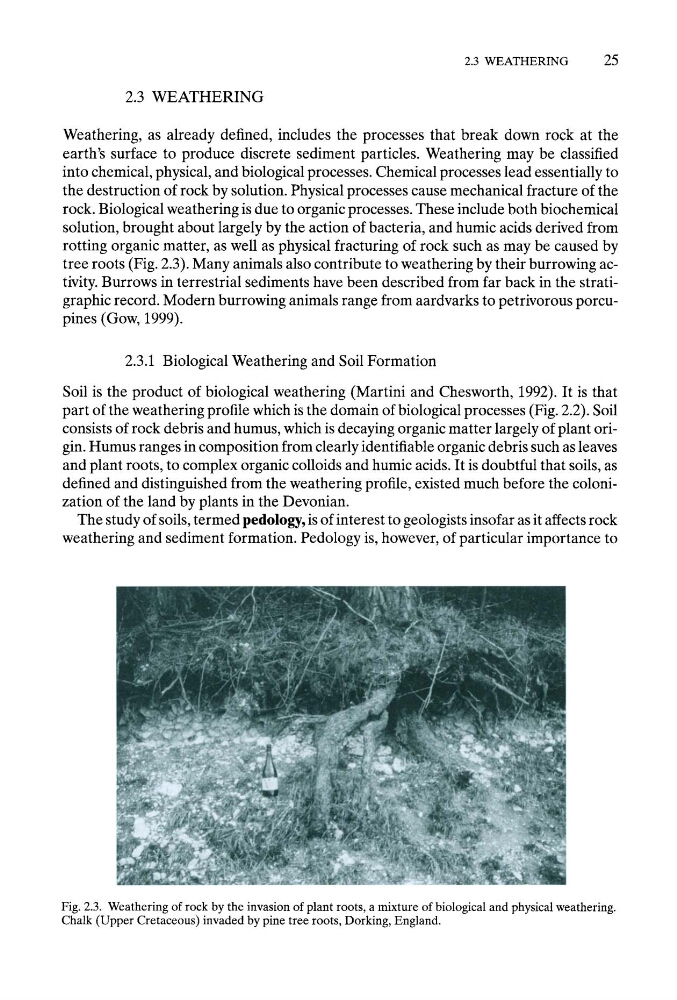
tree roots (Fig. 2.3). Many animals also contribute to weathering by their burrowing activity. Burrows in terrestrial sediments have been described from far back in the stratigraphic record. Modern burrowing animals range from aardvarks to petrivorous porcupines (Gow, 1999).
2.3.1 Biological Weathering and Soil Formation
Soil is the product of biological weathering (Martini and Chesworth, 1992). It is that
part of the weathering profile which is the domain of biological processes (Fig. 2.2). Soil
consists of rock debris and humus, which is decaying organic matter largely of plant origin. Humus ranges in composition from clearly identifiable organic debris such as leaves
and plant roots, to complex organic colloids and humic acids. It is doubtful that soils, as
defined and distinguished from the weathering profile, existed much before the colonization of the land by plants in the Devonian.
The study of soils, termed pedology, is of interest to geologists insofar as it affects rock
weathering and sediment formation. Pedology is, however, of particular importance to
Fig. 2.3. Weathering of rock by the invasion of plant roots, a mixture of biological and physical weathering.
Chalk (Upper Cretaceous) invaded by pine tree roots, Dorking, England.
25
2.3 WEATHERING
Weathering, as already defined, includes the processes that break down rock at the
earth's surface to produce discrete sediment particles. Weathering may be classified
into chemical, physical, and biological processes. Chemical processes lead essentially to
the destruction of rock by solution. Physical processes cause mechanical fracture of the
rock. Biological weathering is due to organic processes. These include both biochemical
solution, brought about largely by the action of bacteria, and humic acids derived from
rotting organic matter, as well as physical fracturing of rock such as may be caused by
tree roots (Fig. 2.3). Many animals also contribute to weathering by their burrowing activity. Burrows in terrestrial sediments have been described from far back in the stratigraphic record. Modern burrowing animals range from aardvarks to petrivorous porcupines (Gow, 1999).
2.3.1 Biological Weathering and Soil Formation
Soil is the product of biological weathering (Martini and Chesworth, 1992). It is that
part of the weathering profile which is the domain of biological processes (Fig. 2.2). Soil
consists of rock debris and humus, which is decaying organic matter largely of plant origin. Humus ranges in composition from clearly identifiable organic debris such as leaves
and plant roots, to complex organic colloids and humic acids. It is doubtful that soils, as
defined and distinguished from the weathering profile, existed much before the colonization of the land by plants in the Devonian.
The study of soils, termed pedology, is of interest to geologists insofar as it affects rock
weathering and sediment formation. Pedology is, however, of particular importance to
Fig. 2.3. Weathering of rock by the invasion of plant roots, a mixture of biological and physical weathering.
Chalk (Upper Cretaceous) invaded by pine tree roots, Dorking, England.