

24
2 WEATHERING AND THE SEDIMENTARY CYCLE
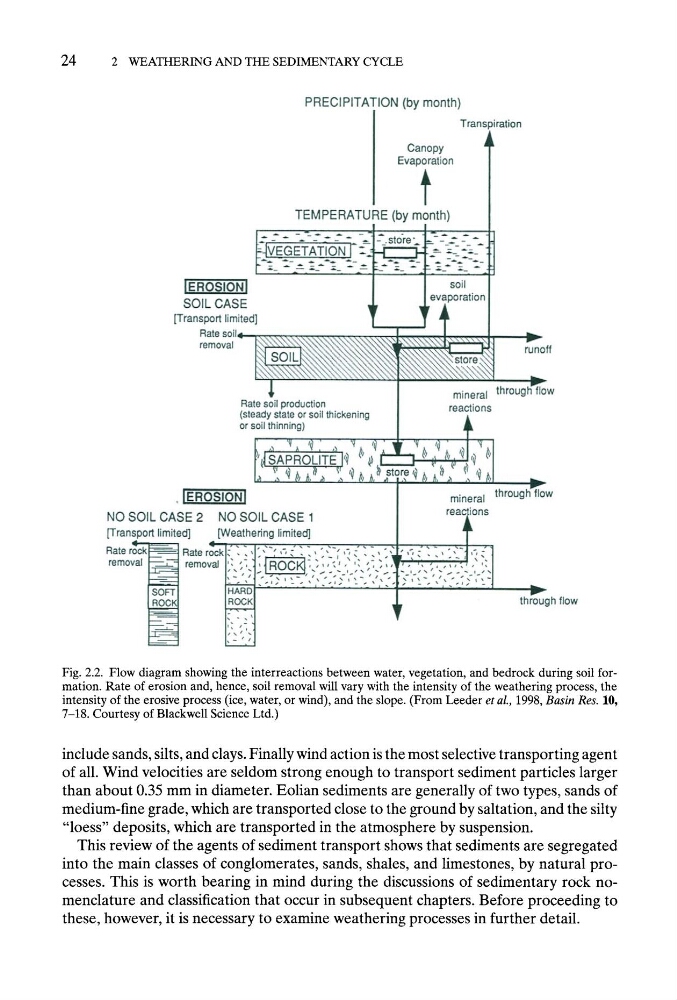
Fig. 2.2. Flow diagram showing the interreactions between water, vegetation, and bedrock during soil formation. Rate of erosion and, hence, soil removal will vary with the intensity of the weathering process, the
intensity of the erosive process (ice, water, or wind), and the slope. (From Leeder et al., 1998, Basin Res. 10,
7-18. Courtesy of Blackwell Science Ltd.)
include sands, silts, and clays. Finally wind action is the most selective transporting agent
of all. Wind velocities are seldom strong enough to transport sediment particles larger
than about 0.35 mm in diameter. Eolian sediments are generally of two types, sands of
medium-fine grade, which are transported close to the ground by saltation, and the silty
"loess" deposits, which are transported in the atmosphere by suspension.
This review of the agents of sediment transport shows that sediments are segregated
into the main classes of conglomerates, sands, shales, and limestones, by natural processes. This is worth bearing in mind during the discussions of sedimentary rock nomenclature and classification that occur in subsequent chapters. Before proceeding to
these, however, it is necessary to examine weathering processes in further detail.
2 WEATHERING AND THE SEDIMENTARY CYCLE
Fig. 2.2. Flow diagram showing the interreactions between water, vegetation, and bedrock during soil formation. Rate of erosion and, hence, soil removal will vary with the intensity of the weathering process, the
intensity of the erosive process (ice, water, or wind), and the slope. (From Leeder et al., 1998, Basin Res. 10,
7-18. Courtesy of Blackwell Science Ltd.)
include sands, silts, and clays. Finally wind action is the most selective transporting agent
of all. Wind velocities are seldom strong enough to transport sediment particles larger
than about 0.35 mm in diameter. Eolian sediments are generally of two types, sands of
medium-fine grade, which are transported close to the ground by saltation, and the silty
"loess" deposits, which are transported in the atmosphere by suspension.
This review of the agents of sediment transport shows that sediments are segregated
into the main classes of conglomerates, sands, shales, and limestones, by natural processes. This is worth bearing in mind during the discussions of sedimentary rock nomenclature and classification that occur in subsequent chapters. Before proceeding to
these, however, it is necessary to examine weathering processes in further detail.