

2.2 THE SEDIMENTARY CYCLE
23
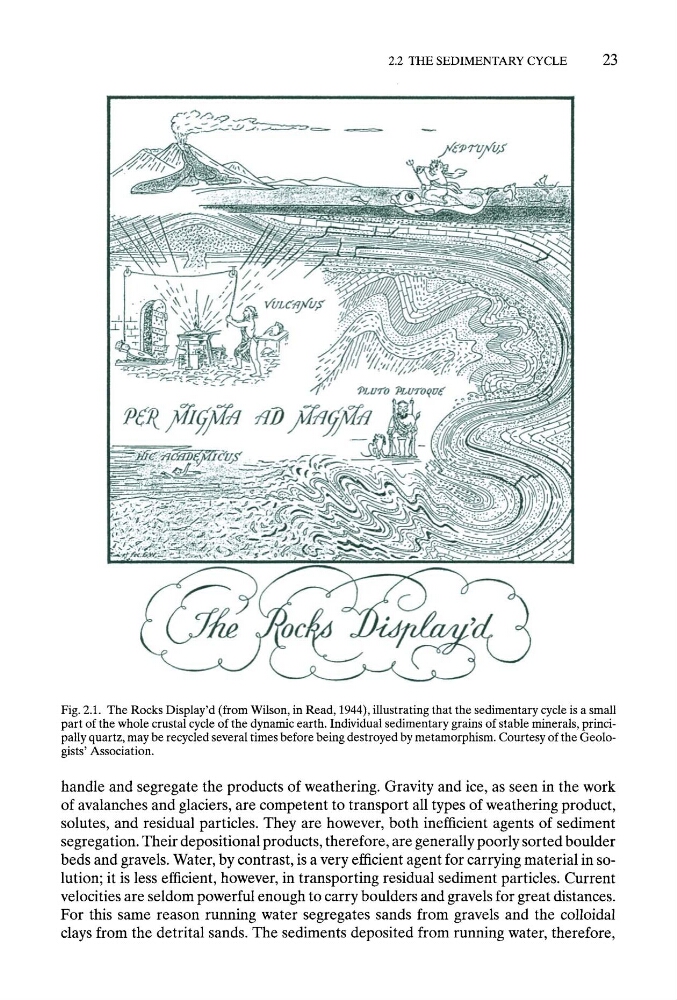
Fig. 2.1. The Rocks Display'd (from Wilson, in Read, 1944), illustrating that the sedimentary cycle is a small
part of the whole crustal cycle of the dynamic earth. Individual sedimentary grains of stable minerals, principally quartz, may be recycled several times before being destroyed by metamorphism. Courtesy of the Geologists' Association.
handle and segregate the products of weathering. Gravity and ice, as seen in the work
of avalanches and glaciers, are competent to transport all types of weathering product,
solutes, and residual particles. They are however, both inefficient agents of sediment
segregation. Their depositional products, therefore, are generally poorly sorted boulder
beds and gravels. Water, by contrast, is a very efficient agent for carrying material in solution; it is less efficient, however, in transporting residual sediment particles. Current
velocities are seldom powerful enough to carry boulders and gravels for great distances.
For this same reason running water segregates sands from gravels and the colloidal
clays from the detrital sands. The sediments deposited from running water, therefore,
23
Fig. 2.1. The Rocks Display'd (from Wilson, in Read, 1944), illustrating that the sedimentary cycle is a small
part of the whole crustal cycle of the dynamic earth. Individual sedimentary grains of stable minerals, principally quartz, may be recycled several times before being destroyed by metamorphism. Courtesy of the Geologists' Association.
handle and segregate the products of weathering. Gravity and ice, as seen in the work
of avalanches and glaciers, are competent to transport all types of weathering product,
solutes, and residual particles. They are however, both inefficient agents of sediment
segregation. Their depositional products, therefore, are generally poorly sorted boulder
beds and gravels. Water, by contrast, is a very efficient agent for carrying material in solution; it is less efficient, however, in transporting residual sediment particles. Current
velocities are seldom powerful enough to carry boulders and gravels for great distances.
For this same reason running water segregates sands from gravels and the colloidal
clays from the detrital sands. The sediments deposited from running water, therefore,