

26
2 WEATHERING AND THE SEDIMENTARY CYCLE
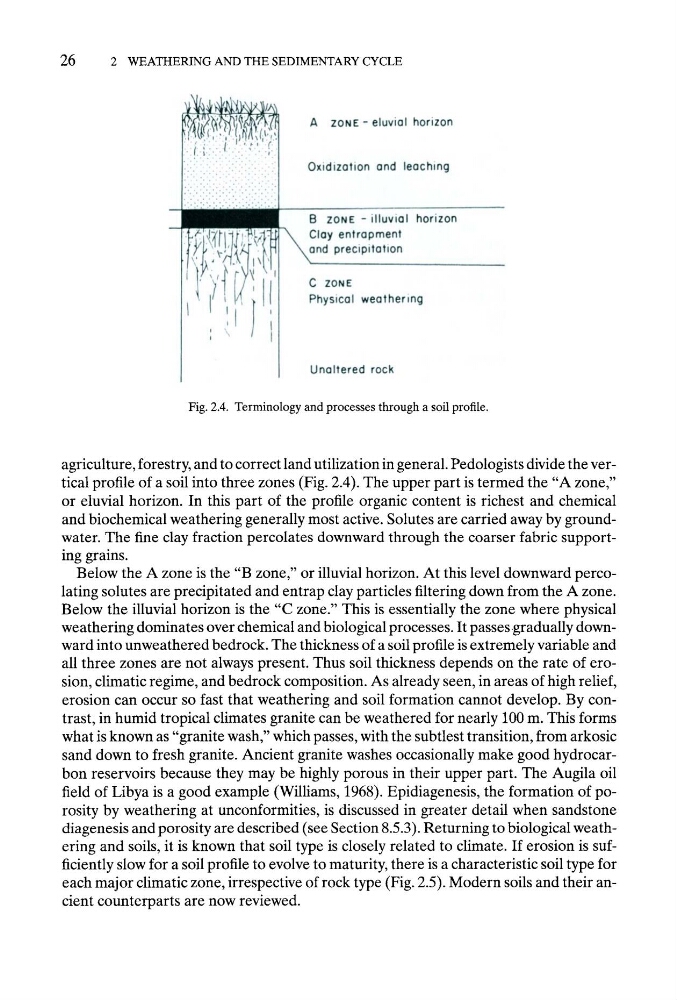
Fig. 2.4. Terminology and processes through a soil profile.
agriculture, forestry, and to correct land utilization in general. Pedologists divide the vertical profile of a soil into three zones (Fig. 2.4). The upper part is termed the "A zone,"
or eluvial horizon. In this part of the profile organic content is richest and chemical
and biochemical weathering generally most active. Solutes are carried away by groundwater. The fine clay fraction percolates downward through the coarser fabric supporting grains.
Below the A zone is the "B zone," or illuvial horizon. At this level downward percolating solutes are precipitated and entrap clay particles filtering down from the A zone.
Below the illuvial horizon is the "C zone." This is essentially the zone where physical
weathering dominates over chemical and biological processes. It passes gradually downward into unweathered bedrock. The thickness of a soil profile is extremely variable and
all three zones are not always present. Thus soil thickness depends on the rate of erosion, climatic regime, and bedrock composition. As already seen, in areas of high relief,
erosion can occur so fast that weathering and soil formation cannot develop. By contrast, in humid tropical climates granite can be weathered for nearly 100 m. This forms
what is known as "granite wash," which passes, with the subtlest transition, from arkosic
sand down to fresh granite. Ancient granite washes occasionally make good hydrocarbon reservoirs because they may be highly porous in their upper part. The Augila oil
field of Libya is a good example (Williams, 1968). Epidiagenesis, the formation of porosity by weathering at unconformities, is discussed in greater detail when sandstone
diagenesis and porosity are described (see Section 8.5.3). Returning to biological weathering and soils, it is known that soil type is closely related to climate. If erosion is sufficiently slow for a soil profile to evolve to maturity, there is a characteristic soil type for
each major climatic zone, irrespective of rock type (Fig. 2.5). Modern soils and their ancient counterparts are now reviewed.
2 WEATHERING AND THE SEDIMENTARY CYCLE
Fig. 2.4. Terminology and processes through a soil profile.
agriculture, forestry, and to correct land utilization in general. Pedologists divide the vertical profile of a soil into three zones (Fig. 2.4). The upper part is termed the "A zone,"
or eluvial horizon. In this part of the profile organic content is richest and chemical
and biochemical weathering generally most active. Solutes are carried away by groundwater. The fine clay fraction percolates downward through the coarser fabric supporting grains.
Below the A zone is the "B zone," or illuvial horizon. At this level downward percolating solutes are precipitated and entrap clay particles filtering down from the A zone.
Below the illuvial horizon is the "C zone." This is essentially the zone where physical
weathering dominates over chemical and biological processes. It passes gradually downward into unweathered bedrock. The thickness of a soil profile is extremely variable and
all three zones are not always present. Thus soil thickness depends on the rate of erosion, climatic regime, and bedrock composition. As already seen, in areas of high relief,
erosion can occur so fast that weathering and soil formation cannot develop. By contrast, in humid tropical climates granite can be weathered for nearly 100 m. This forms
what is known as "granite wash," which passes, with the subtlest transition, from arkosic
sand down to fresh granite. Ancient granite washes occasionally make good hydrocarbon reservoirs because they may be highly porous in their upper part. The Augila oil
field of Libya is a good example (Williams, 1968). Epidiagenesis, the formation of porosity by weathering at unconformities, is discussed in greater detail when sandstone
diagenesis and porosity are described (see Section 8.5.3). Returning to biological weathering and soils, it is known that soil type is closely related to climate. If erosion is sufficiently slow for a soil profile to evolve to maturity, there is a characteristic soil type for
each major climatic zone, irrespective of rock type (Fig. 2.5). Modern soils and their ancient counterparts are now reviewed.