

340
8 ALLOCHTHONOUS SEDIMENTS
-Porosity
~SurfQceO
20
40
60
80
100
1000
ooo[ ;f/H// 9
oool
~176 / /
7oooL
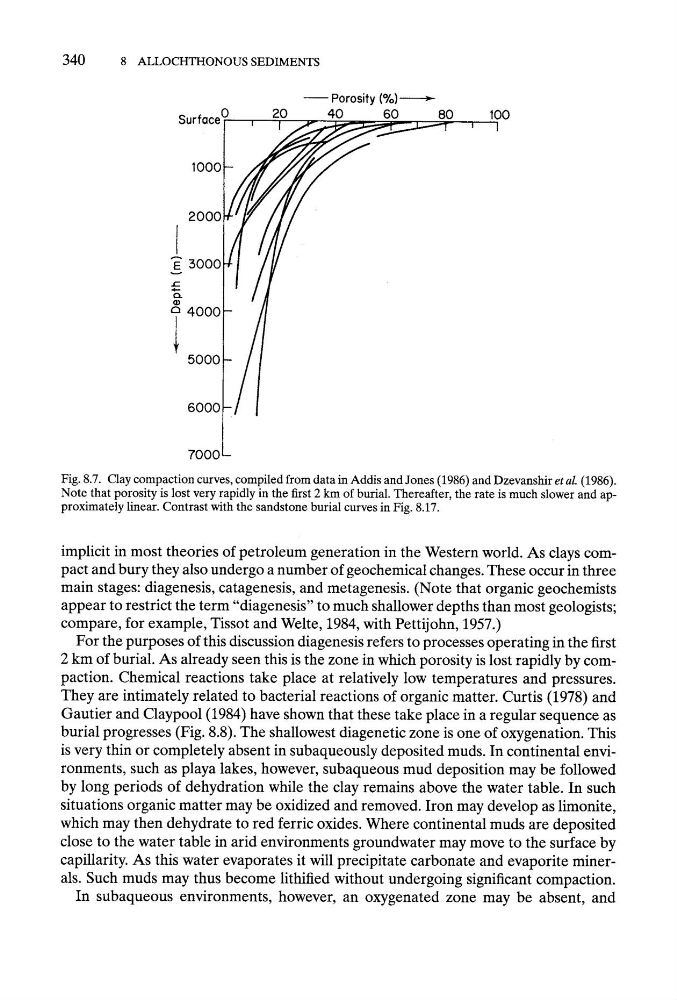
Fig. 8.7. Clay compaction curves, compiled from data in Addis and Jones (1986) and Dzevanshir et al. (1986).
Note that porosity is lost very rapidly in the first 2 km of burial. Thereafter, the rate is much slower and approximately linear. Contrast with the sandstone burial curves in Fig. 8.17.
implicit in most theories of petroleum generation in the Western world. As clays compact and bury they also undergo a number of geochemical changes. These occur in three
main stages: diagenesis, catagenesis, and metagenesis. (Note that organic geochemists
appear to restrict the term "diagenesis" to much shallower depths than most geologists;
compare, for example, Tissot and Welte, 1984, with Pettijohn, 1957.)
For the purposes of this discussion diagenesis refers to processes operating in the first
2 km of burial. As already seen this is the zone in which porosity is lost rapidly by compaction. Chemical reactions take place at relatively low temperatures and pressures.
They are intimately related to bacterial reactions of organic matter. Curtis (1978) and
Gautier and Claypool (1984) have shown that these take place in a regular sequence as
burial progresses (Fig. 8.8). The shallowest diagenetic zone is one of oxygenation. This
is very thin or completely absent in subaqueously deposited muds. In continental environments, such as playa lakes, however, subaqueous mud deposition may be followed
by long periods of dehydration while the clay remains above the water table. In such
situations organic matter may be oxidized and removed. Iron may develop as limonite,
which may then dehydrate to red ferric oxides. Where continental muds are deposited
close to the water table in arid environments groundwater may move to the surface by
capillarity. As this water evaporates it will precipitate carbonate and evaporite minerals. Such muds may thus become lithified without undergoing significant compaction.
In subaqueous environments, however, an oxygenated zone may be absent, and
8 ALLOCHTHONOUS SEDIMENTS
-Porosity
~SurfQceO
20
40
60
80
100
1000
ooo[ ;f/H// 9
oool
~176 / /
7oooL
Fig. 8.7. Clay compaction curves, compiled from data in Addis and Jones (1986) and Dzevanshir et al. (1986).
Note that porosity is lost very rapidly in the first 2 km of burial. Thereafter, the rate is much slower and approximately linear. Contrast with the sandstone burial curves in Fig. 8.17.
implicit in most theories of petroleum generation in the Western world. As clays compact and bury they also undergo a number of geochemical changes. These occur in three
main stages: diagenesis, catagenesis, and metagenesis. (Note that organic geochemists
appear to restrict the term "diagenesis" to much shallower depths than most geologists;
compare, for example, Tissot and Welte, 1984, with Pettijohn, 1957.)
For the purposes of this discussion diagenesis refers to processes operating in the first
2 km of burial. As already seen this is the zone in which porosity is lost rapidly by compaction. Chemical reactions take place at relatively low temperatures and pressures.
They are intimately related to bacterial reactions of organic matter. Curtis (1978) and
Gautier and Claypool (1984) have shown that these take place in a regular sequence as
burial progresses (Fig. 8.8). The shallowest diagenetic zone is one of oxygenation. This
is very thin or completely absent in subaqueously deposited muds. In continental environments, such as playa lakes, however, subaqueous mud deposition may be followed
by long periods of dehydration while the clay remains above the water table. In such
situations organic matter may be oxidized and removed. Iron may develop as limonite,
which may then dehydrate to red ferric oxides. Where continental muds are deposited
close to the water table in arid environments groundwater may move to the surface by
capillarity. As this water evaporates it will precipitate carbonate and evaporite minerals. Such muds may thus become lithified without undergoing significant compaction.
In subaqueous environments, however, an oxygenated zone may be absent, and