

8.3 MUDROCKS
341
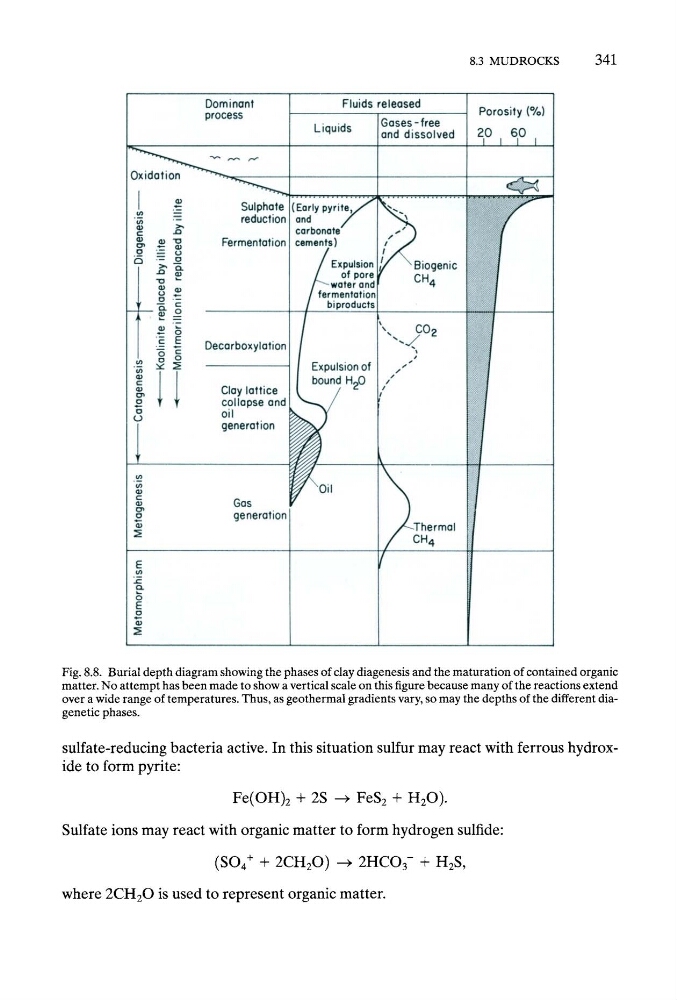
Fig. 8.8. Burial depth diagram showing the phases of clay diagenesis and the maturation of contained organic
matter. No attempt has been made to show a vertical scale on this figure because many of the reactions extend
over a wide range of temperatures. Thus, as geothermal gradients vary, so may the depths of the different diagenetic phases.
sulfate-reducing bacteria active. In this situation sulfur may react with ferrous hydroxide to form pyrite:
Fe(OH)2 + 2S --4 FeS2 + H20 ).
Sulfate ions may react with organic matter to form hydrogen sulfide:
( 5 0 4 + --F 2CH20 ) ~ 2HCO3- + H2S,
where 2CH20 is used to represent organic matter.
341
Fig. 8.8. Burial depth diagram showing the phases of clay diagenesis and the maturation of contained organic
matter. No attempt has been made to show a vertical scale on this figure because many of the reactions extend
over a wide range of temperatures. Thus, as geothermal gradients vary, so may the depths of the different diagenetic phases.
sulfate-reducing bacteria active. In this situation sulfur may react with ferrous hydroxide to form pyrite:
Fe(OH)2 + 2S --4 FeS2 + H20 ).
Sulfate ions may react with organic matter to form hydrogen sulfide:
( 5 0 4 + --F 2CH20 ) ~ 2HCO3- + H2S,
where 2CH20 is used to represent organic matter.