

7.4 FLUID FLOW IN SEDIMENTARY BASINS
325
7.4.3 Convective Flow
Convection currents are an important process in nature. They generate thunderstorms
in the atmosphere, and convection cells in the mantle are believed to be responsible for
plate tectonics. There is some evidence for convective flow of pore fluids in sedimentary
basins. On a small scale convection currents have been shown to exist within oil fields
a few kilometers across (Combarnous and Aziz, 1970). There is evidence, however, that
convective flow may occur on a large scale in sedimentary basins. If this is true it must
have an important effect on diagenesis, and on the emplacement of petroleum and epigenetic ore bodies. Positive geothermal anomalies that generate "hot spots" may well
cause fluid to expand, decrease in density, and thus move upward. It was once believed
that the mineralization around igneous intrusions was solely due to the magmatic fluids.
Stable isotope analysis shows, however, that mineral emplacement was partly due to
fluids from the adjacent sedimentary cover. A popular model for intrusive-related minerals invokes a peripheral convection cell of connate fluids (see Jensen and Bateman,
1979, p. 61, for sources). These fluids are drawn from the country rock into the metamorphic aureole and stock, within which mineralization takes place (see Fig. 7.3F).
Wood and Hewitt (1982, 1984) have argued for the existence of basin-wide convection cells. These may cause connate waters to flow for considerable distances, aiding petroleum migration, and leaching minerals into solution in some parts of the basin, to
precipitate them as cements elsewhere. Such a large convection cell has been identified
in the Tertiary Gulf Coast basin of the USA (Blanchard and Sharp, 1985).
Note that convection cells will only develop in basins with laterally extensive permeable formations. They are unlikely to evolve in impermeable shale or evaporitic basin
centers.
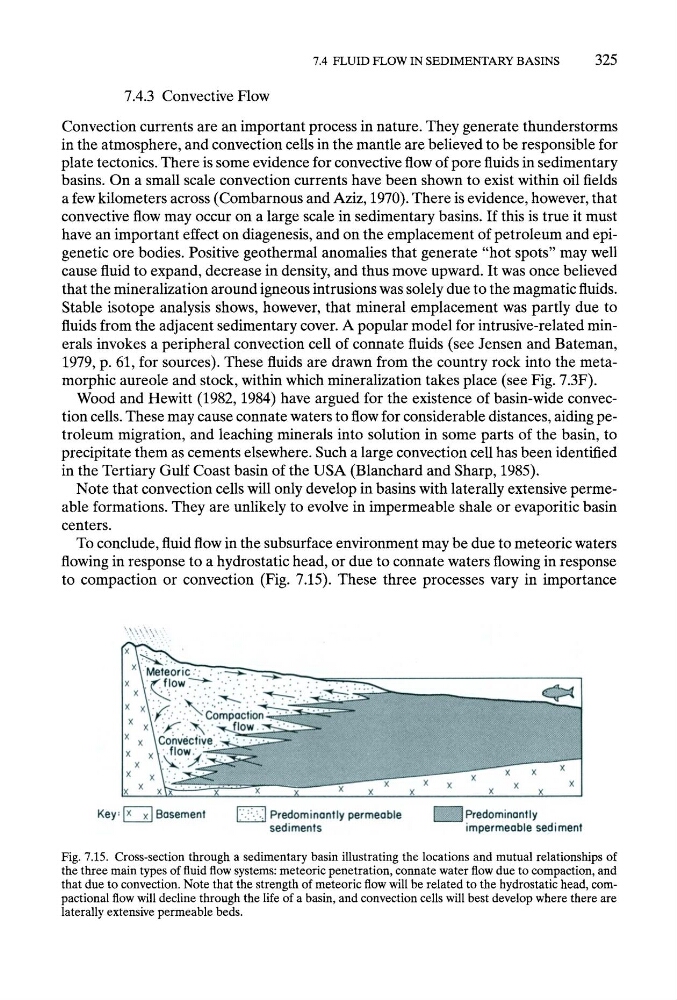
To conclude, fluid flow in the subsurface environment may be due to meteoric waters
flowing in response to a hydrostatic head, or due to connate waters flowing in response
to compaction or convection (Fig. 7.15). These three processes vary in importance
Fig. 7.15. Cross-section through a sedimentary basin illustrating the locations and mutual relationships of
the three main types of fluid flow systems: meteoric penetration, connate water flow due to compaction, and
that due to convection. Note that the strength of meteoric flow will be related to the hydrostatic head, compactional flow will decline through the life of a basin, and convection cells will best develop where there are
laterally extensive permeable beds.
325
7.4.3 Convective Flow
Convection currents are an important process in nature. They generate thunderstorms
in the atmosphere, and convection cells in the mantle are believed to be responsible for
plate tectonics. There is some evidence for convective flow of pore fluids in sedimentary
basins. On a small scale convection currents have been shown to exist within oil fields
a few kilometers across (Combarnous and Aziz, 1970). There is evidence, however, that
convective flow may occur on a large scale in sedimentary basins. If this is true it must
have an important effect on diagenesis, and on the emplacement of petroleum and epigenetic ore bodies. Positive geothermal anomalies that generate "hot spots" may well
cause fluid to expand, decrease in density, and thus move upward. It was once believed
that the mineralization around igneous intrusions was solely due to the magmatic fluids.
Stable isotope analysis shows, however, that mineral emplacement was partly due to
fluids from the adjacent sedimentary cover. A popular model for intrusive-related minerals invokes a peripheral convection cell of connate fluids (see Jensen and Bateman,
1979, p. 61, for sources). These fluids are drawn from the country rock into the metamorphic aureole and stock, within which mineralization takes place (see Fig. 7.3F).
Wood and Hewitt (1982, 1984) have argued for the existence of basin-wide convection cells. These may cause connate waters to flow for considerable distances, aiding petroleum migration, and leaching minerals into solution in some parts of the basin, to
precipitate them as cements elsewhere. Such a large convection cell has been identified
in the Tertiary Gulf Coast basin of the USA (Blanchard and Sharp, 1985).
Note that convection cells will only develop in basins with laterally extensive permeable formations. They are unlikely to evolve in impermeable shale or evaporitic basin
centers.
To conclude, fluid flow in the subsurface environment may be due to meteoric waters
flowing in response to a hydrostatic head, or due to connate waters flowing in response
to compaction or convection (Fig. 7.15). These three processes vary in importance
Fig. 7.15. Cross-section through a sedimentary basin illustrating the locations and mutual relationships of
the three main types of fluid flow systems: meteoric penetration, connate water flow due to compaction, and
that due to convection. Note that the strength of meteoric flow will be related to the hydrostatic head, compactional flow will decline through the life of a basin, and convection cells will best develop where there are
laterally extensive permeable beds.