

324
7 THE SUBSURFACE ENVIRONMENT
FLUSHING WITH
.METEORIC WATER
L
TOTAL FLUX DEPENDS UPON:
1) TOPOGRAPHIC HEAD
2) SANDSTONE PERMEABILITY
AND GEOMETRY
3) TIME
---'A Pore' water in~ "~
.o
THERMOBARIC
COMPACTIVE DRIVE
,
TOTAL FLUX LIMITED BY
AMOUNT OF WATER
CONTAINED IN THE BASIN
CONVECTION CURRENTS
_
DRIVEN BY DENSITY OR
TEMPERATURE DIFFERENCES.
WILL NOT OPERATE ACROSS
PERMEABILITY BARRIERS
AND ABNORMAL PRESSURE
GRADIENTS
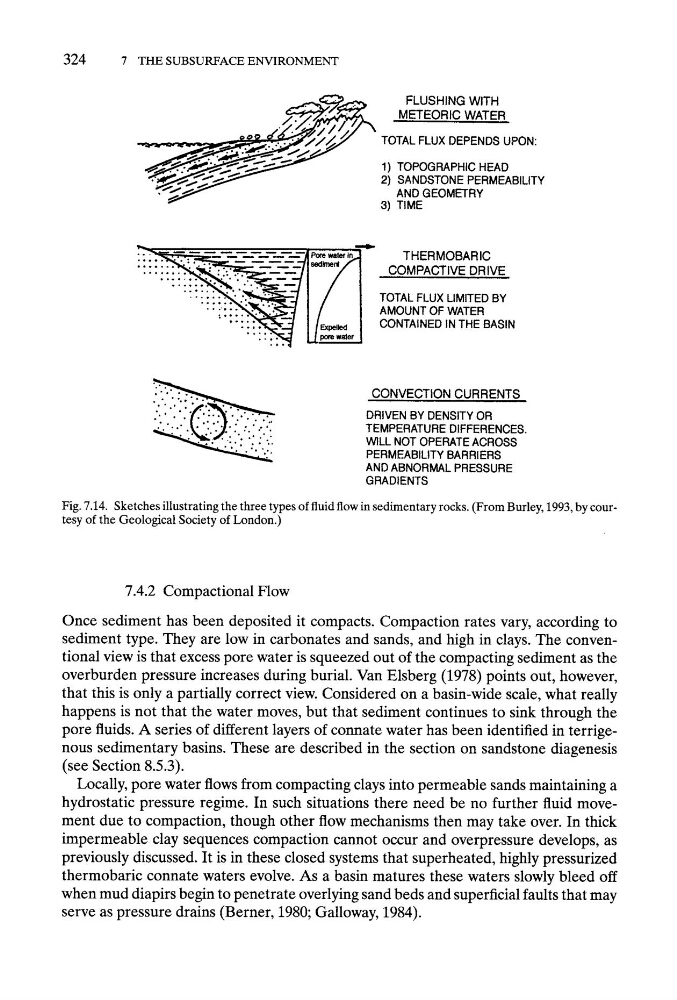
Fig. 7.14. Sketches illustrating the three types of fluid flow in sedimentary rocks. (From Burley, 1993, by courtesy of the Geological Society of London.)
7.4.2 Compactional Flow
Once sediment has been deposited it compacts. Compaction rates vary, according to
sediment type. They are low in carbonates and sands, and high in clays. The conventional view is that excess pore water is squeezed out of the compacting sediment as the
overburden pressure increases during burial. Van Elsberg (1978) points out, however,
that this is only a partially correct view. Considered on a basin-wide scale, what really
happens is not that the water moves, but that sediment continues to sink through the
pore fluids. A series of different layers of connate water has been identified in terrigenous sedimentary basins. These are described in the section on sandstone diagenesis
(see Section 8.5.3).
Locally, pore water flows from compacting clays into permeable sands maintaining a
hydrostatic pressure regime. In such situations there need be no further fluid movement due to compaction, though other flow mechanisms then may take over. In thick
impermeable clay sequences compaction cannot occur and overpressure develops, as
previously discussed. It is in these closed systems that superheated, highly pressurized
thermobaric connate waters evolve. As a basin matures these waters slowly bleed off
when mud diapirs begin to penetrate overlying sand beds and superficial faults that may
serve as pressure drains (Berner, 1980; Galloway, 1984).
7 THE SUBSURFACE ENVIRONMENT
FLUSHING WITH
.METEORIC WATER
L
TOTAL FLUX DEPENDS UPON:
1) TOPOGRAPHIC HEAD
2) SANDSTONE PERMEABILITY
AND GEOMETRY
3) TIME
---'A Pore' water in~ "~
.o
THERMOBARIC
COMPACTIVE DRIVE
,
TOTAL FLUX LIMITED BY
AMOUNT OF WATER
CONTAINED IN THE BASIN
CONVECTION CURRENTS
_
DRIVEN BY DENSITY OR
TEMPERATURE DIFFERENCES.
WILL NOT OPERATE ACROSS
PERMEABILITY BARRIERS
AND ABNORMAL PRESSURE
GRADIENTS
Fig. 7.14. Sketches illustrating the three types of fluid flow in sedimentary rocks. (From Burley, 1993, by courtesy of the Geological Society of London.)
7.4.2 Compactional Flow
Once sediment has been deposited it compacts. Compaction rates vary, according to
sediment type. They are low in carbonates and sands, and high in clays. The conventional view is that excess pore water is squeezed out of the compacting sediment as the
overburden pressure increases during burial. Van Elsberg (1978) points out, however,
that this is only a partially correct view. Considered on a basin-wide scale, what really
happens is not that the water moves, but that sediment continues to sink through the
pore fluids. A series of different layers of connate water has been identified in terrigenous sedimentary basins. These are described in the section on sandstone diagenesis
(see Section 8.5.3).
Locally, pore water flows from compacting clays into permeable sands maintaining a
hydrostatic pressure regime. In such situations there need be no further fluid movement due to compaction, though other flow mechanisms then may take over. In thick
impermeable clay sequences compaction cannot occur and overpressure develops, as
previously discussed. It is in these closed systems that superheated, highly pressurized
thermobaric connate waters evolve. As a basin matures these waters slowly bleed off
when mud diapirs begin to penetrate overlying sand beds and superficial faults that may
serve as pressure drains (Berner, 1980; Galloway, 1984).