

274
6 DEPOSITIONAL SYSTEMS
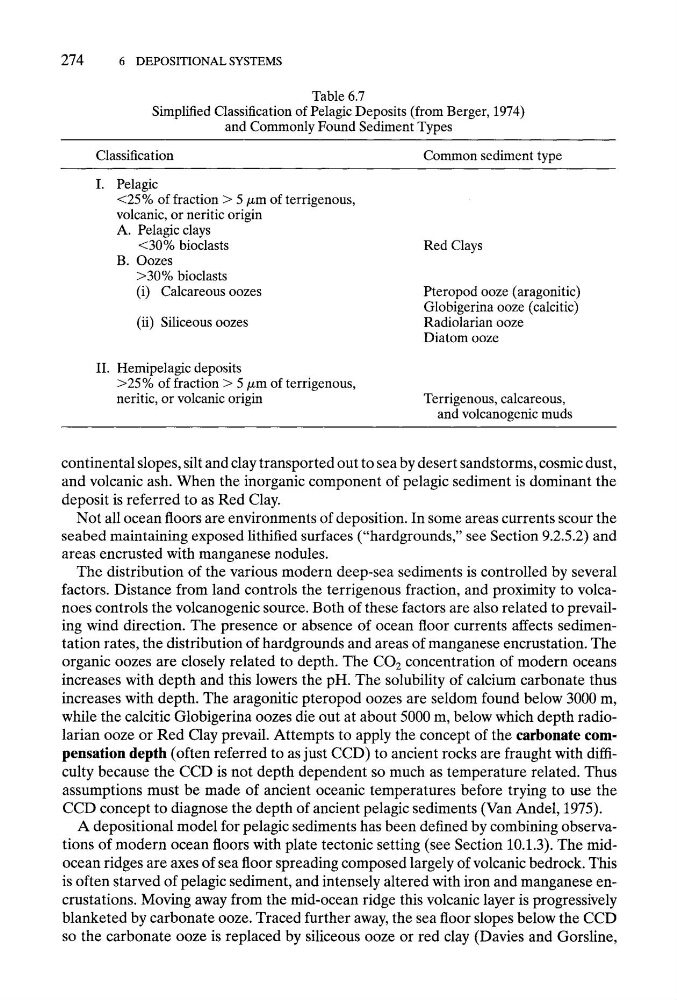
Table 6.7
Simplified Classification of Pelagic Deposits (from Berger, 1974)
and Commonly Found Sediment Types
Classification
Common sediment type
I. Pelagic
<25 % of fraction > 5/zm of terrigenous,
volcanic, or neritic origin
A. Pelagic clays
<30% bioclasts
B. Oozes
>30% bioclasts
(i) Calcareous oozes
(ii) Siliceous oozes
II. Hemipelagic deposits
>25 % of fraction > 5/xm of terrigenous,
neritic, or volcanic origin
Red Clays
Pteropod ooze (aragonitic)
Globigerina ooze (calcitic)
Radiolarian ooze
Diatom ooze
Terrigenous, calcareous,
and volcanogenic muds
continental slopes, silt and clay transported out to sea by desert sandstorms, cosmic dust,
and volcanic ash. When the inorganic component of pelagic sediment is dominant the
deposit is referred to as Red Clay.
Not all ocean floors are environments of deposition. In some areas currents scour the
seabed maintaining exposed lithified surfaces ("hardgrounds," see Section 9.2.5.2) and
areas encrusted with manganese nodules.
The distribution of the various modern deep-sea sediments is controlled by several
factors. Distance from land controls the terrigenous fraction, and proximity to volcanoes controls the volcanogenic source. Both of these factors are also related to prevailing wind direction. The presence or absence of ocean floor currents affects sedimentation rates, the distribution of hardgrounds and areas of manganese encrustation. The
organic oozes are closely related to depth. The CO2 concentration of modern oceans
increases with depth and this lowers the pH. The solubility of calcium carbonate thus
increases with depth. The aragonitic pteropod oozes are seldom found below 3000 m,
while the calcitic Globigerina oozes die out at about 5000 m, below which depth radiolarian ooze or Red Clay prevail. Attempts to apply the concept of the carbonate compensation depth (often referred to as just CCD) to ancient rocks are fraught with difficulty because the CCD is not depth dependent so much as temperature related. Thus
assumptions must be made of ancient oceanic temperatures before trying to use the
CCD concept to diagnose the depth of ancient pelagic sediments (Van Andel, 1975).
A depositional model for pelagic sediments has been defined by combining observations of modern ocean floors with plate tectonic setting (see Section 10.1.3). The midocean ridges are axes of sea floor spreading composed largely of volcanic bedrock. This
is often starved of pelagic sediment, and intensely altered with iron and manganese encrustations. Moving away from the mid-ocean ridge this volcanic layer is progressively
blanketed by carbonate ooze. Traced further away, the sea floor slopes below the CCD
so the carbonate ooze is replaced by siliceous ooze or red clay (Davies and Gorsline,
6 DEPOSITIONAL SYSTEMS
Table 6.7
Simplified Classification of Pelagic Deposits (from Berger, 1974)
and Commonly Found Sediment Types
Classification
Common sediment type
I. Pelagic
<25 % of fraction > 5/zm of terrigenous,
volcanic, or neritic origin
A. Pelagic clays
<30% bioclasts
B. Oozes
>30% bioclasts
(i) Calcareous oozes
(ii) Siliceous oozes
II. Hemipelagic deposits
>25 % of fraction > 5/xm of terrigenous,
neritic, or volcanic origin
Red Clays
Pteropod ooze (aragonitic)
Globigerina ooze (calcitic)
Radiolarian ooze
Diatom ooze
Terrigenous, calcareous,
and volcanogenic muds
continental slopes, silt and clay transported out to sea by desert sandstorms, cosmic dust,
and volcanic ash. When the inorganic component of pelagic sediment is dominant the
deposit is referred to as Red Clay.
Not all ocean floors are environments of deposition. In some areas currents scour the
seabed maintaining exposed lithified surfaces ("hardgrounds," see Section 9.2.5.2) and
areas encrusted with manganese nodules.
The distribution of the various modern deep-sea sediments is controlled by several
factors. Distance from land controls the terrigenous fraction, and proximity to volcanoes controls the volcanogenic source. Both of these factors are also related to prevailing wind direction. The presence or absence of ocean floor currents affects sedimentation rates, the distribution of hardgrounds and areas of manganese encrustation. The
organic oozes are closely related to depth. The CO2 concentration of modern oceans
increases with depth and this lowers the pH. The solubility of calcium carbonate thus
increases with depth. The aragonitic pteropod oozes are seldom found below 3000 m,
while the calcitic Globigerina oozes die out at about 5000 m, below which depth radiolarian ooze or Red Clay prevail. Attempts to apply the concept of the carbonate compensation depth (often referred to as just CCD) to ancient rocks are fraught with difficulty because the CCD is not depth dependent so much as temperature related. Thus
assumptions must be made of ancient oceanic temperatures before trying to use the
CCD concept to diagnose the depth of ancient pelagic sediments (Van Andel, 1975).
A depositional model for pelagic sediments has been defined by combining observations of modern ocean floors with plate tectonic setting (see Section 10.1.3). The midocean ridges are axes of sea floor spreading composed largely of volcanic bedrock. This
is often starved of pelagic sediment, and intensely altered with iron and manganese encrustations. Moving away from the mid-ocean ridge this volcanic layer is progressively
blanketed by carbonate ooze. Traced further away, the sea floor slopes below the CCD
so the carbonate ooze is replaced by siliceous ooze or red clay (Davies and Gorsline,