

6.3 SEDIMENTARY MODELS
275
Continental
Ocean basin
Mid-ocean ridge
margin
with axial volcanic rift
Terrigenous
compensation depth
.....-.- ~.~ .......
Volcanics and I
........ ~
"Carbonate
nodules
1
%
oozes
Red clays and
siliceous oozes
|
J
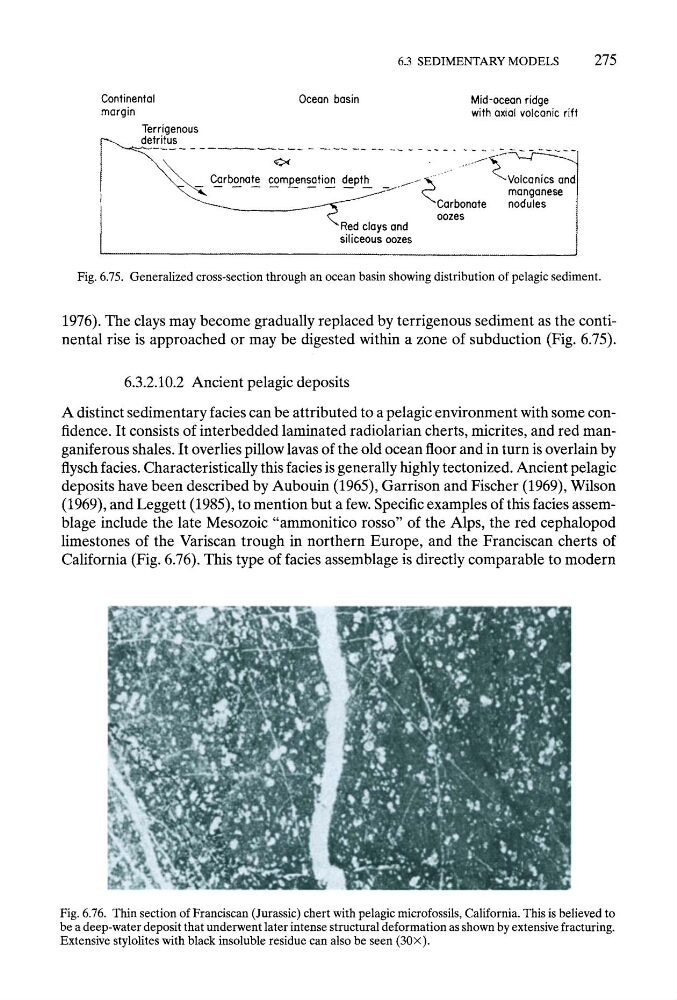
Fig. 6.75. Generalized cross-section through an ocean basin showing distribution of pelagic sediment.
1976). The clays may become gradually replaced by terrigenous sediment as the continental rise is approached or may be digested within a zone of subduction (Fig. 6.75).
6.3.2.10.2 Ancient pelagic deposits
A distinct sedimentary facies can be attributed to a pelagic environment with some confidence. It consists of interbedded laminated radiolarian cherts, micrites, and red manganiferous shales. It overlies pillow lavas of the old ocean floor and in turn is overlain by
flysch facies. Characteristically this facies is generally highly tectonized. Ancient pelagic
deposits have been described by Aubouin (1965), Garrison and Fischer (1969), Wilson
(1969), and Leggett (1985), to mention but a few. Specific examples of this facies assemblage include the late Mesozoic "ammonitico rosso" of the Alps, the red cephalopod
limestones of the Variscan trough in northern Europe, and the Franciscan cherts of
California (Fig. 6.76). This type of facies assemblage is directly comparable to modern
Fig. 6.76. Thin section of Franciscan (Jurassic) chert with pelagic microfossils, California. This is believed to
be a deep-water deposit that underwent later intense structural deformation as shown by extensive fracturing.
Extensive stylolites with black insoluble residue can also be seen (30x).
275
Continental
Ocean basin
Mid-ocean ridge
margin
with axial volcanic rift
Terrigenous
compensation depth
.....-.- ~.~ .......
Volcanics and I
........ ~
"Carbonate
nodules
1
%
oozes
Red clays and
siliceous oozes
|
J
Fig. 6.75. Generalized cross-section through an ocean basin showing distribution of pelagic sediment.
1976). The clays may become gradually replaced by terrigenous sediment as the continental rise is approached or may be digested within a zone of subduction (Fig. 6.75).
6.3.2.10.2 Ancient pelagic deposits
A distinct sedimentary facies can be attributed to a pelagic environment with some confidence. It consists of interbedded laminated radiolarian cherts, micrites, and red manganiferous shales. It overlies pillow lavas of the old ocean floor and in turn is overlain by
flysch facies. Characteristically this facies is generally highly tectonized. Ancient pelagic
deposits have been described by Aubouin (1965), Garrison and Fischer (1969), Wilson
(1969), and Leggett (1985), to mention but a few. Specific examples of this facies assemblage include the late Mesozoic "ammonitico rosso" of the Alps, the red cephalopod
limestones of the Variscan trough in northern Europe, and the Franciscan cherts of
California (Fig. 6.76). This type of facies assemblage is directly comparable to modern
Fig. 6.76. Thin section of Franciscan (Jurassic) chert with pelagic microfossils, California. This is believed to
be a deep-water deposit that underwent later intense structural deformation as shown by extensive fracturing.
Extensive stylolites with black insoluble residue can also be seen (30x).