

6.3 SEDIMENTARY MODELS
273
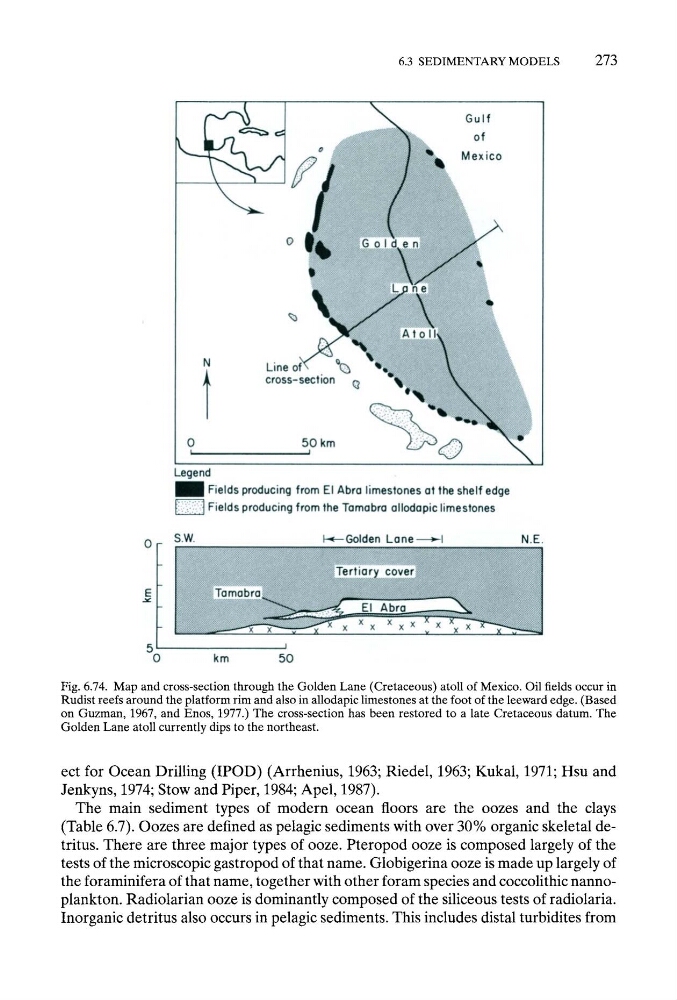
Fig. 6.74. Map and cross-section through the Golden Lane (Cretaceous) atoll of Mexico. Oil fields occur in
Rudist reefs around the platform rim and also in allodapic limestones at the foot of the leeward edge. (Based
on Guzman, 1967, and Enos, 1977.) The cross-section has been restored to a late Cretaceous datum. The
Golden Lane atoll currently dips to the northeast.
ect for Ocean Drilling (IPOD) (Arrhenius, 1963; Riedel, 1963; Kukal, 1971; Hsu and
Jenkyns, 1974; Stow and Piper, 1984; Apel, 1987).
The main sediment types of modern ocean floors are the oozes and the clays
(Table 6.7). Oozes are defined as pelagic sediments with over 30% organic skeletal detritus. There are three major types of ooze. Pteropod ooze is composed largely of the
tests of the microscopic gastropod of that name. Globigerina ooze is made up largely of
the foraminifera of that name, together with other foram species and coccolithic nannoplankton. Radiolarian ooze is dominantly composed of the siliceous tests of radiolaria.
Inorganic detritus also occurs in pelagic sediments. This includes distal turbidites from
273
Fig. 6.74. Map and cross-section through the Golden Lane (Cretaceous) atoll of Mexico. Oil fields occur in
Rudist reefs around the platform rim and also in allodapic limestones at the foot of the leeward edge. (Based
on Guzman, 1967, and Enos, 1977.) The cross-section has been restored to a late Cretaceous datum. The
Golden Lane atoll currently dips to the northeast.
ect for Ocean Drilling (IPOD) (Arrhenius, 1963; Riedel, 1963; Kukal, 1971; Hsu and
Jenkyns, 1974; Stow and Piper, 1984; Apel, 1987).
The main sediment types of modern ocean floors are the oozes and the clays
(Table 6.7). Oozes are defined as pelagic sediments with over 30% organic skeletal detritus. There are three major types of ooze. Pteropod ooze is composed largely of the
tests of the microscopic gastropod of that name. Globigerina ooze is made up largely of
the foraminifera of that name, together with other foram species and coccolithic nannoplankton. Radiolarian ooze is dominantly composed of the siliceous tests of radiolaria.
Inorganic detritus also occurs in pelagic sediments. This includes distal turbidites from