

272
6 DEPOSITIONAL SYSTEMS
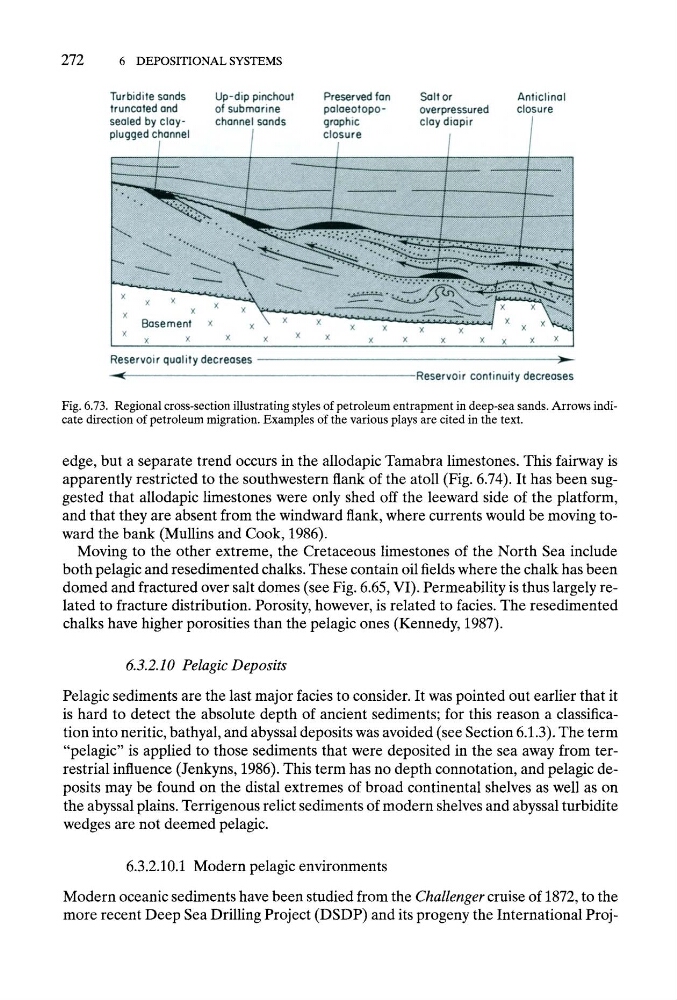
Fig. 6.73. Regional cross-section illustrating styles of petroleum entrapment in deep-sea sands. Arrows indicate direction of petroleum migration. Examples of the various plays are cited in the text.
edge, but a separate trend occurs in the allodapic Tamabra limestones. This fairway is
apparently restricted to the southwestern flank of the atoll (Fig. 6.74). It has been suggested that allodapic limestones were only shed off the leeward side of the platform,
and that they are absent from the windward flank, where currents would be moving toward the bank (Mullins and Cook, 1986).
Moving to the other extreme, the Cretaceous limestones of the North Sea include
both pelagic and resedimented chalks. These contain oil fields where the chalk has been
domed and fractured over salt domes (see Fig. 6.65, VI). Permeability is thus largely related to fracture distribution. Porosity, however, is related to facies. The resedimented
chalks have higher porosities than the pelagic ones (Kennedy, 1987).
6.3.2.10 Pelagic Deposits
Pelagic sediments are the last major facies to consider. It was pointed out earlier that it
is hard to detect the absolute depth of ancient sediments; for this reason a classification into neritic, bathyal, and abyssal deposits was avoided (see Section 6.1.3). The term
"pelagic" is applied to those sediments that were deposited in the sea away from terrestrial influence (Jenkyns, 1986). This term has no depth connotation, and pelagic deposits may be found on the distal extremes of broad continental shelves as well as on
the abyssal plains. Terrigenous relict sediments of modern shelves and abyssal turbidite
wedges are not deemed pelagic.
6.3.2.10.1 Modern pelagic environments
Modern oceanic sediments have been studied from the Challenger cruise of 1872, to the
more recent Deep Sea Drilling Project (DSDP) and its progeny the International Proj-
6 DEPOSITIONAL SYSTEMS
Fig. 6.73. Regional cross-section illustrating styles of petroleum entrapment in deep-sea sands. Arrows indicate direction of petroleum migration. Examples of the various plays are cited in the text.
edge, but a separate trend occurs in the allodapic Tamabra limestones. This fairway is
apparently restricted to the southwestern flank of the atoll (Fig. 6.74). It has been suggested that allodapic limestones were only shed off the leeward side of the platform,
and that they are absent from the windward flank, where currents would be moving toward the bank (Mullins and Cook, 1986).
Moving to the other extreme, the Cretaceous limestones of the North Sea include
both pelagic and resedimented chalks. These contain oil fields where the chalk has been
domed and fractured over salt domes (see Fig. 6.65, VI). Permeability is thus largely related to fracture distribution. Porosity, however, is related to facies. The resedimented
chalks have higher porosities than the pelagic ones (Kennedy, 1987).
6.3.2.10 Pelagic Deposits
Pelagic sediments are the last major facies to consider. It was pointed out earlier that it
is hard to detect the absolute depth of ancient sediments; for this reason a classification into neritic, bathyal, and abyssal deposits was avoided (see Section 6.1.3). The term
"pelagic" is applied to those sediments that were deposited in the sea away from terrestrial influence (Jenkyns, 1986). This term has no depth connotation, and pelagic deposits may be found on the distal extremes of broad continental shelves as well as on
the abyssal plains. Terrigenous relict sediments of modern shelves and abyssal turbidite
wedges are not deemed pelagic.
6.3.2.10.1 Modern pelagic environments
Modern oceanic sediments have been studied from the Challenger cruise of 1872, to the
more recent Deep Sea Drilling Project (DSDP) and its progeny the International Proj-