

6.3 SEDIMENTARY MODELS
269
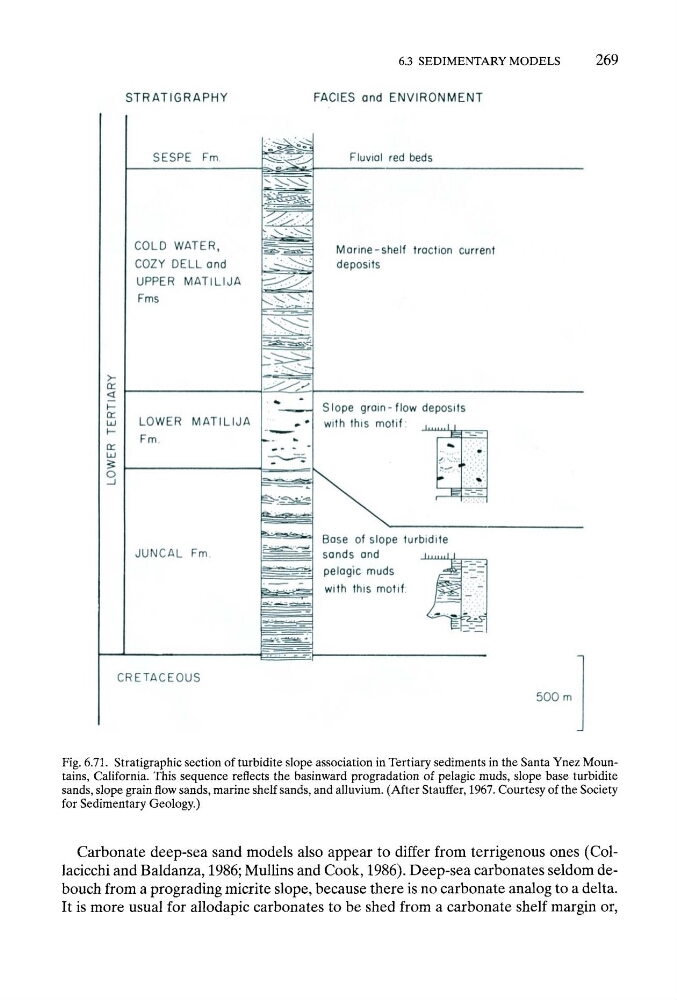
Fig. 6.71. Stratigraphic section of turbidite slope association in Tertiary sediments in the Santa Ynez Mountains, California. This sequence reflects the basinward progradation of pelagic muds, slope base turbidite
sands, slope grain flow sands, marine shelf sands, and alluvium. (After Stauffer, 1967. Courtesy of the Society
for Sedimentary Geology.)
Carbonate deep-sea sand models also appear to differ from terrigenous ones (Collacicchi and Baldanza, 1986; Mullins and Cook, 1986). Deep-sea carbonates seldom debouch from a prograding micrite slope, because there is no carbonate analog to a delta.
It is more usual for allodapic carbonates to be shed from a carbonate shelf margin or,
269
Fig. 6.71. Stratigraphic section of turbidite slope association in Tertiary sediments in the Santa Ynez Mountains, California. This sequence reflects the basinward progradation of pelagic muds, slope base turbidite
sands, slope grain flow sands, marine shelf sands, and alluvium. (After Stauffer, 1967. Courtesy of the Society
for Sedimentary Geology.)
Carbonate deep-sea sand models also appear to differ from terrigenous ones (Collacicchi and Baldanza, 1986; Mullins and Cook, 1986). Deep-sea carbonates seldom debouch from a prograding micrite slope, because there is no carbonate analog to a delta.
It is more usual for allodapic carbonates to be shed from a carbonate shelf margin or,