

268
6 DEPOSITIONAL SYSTEMS
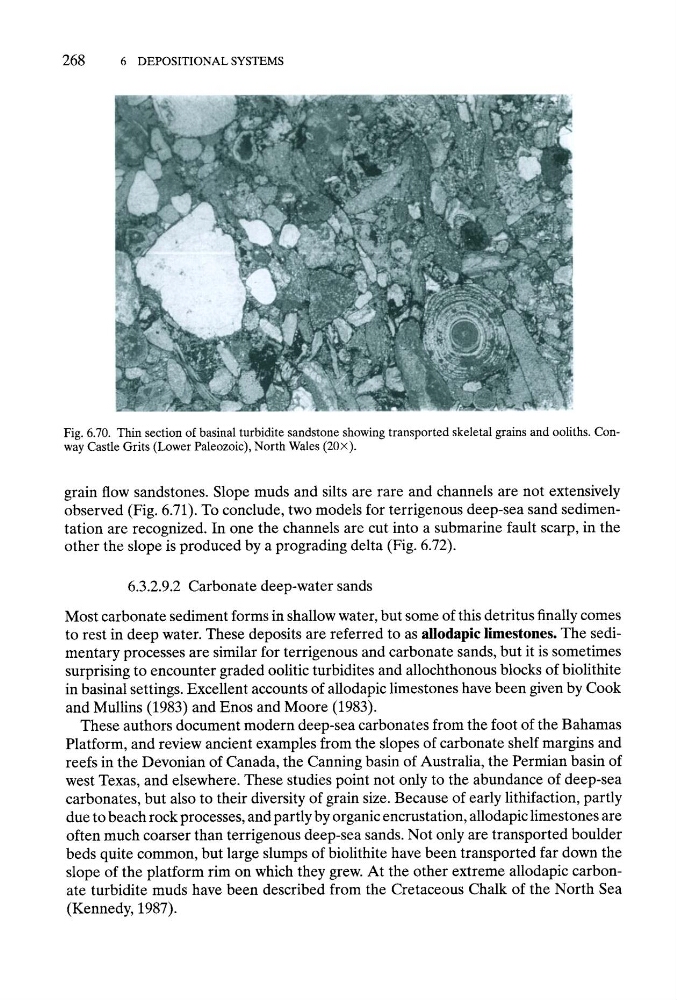
Fig. 6.70. Thin section of basinal turbidite sandstone showing transported skeletal grains and ooliths. Conway Castle Grits (Lower Paleozoic), North Wales (20x).
grain flow sandstones. Slope muds and silts are rare and channels are not extensively
observed (Fig. 6.71). To conclude, two models for terrigenous deep-sea sand sedimentation are recognized. In one the channels are cut into a submarine fault scarp, in the
other the slope is produced by a prograding delta (Fig. 6.72).
6.3.2.9.2 Carbonate deep-water sands
Most carbonate sediment forms in shallow water, but some of this detritus finally comes
to rest in deep water. These deposits are referred to as allodapie limestones. The sedimentary processes are similar for terrigenous and carbonate sands, but it is sometimes
surprising to encounter graded oolitic turbidites and allochthonous blocks of biolithite
in basinal settings. Excellent accounts of allodapic limestones have been given by Cook
and Mullins (1983) and Enos and Moore (1983).
These authors document modern deep-sea carbonates from the foot of the Bahamas
Platform, and review ancient examples from the slopes of carbonate shelf margins and
reefs in the Devonian of Canada, the Canning basin of Australia, the Permian basin of
west Texas, and elsewhere. These studies point not only to the abundance of deep-sea
carbonates, but also to their diversity of grain size. Because of early lithifaction, partly
due to beach rock processes, and partly by organic encrustation, allodapic limestones are
often much coarser than terrigenous deep-sea sands. Not only are transported boulder
beds quite common, but large slumps of biolithite have been transported far down the
slope of the platform rim on which they grew. At the other extreme allodapic carbonate turbidite muds have been described from the Cretaceous Chalk of the North Sea
(Kennedy, 1987).
6 DEPOSITIONAL SYSTEMS
Fig. 6.70. Thin section of basinal turbidite sandstone showing transported skeletal grains and ooliths. Conway Castle Grits (Lower Paleozoic), North Wales (20x).
grain flow sandstones. Slope muds and silts are rare and channels are not extensively
observed (Fig. 6.71). To conclude, two models for terrigenous deep-sea sand sedimentation are recognized. In one the channels are cut into a submarine fault scarp, in the
other the slope is produced by a prograding delta (Fig. 6.72).
6.3.2.9.2 Carbonate deep-water sands
Most carbonate sediment forms in shallow water, but some of this detritus finally comes
to rest in deep water. These deposits are referred to as allodapie limestones. The sedimentary processes are similar for terrigenous and carbonate sands, but it is sometimes
surprising to encounter graded oolitic turbidites and allochthonous blocks of biolithite
in basinal settings. Excellent accounts of allodapic limestones have been given by Cook
and Mullins (1983) and Enos and Moore (1983).
These authors document modern deep-sea carbonates from the foot of the Bahamas
Platform, and review ancient examples from the slopes of carbonate shelf margins and
reefs in the Devonian of Canada, the Canning basin of Australia, the Permian basin of
west Texas, and elsewhere. These studies point not only to the abundance of deep-sea
carbonates, but also to their diversity of grain size. Because of early lithifaction, partly
due to beach rock processes, and partly by organic encrustation, allodapic limestones are
often much coarser than terrigenous deep-sea sands. Not only are transported boulder
beds quite common, but large slumps of biolithite have been transported far down the
slope of the platform rim on which they grew. At the other extreme allodapic carbonate turbidite muds have been described from the Cretaceous Chalk of the North Sea
(Kennedy, 1987).