

6.3 SEDIMENTARY MODELS
267
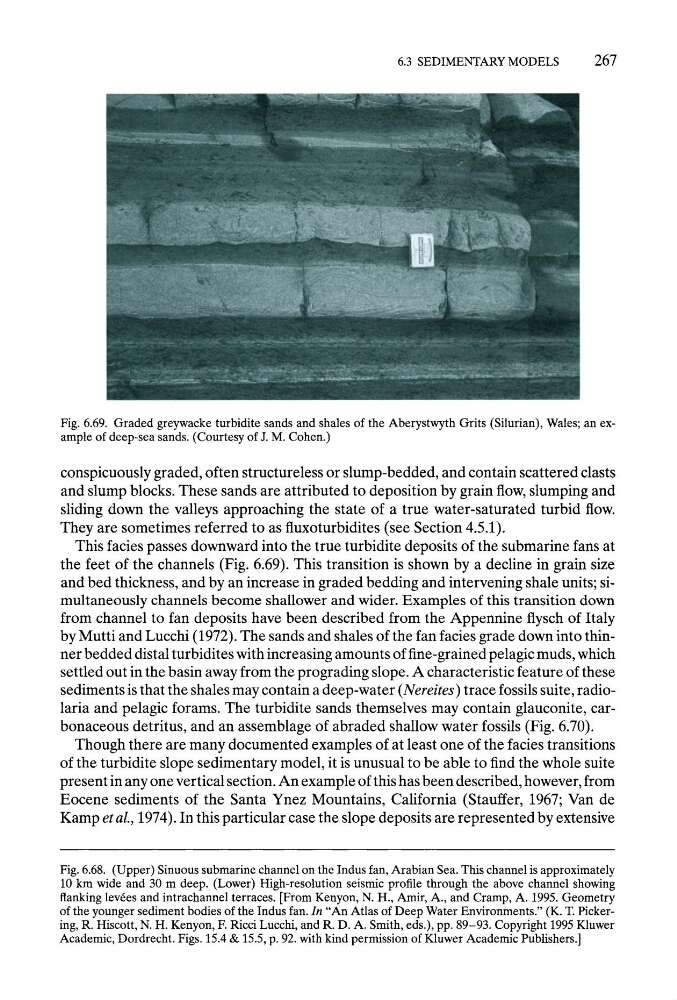
Fig. 6.69. Graded greywacke turbidite sands and shales of the Aberystwyth Grits (Silurian), Wales; an example of deep-sea sands. (Courtesy of J. M. Cohen.)
conspicuously graded, often structureless or slump-bedded, and contain scattered clasts
and slump blocks. These sands are attributed to deposition by grain flow, slumping and
sliding down the valleys approaching the state of a true water-saturated turbid flow.
They are sometimes referred to as fluxoturbidites (see Section 4.5.1).
This facies passes downward into the true turbidite deposits of the submarine fans at
the feet of the channels (Fig. 6.69). This transition is shown by a decline in grain size
and bed thickness, and by an increase in graded bedding and intervening shale units; simultaneously channels become shallower and wider. Examples of this transition down
from channel to fan deposits have been described from the Appennine flysch of Italy
by Mutti and Lucchi (1972). The sands and shales of the fan facies grade down into thinner bedded distal turbidites with increasing amounts of fine-grained pelagic muds, which
settled out in the basin away from the prograding slope. A characteristic feature of these
sediments is that the shales may contain a deep-water (Nereites) trace fossils suite, radiolaria and pelagic forams. The turbidite sands themselves may contain glauconite, carbonaceous detritus, and an assemblage of abraded shallow water fossils (Fig. 6.70).
Though there are many documented examples of at least one of the facies transitions
of the turbidite slope sedimentary model, it is unusual to be able to find the whole suite
present in any one vertical section. An example of this has been described, however, from
Eocene sediments of the Santa Ynez Mountains, California (Stauffer, 1967; Van de
Kamp et al., 1974). In this particular case the slope deposits are represented by extensive
Fig. 6.68. (Upper) Sinuous submarine channel on the Indus fan, Arabian Sea. This channel is approximately
10 km wide and 30 m deep. (Lower) High-resolution seismic profile through the above channel showing
flanking lev6es and intrachannel terraces. [From Kenyon, N. H., Amir, A., and Cramp, A. 1995. Geometry
of the younger sediment bodies of the Indus fan. In "An Atlas of Deep Water Environments." (K. T. Pickering, R. Hiscott, N. H. Kenyon, F. Ricci Lucchi, and R. D. A. Smith, eds.), pp. 89-93. Copyright 1995 Kluwer
Academic, Dordrecht. Figs. 15.4 & 15.5, p. 92. with kind permission of Kluwer Academic Publishers.]
267
Fig. 6.69. Graded greywacke turbidite sands and shales of the Aberystwyth Grits (Silurian), Wales; an example of deep-sea sands. (Courtesy of J. M. Cohen.)
conspicuously graded, often structureless or slump-bedded, and contain scattered clasts
and slump blocks. These sands are attributed to deposition by grain flow, slumping and
sliding down the valleys approaching the state of a true water-saturated turbid flow.
They are sometimes referred to as fluxoturbidites (see Section 4.5.1).
This facies passes downward into the true turbidite deposits of the submarine fans at
the feet of the channels (Fig. 6.69). This transition is shown by a decline in grain size
and bed thickness, and by an increase in graded bedding and intervening shale units; simultaneously channels become shallower and wider. Examples of this transition down
from channel to fan deposits have been described from the Appennine flysch of Italy
by Mutti and Lucchi (1972). The sands and shales of the fan facies grade down into thinner bedded distal turbidites with increasing amounts of fine-grained pelagic muds, which
settled out in the basin away from the prograding slope. A characteristic feature of these
sediments is that the shales may contain a deep-water (Nereites) trace fossils suite, radiolaria and pelagic forams. The turbidite sands themselves may contain glauconite, carbonaceous detritus, and an assemblage of abraded shallow water fossils (Fig. 6.70).
Though there are many documented examples of at least one of the facies transitions
of the turbidite slope sedimentary model, it is unusual to be able to find the whole suite
present in any one vertical section. An example of this has been described, however, from
Eocene sediments of the Santa Ynez Mountains, California (Stauffer, 1967; Van de
Kamp et al., 1974). In this particular case the slope deposits are represented by extensive
Fig. 6.68. (Upper) Sinuous submarine channel on the Indus fan, Arabian Sea. This channel is approximately
10 km wide and 30 m deep. (Lower) High-resolution seismic profile through the above channel showing
flanking lev6es and intrachannel terraces. [From Kenyon, N. H., Amir, A., and Cramp, A. 1995. Geometry
of the younger sediment bodies of the Indus fan. In "An Atlas of Deep Water Environments." (K. T. Pickering, R. Hiscott, N. H. Kenyon, F. Ricci Lucchi, and R. D. A. Smith, eds.), pp. 89-93. Copyright 1995 Kluwer
Academic, Dordrecht. Figs. 15.4 & 15.5, p. 92. with kind permission of Kluwer Academic Publishers.]