

254
6 DEPOSITIONAL SYSTEMS
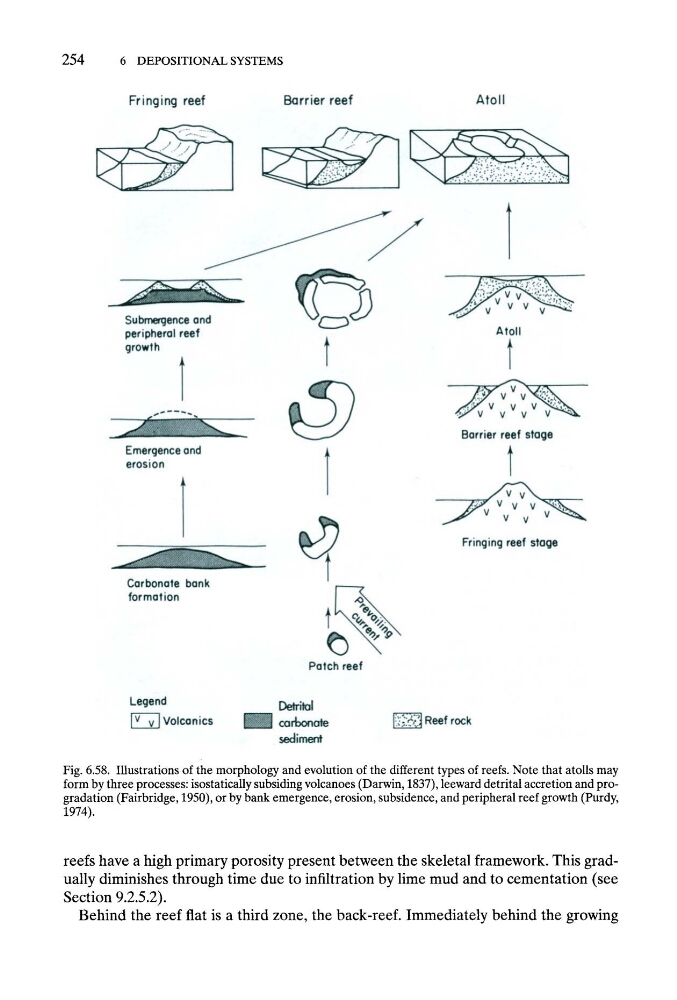
Fig. 6.58. Illustrations of the morphology and evolution of the different types of reefs. Note that atolls may
form by three processes: isostatically subsiding volcanoes (Darwin, 1837), leeward detrital accretion and progradation (Fairbridge, 1950), or by bank emergence, erosion, subsidence, and peripheral reef growth (Purdy,
1974).
reefs have a high primary porosity present between the skeletal framework. This gradually diminishes through time due to infiltration by lime mud and to cementation (see
Section 9.2.5.2).
Behind the reef flat is a third zone, the back-reef. Immediately behind the growing
6 DEPOSITIONAL SYSTEMS
Fig. 6.58. Illustrations of the morphology and evolution of the different types of reefs. Note that atolls may
form by three processes: isostatically subsiding volcanoes (Darwin, 1837), leeward detrital accretion and progradation (Fairbridge, 1950), or by bank emergence, erosion, subsidence, and peripheral reef growth (Purdy,
1974).
reefs have a high primary porosity present between the skeletal framework. This gradually diminishes through time due to infiltration by lime mud and to cementation (see
Section 9.2.5.2).
Behind the reef flat is a third zone, the back-reef. Immediately behind the growing