

252
6 DEPOSITIONAL SYSTEMS
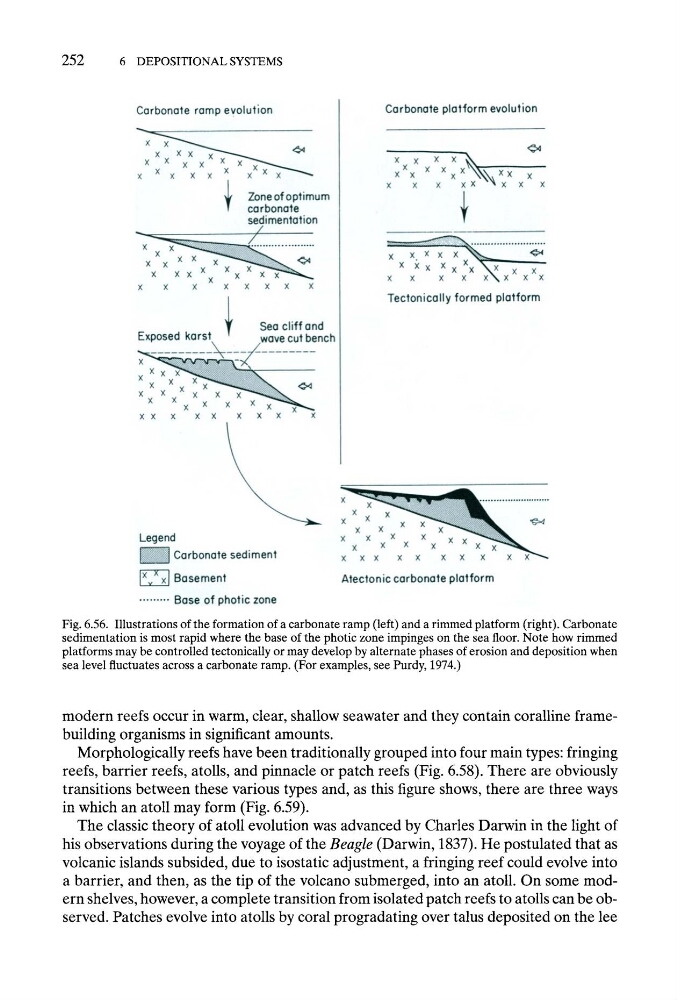
Fig. 6.56. Illustrations of the formation of a carbonate ramp (left) and a rimmed platform (right). Carbonate
sedimentation is most rapid where the base of the photic zone impinges on the sea floor. Note how rimmed
platforms may be controlled tectonically or may develop by alternate phases of erosion and deposition when
sea level fluctuates across a carbonate ramp. (For examples, see Purdy, 1974.)
modern reefs occur in warm, clear, shallow seawater and they contain coralline flamebuilding organisms in significant amounts.
Morphologically reefs have been traditionally grouped into four main types: flinging
reefs, barrier reefs, atolls, and pinnacle or patch reefs (Fig. 6.58). There are obviously
transitions between these various types and, as this figure shows, there are three ways
in which an atoll may form (Fig. 6.59).
The classic theory of atoll evolution was advanced by Charles Darwin in the light of
his observations during the voyage of the Beagle (Darwin, 1837). He postulated that as
volcanic islands subsided, due to isostatic adjustment, a flinging reef could evolve into
a barrier, and then, as the tip of the volcano submerged, into an atoll. On some modern shelves, however, a complete transition from isolated patch reefs to atolls can be observed. Patches evolve into atolls by coral progradating over talus deposited on the lee
6 DEPOSITIONAL SYSTEMS
Fig. 6.56. Illustrations of the formation of a carbonate ramp (left) and a rimmed platform (right). Carbonate
sedimentation is most rapid where the base of the photic zone impinges on the sea floor. Note how rimmed
platforms may be controlled tectonically or may develop by alternate phases of erosion and deposition when
sea level fluctuates across a carbonate ramp. (For examples, see Purdy, 1974.)
modern reefs occur in warm, clear, shallow seawater and they contain coralline flamebuilding organisms in significant amounts.
Morphologically reefs have been traditionally grouped into four main types: flinging
reefs, barrier reefs, atolls, and pinnacle or patch reefs (Fig. 6.58). There are obviously
transitions between these various types and, as this figure shows, there are three ways
in which an atoll may form (Fig. 6.59).
The classic theory of atoll evolution was advanced by Charles Darwin in the light of
his observations during the voyage of the Beagle (Darwin, 1837). He postulated that as
volcanic islands subsided, due to isostatic adjustment, a flinging reef could evolve into
a barrier, and then, as the tip of the volcano submerged, into an atoll. On some modern shelves, however, a complete transition from isolated patch reefs to atolls can be observed. Patches evolve into atolls by coral progradating over talus deposited on the lee