

6.3 SEDIMENTARY MODELS
251
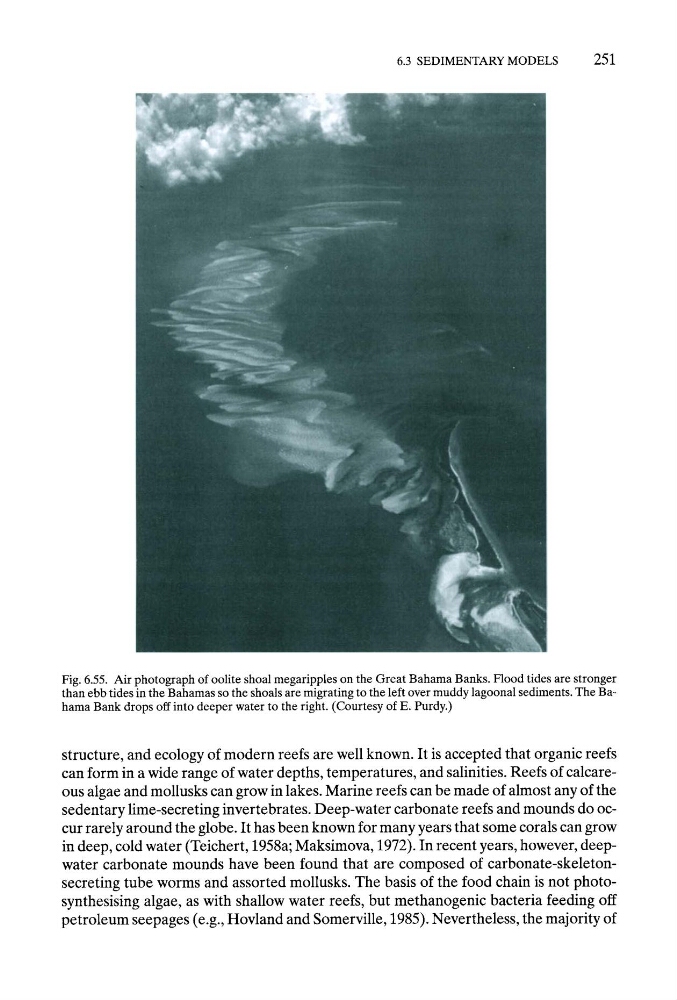
Fig. 6.55. Air photograph of oolite shoal megaripples on the Great Bahama Banks. Flood tides are stronger
than ebb tides in the Bahamas so the shoals are migrating to the left over muddy lagoonal sediments. The Bahama Bank drops off into deeper water to the right. (Courtesy of E. Purdy.)
structure, and ecology of modern reefs are well known. It is accepted that organic reefs
can form in a wide range of water depths, temperatures, and salinities. Reefs of calcareous algae and mollusks can grow in lakes. Marine reefs can be made of almost any of the
sedentary lime-secreting invertebrates. Deep-water carbonate reefs and mounds do occur rarely around the globe. It has been known for many years that some corals can grow
in deep, cold water (Teichert, 1958a; Maksimova, 1972). In recent years, however, deepwater carbonate mounds have been found that are composed of carbonate-skeletonsecreting tube worms and assorted mollusks. The basis of the food chain is not photosynthesising algae, as with shallow water reefs, but methanogenic bacteria feeding off
petroleum seepages (e.g., Hovland and Somerville, 1985). Nevertheless, the majority of
251
Fig. 6.55. Air photograph of oolite shoal megaripples on the Great Bahama Banks. Flood tides are stronger
than ebb tides in the Bahamas so the shoals are migrating to the left over muddy lagoonal sediments. The Bahama Bank drops off into deeper water to the right. (Courtesy of E. Purdy.)
structure, and ecology of modern reefs are well known. It is accepted that organic reefs
can form in a wide range of water depths, temperatures, and salinities. Reefs of calcareous algae and mollusks can grow in lakes. Marine reefs can be made of almost any of the
sedentary lime-secreting invertebrates. Deep-water carbonate reefs and mounds do occur rarely around the globe. It has been known for many years that some corals can grow
in deep, cold water (Teichert, 1958a; Maksimova, 1972). In recent years, however, deepwater carbonate mounds have been found that are composed of carbonate-skeletonsecreting tube worms and assorted mollusks. The basis of the food chain is not photosynthesising algae, as with shallow water reefs, but methanogenic bacteria feeding off
petroleum seepages (e.g., Hovland and Somerville, 1985). Nevertheless, the majority of