

250
6 DEPOSITIONAL SYSTEMS
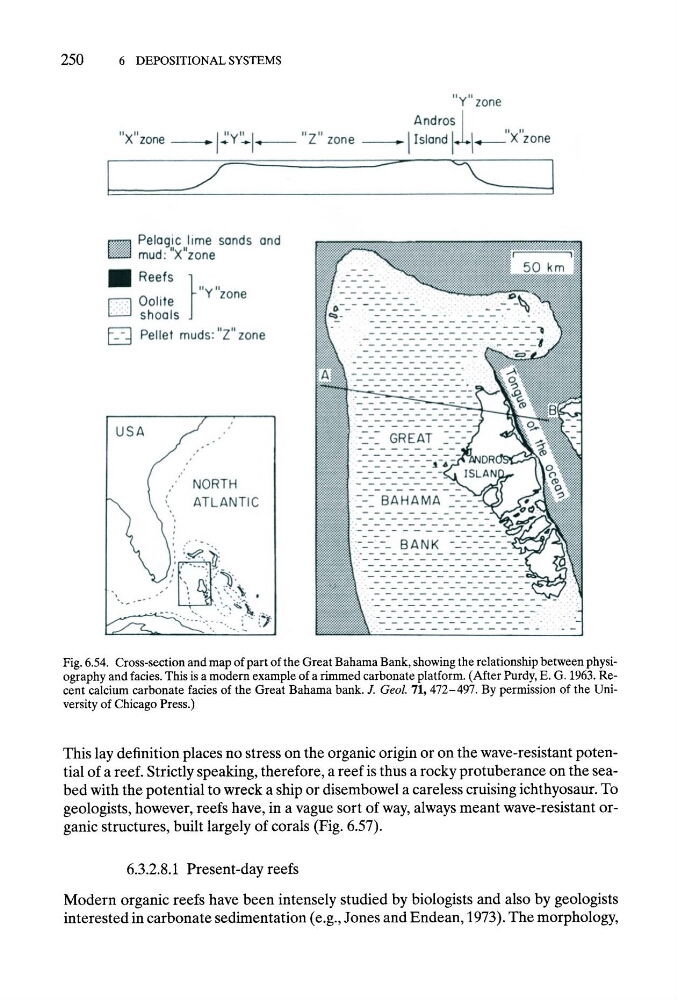
Fig. 6.54. Cross-section and map of part of the Great Bahama Bank, showing the relationship between physiography and facies. This is a modern example of a rimmed carbonate platform. (After Purdy, E. G. 1963. Recent calcium carbonate facies of the Great Bahama bank. J. Geol. 71, 472-497. By permission of the University of Chicago Press.)
This lay definition places no stress on the organic origin or on the wave-resistant potential of a reef. Strictly speaking, therefore, a reef is thus a rocky protuberance on the seabed with the potential to wreck a ship or disembowel a careless cruising ichthyosaur. To
geologists, however, reefs have, in a vague sort of way, always meant wave-resistant organic structures, built largely of corals (Fig. 6.57).
6.3.2.8.1 Present-day reefs
Modern organic reefs have been intensely studied by biologists and also by geologists
interested in carbonate sedimentation (e.g., Jones and Endean, 1973). The morphology,
6 DEPOSITIONAL SYSTEMS
Fig. 6.54. Cross-section and map of part of the Great Bahama Bank, showing the relationship between physiography and facies. This is a modern example of a rimmed carbonate platform. (After Purdy, E. G. 1963. Recent calcium carbonate facies of the Great Bahama bank. J. Geol. 71, 472-497. By permission of the University of Chicago Press.)
This lay definition places no stress on the organic origin or on the wave-resistant potential of a reef. Strictly speaking, therefore, a reef is thus a rocky protuberance on the seabed with the potential to wreck a ship or disembowel a careless cruising ichthyosaur. To
geologists, however, reefs have, in a vague sort of way, always meant wave-resistant organic structures, built largely of corals (Fig. 6.57).
6.3.2.8.1 Present-day reefs
Modern organic reefs have been intensely studied by biologists and also by geologists
interested in carbonate sedimentation (e.g., Jones and Endean, 1973). The morphology,