

6.3 SEDIMENTARY
MODELS
221
alike. A modern definition cites a delta as "the subaerial and submerged contiguous
sediment mass deposited in a body of water (ocean or lake) primarily by the action of
a river" (Moore and Asquith, 1971, p. 2563). This definition, though broadly correlative
with the original meaning of Herodotus, lays no stress on a triangular geometry. Not all
deltas, as presently defined, possess this feature.
6.3.2.5.1 Processes in a model delta
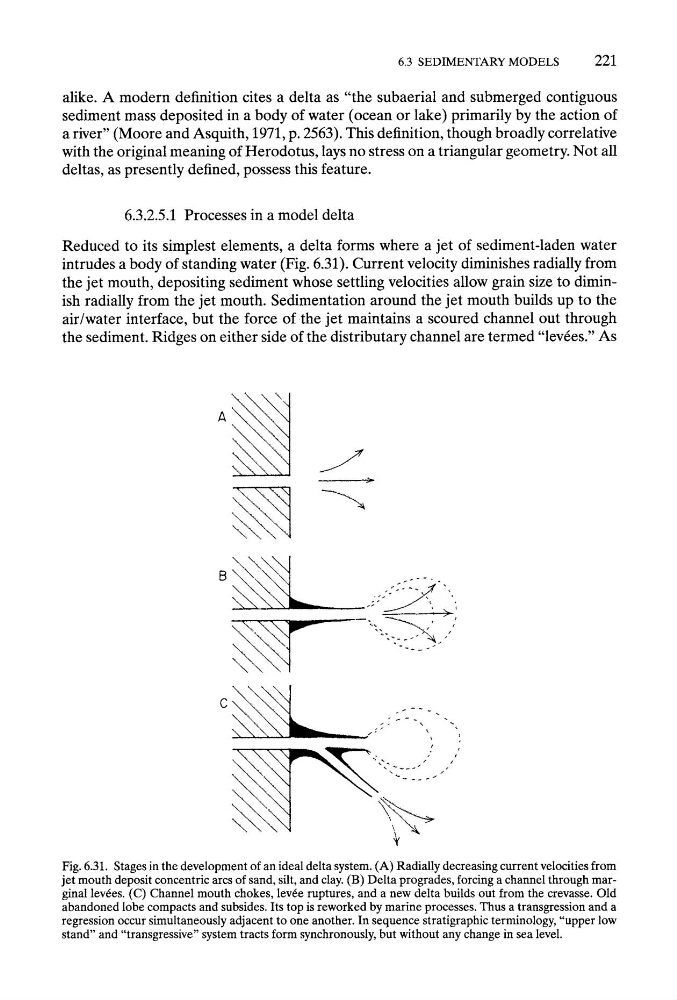
Reduced to its simplest elements, a delta forms where a jet of sediment-laden water
intrudes a body of standing water (Fig. 6.31). Current velocity diminishes radially from
the jet mouth, depositing sediment whose settling velocities allow grain size to diminish radially from the jet mouth. Sedimentation around the jet mouth builds up to the
air/water interface, but the force of the jet maintains a scoured channel out through
the sediment. Ridges on either side of the distributary channel are termed "lev6es." As
A
J
B "x,.\
._ .~ ...........
,j'2
,
4t
/
d
/
Fig. 6.31. Stages in the development of an ideal delta system. (A) Radially decreasing current velocities from
jet mouth deposit concentric arcs of sand, silt, and clay. (B) Delta progrades, forcing a channel through marginal lev6es. (C) Channel mouth chokes, lev6e ruptures, and a new delta builds out from the crevasse. Old
abandoned lobe compacts and subsides. Its top is reworked by marine processes. Thus a transgression and a
regression occur simultaneously adjacent to one another. In sequence stratigraphic terminology, "upper low
stand" and "transgressive" system tracts form synchronously, but without any change in sea level.
MODELS
221
alike. A modern definition cites a delta as "the subaerial and submerged contiguous
sediment mass deposited in a body of water (ocean or lake) primarily by the action of
a river" (Moore and Asquith, 1971, p. 2563). This definition, though broadly correlative
with the original meaning of Herodotus, lays no stress on a triangular geometry. Not all
deltas, as presently defined, possess this feature.
6.3.2.5.1 Processes in a model delta
Reduced to its simplest elements, a delta forms where a jet of sediment-laden water
intrudes a body of standing water (Fig. 6.31). Current velocity diminishes radially from
the jet mouth, depositing sediment whose settling velocities allow grain size to diminish radially from the jet mouth. Sedimentation around the jet mouth builds up to the
air/water interface, but the force of the jet maintains a scoured channel out through
the sediment. Ridges on either side of the distributary channel are termed "lev6es." As
A
J
B "x,.\
._ .~ ...........
,j'2
,
4t
/
d
/
Fig. 6.31. Stages in the development of an ideal delta system. (A) Radially decreasing current velocities from
jet mouth deposit concentric arcs of sand, silt, and clay. (B) Delta progrades, forcing a channel through marginal lev6es. (C) Channel mouth chokes, lev6e ruptures, and a new delta builds out from the crevasse. Old
abandoned lobe compacts and subsides. Its top is reworked by marine processes. Thus a transgression and a
regression occur simultaneously adjacent to one another. In sequence stratigraphic terminology, "upper low
stand" and "transgressive" system tracts form synchronously, but without any change in sea level.