

220
6 DEPOSITIONAL SYSTEMS
supply rate. Lake sediments tend to reflect an upward-coarsening regressive sequence.
This model will not bear up under close scrutiny because the diverse environmental parameters of lakes can generate a wide range of allochthonous and autochthonous
lithologies. Furthermore, the susceptibility of lakes to climatic changes can cause fluctuating lake levels. These are reflected in transgressive'regressive cycles that disrupt
any overall regressive lacustrine sequence.
6.3.2.4.4 Economic aspects of lake deposits
Lacustrine deposits are of great economic importance. They contain oil shales and
other organic-rich petroleum source beds. Temperate lakes may be infilled with peat
to form coal deposits on burial. Hypersaline lakes may form commercial quantities of
evaporites.
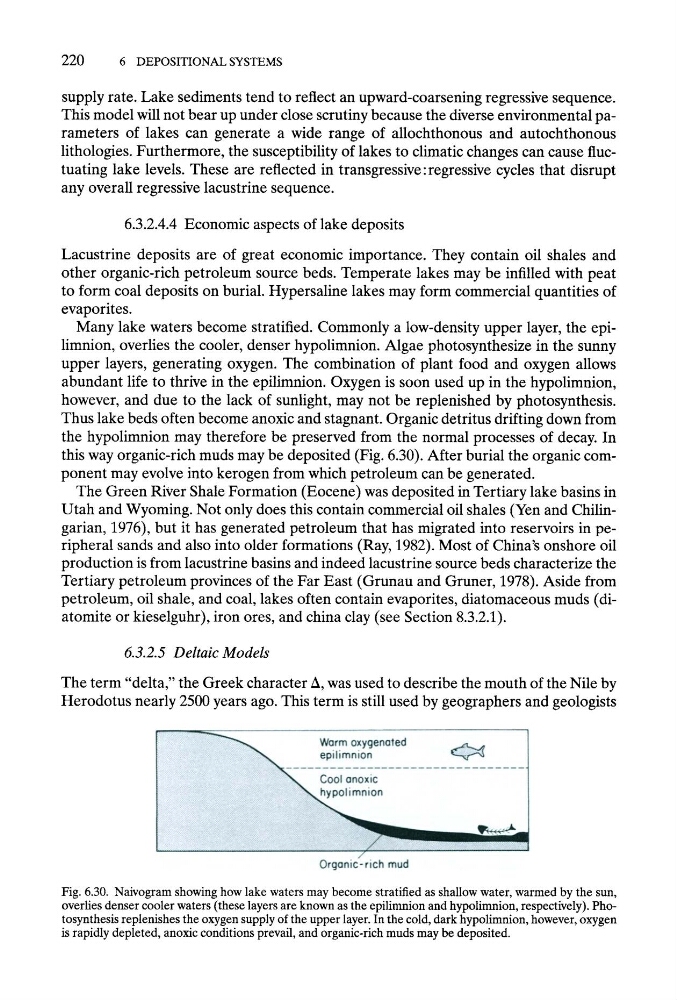
Many lake waters become stratified. Commonly a low-density upper layer, the epilimnion, overlies the cooler, denser hypolimnion. Algae photosynthesize in the sunny
upper layers, generating oxygen. The combination of plant food and oxygen allows
abundant life to thrive in the epilimnion. Oxygen is soon used up in the hypolimnion,
however, and due to the lack of sunlight, may not be replenished by photosynthesis.
Thus lake beds often become anoxic and stagnant. Organic detritus drifting down from
the hypolimnion may therefore be preserved from the normal processes of decay. In
this way organic-rich muds may be deposited (Fig. 6.30). After burial the organic component may evolve into kerogen from which petroleum can be generated.
The Green RiVer Shale Formation (Eocene) was deposited in Tertiary lake basins in
Utah and Wyoming. Not only does this contain commercial oil shales (Yen and Chilingarian, 1976), but it has generated petroleum that has migrated into reservoirs in peripheral sands and also into older formations (Ray, 1982). Most of China's onshore oil
production is from lacustrine basins and indeed lacustrine source beds characterize the
Tertiary petroleum provinces of the Far East (Grunau and Gruner, 1978). Aside from
petroleum, oil shale, and coal, lakes often contain evaporites, diatomaceous muds (diatomite or kieselguhr), iron ores, and china clay (see Section 8.3.2.1).
6.3.2.5 Deltaic Models
The term "delta," the Greek character A, was used to describe the mouth of the Nile by
Herodotus nearly 2500 years ago. This term is still used by geographers and geologists
Fig. 6.30. Naivogram showing how lake waters may become stratified as shallow water, warmed by the sun,
overlies denser cooler waters (these layers are known as the epilimnion and hypolimnion, respectively). Photosynthesis replenishes the oxygen supply of the upper layer. In the cold, dark hypolimnion, however, oxygen
is rapidly depleted, anoxic conditions prevail, and organic-rich muds may be deposited.
6 DEPOSITIONAL SYSTEMS
supply rate. Lake sediments tend to reflect an upward-coarsening regressive sequence.
This model will not bear up under close scrutiny because the diverse environmental parameters of lakes can generate a wide range of allochthonous and autochthonous
lithologies. Furthermore, the susceptibility of lakes to climatic changes can cause fluctuating lake levels. These are reflected in transgressive'regressive cycles that disrupt
any overall regressive lacustrine sequence.
6.3.2.4.4 Economic aspects of lake deposits
Lacustrine deposits are of great economic importance. They contain oil shales and
other organic-rich petroleum source beds. Temperate lakes may be infilled with peat
to form coal deposits on burial. Hypersaline lakes may form commercial quantities of
evaporites.
Many lake waters become stratified. Commonly a low-density upper layer, the epilimnion, overlies the cooler, denser hypolimnion. Algae photosynthesize in the sunny
upper layers, generating oxygen. The combination of plant food and oxygen allows
abundant life to thrive in the epilimnion. Oxygen is soon used up in the hypolimnion,
however, and due to the lack of sunlight, may not be replenished by photosynthesis.
Thus lake beds often become anoxic and stagnant. Organic detritus drifting down from
the hypolimnion may therefore be preserved from the normal processes of decay. In
this way organic-rich muds may be deposited (Fig. 6.30). After burial the organic component may evolve into kerogen from which petroleum can be generated.
The Green RiVer Shale Formation (Eocene) was deposited in Tertiary lake basins in
Utah and Wyoming. Not only does this contain commercial oil shales (Yen and Chilingarian, 1976), but it has generated petroleum that has migrated into reservoirs in peripheral sands and also into older formations (Ray, 1982). Most of China's onshore oil
production is from lacustrine basins and indeed lacustrine source beds characterize the
Tertiary petroleum provinces of the Far East (Grunau and Gruner, 1978). Aside from
petroleum, oil shale, and coal, lakes often contain evaporites, diatomaceous muds (diatomite or kieselguhr), iron ores, and china clay (see Section 8.3.2.1).
6.3.2.5 Deltaic Models
The term "delta," the Greek character A, was used to describe the mouth of the Nile by
Herodotus nearly 2500 years ago. This term is still used by geographers and geologists
Fig. 6.30. Naivogram showing how lake waters may become stratified as shallow water, warmed by the sun,
overlies denser cooler waters (these layers are known as the epilimnion and hypolimnion, respectively). Photosynthesis replenishes the oxygen supply of the upper layer. In the cold, dark hypolimnion, however, oxygen
is rapidly depleted, anoxic conditions prevail, and organic-rich muds may be deposited.