

222
6 DEPOSITIONAL SYSTEMS
sedimentation continues, the delta progrades out into the standing body of water. Three
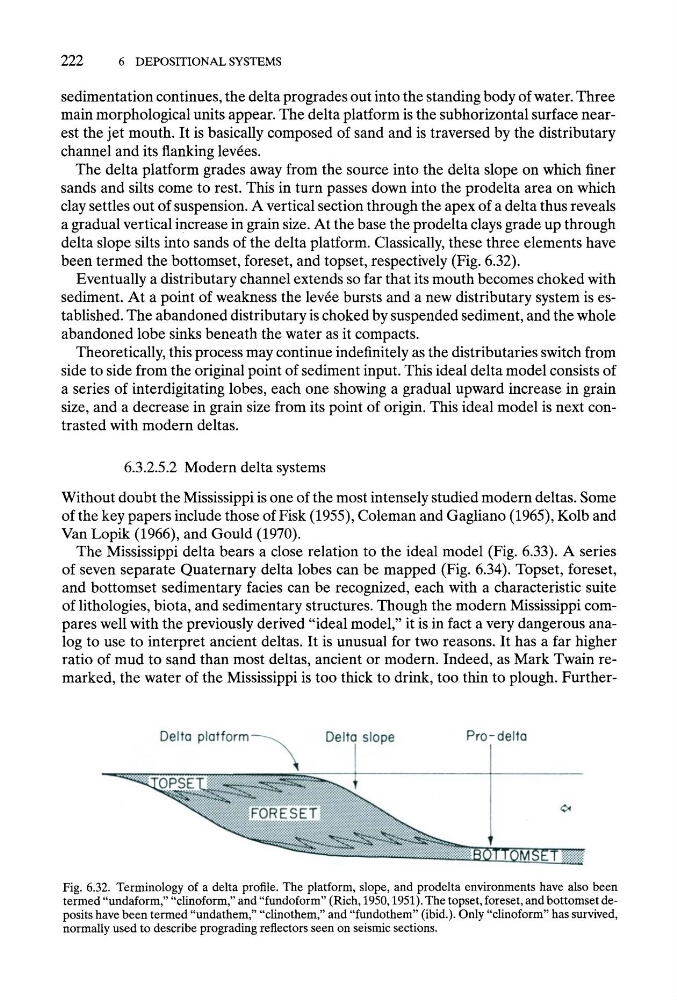
main morphological units appear. The delta platform is the subhorizontal surface nearest the jet mouth. It is basically composed of sand and is traversed by the distributary
channel and its flanking lev6es.
The delta platform grades away from the source into the delta slope on which finer
sands and silts come to rest. This in turn passes down into the prodelta area on which
clay settles out of suspension. A vertical section through the apex of a delta thus reveals
a gradual vertical increase in grain size. At the base the prodelta clays grade up through
delta slope silts into sands of the delta platform. Classically, these three elements have
been termed the bottomset, foreset, and topset, respectively (Fig. 6.32).
Eventually a distributary channel extends so far that its mouth becomes choked with
sediment. At a point of weakness the lev6e bursts and a new distributary system is established. The abandoned distributary is choked by suspended sediment, and the whole
abandoned lobe sinks beneath the water as it compacts.
Theoretically, this process may continue indefinitely as the distributaries switch from
side to side from the original point of sediment input. This ideal delta model consists of
a series of interdigitating lobes, each one showing a gradual upward increase in grain
size, and a decrease in grain size from its point of origin. This ideal model is next contrasted with modern deltas.
6.3.2.5.2 Modern delta systems
Without doubt the Mississippi is one of the most intensely studied modern deltas. Some
of the key papers include those of Fisk (1955), Coleman and Gagliano (1965), Kolb and
Van Lopik (1966), and Gould (1970).
The Mississippi delta bears a close relation to the ideal model (Fig. 6.33). A series
of seven separate Quaternary delta lobes can be mapped (Fig. 6.34). Topset, foreset,
and bottomset sedimentary facies can be recognized, each with a characteristic suite
of lithologies, biota, and sedimentary structures. Though the modern Mississippi compares well with the previously derived "ideal model," it is in fact a very dangerous analog to use to interpret ancient deltas. It is unusual for two reasons. It has a far higher
ratio of mud to sand than most deltas, ancient or modern. Indeed, as Mark Twain remarked, the water of the Mississippi is too thick to drink, too thin to plough. FurtherFig. 6.32. Terminology of a delta profile. The platform, slope, and prodelta environments have also been
termed "undaform," "clinoform," and "fundoform" (Rich, 1950,1951). The topset, foreset, and bottomset deposits have been termed "undathem," "clinothem," and "fundothem" (ibid.). Only "clinoform" has survived,
normally used to describe prograding reflectors seen on seismic sections.
6 DEPOSITIONAL SYSTEMS
sedimentation continues, the delta progrades out into the standing body of water. Three
main morphological units appear. The delta platform is the subhorizontal surface nearest the jet mouth. It is basically composed of sand and is traversed by the distributary
channel and its flanking lev6es.
The delta platform grades away from the source into the delta slope on which finer
sands and silts come to rest. This in turn passes down into the prodelta area on which
clay settles out of suspension. A vertical section through the apex of a delta thus reveals
a gradual vertical increase in grain size. At the base the prodelta clays grade up through
delta slope silts into sands of the delta platform. Classically, these three elements have
been termed the bottomset, foreset, and topset, respectively (Fig. 6.32).
Eventually a distributary channel extends so far that its mouth becomes choked with
sediment. At a point of weakness the lev6e bursts and a new distributary system is established. The abandoned distributary is choked by suspended sediment, and the whole
abandoned lobe sinks beneath the water as it compacts.
Theoretically, this process may continue indefinitely as the distributaries switch from
side to side from the original point of sediment input. This ideal delta model consists of
a series of interdigitating lobes, each one showing a gradual upward increase in grain
size, and a decrease in grain size from its point of origin. This ideal model is next contrasted with modern deltas.
6.3.2.5.2 Modern delta systems
Without doubt the Mississippi is one of the most intensely studied modern deltas. Some
of the key papers include those of Fisk (1955), Coleman and Gagliano (1965), Kolb and
Van Lopik (1966), and Gould (1970).
The Mississippi delta bears a close relation to the ideal model (Fig. 6.33). A series
of seven separate Quaternary delta lobes can be mapped (Fig. 6.34). Topset, foreset,
and bottomset sedimentary facies can be recognized, each with a characteristic suite
of lithologies, biota, and sedimentary structures. Though the modern Mississippi compares well with the previously derived "ideal model," it is in fact a very dangerous analog to use to interpret ancient deltas. It is unusual for two reasons. It has a far higher
ratio of mud to sand than most deltas, ancient or modern. Indeed, as Mark Twain remarked, the water of the Mississippi is too thick to drink, too thin to plough. FurtherFig. 6.32. Terminology of a delta profile. The platform, slope, and prodelta environments have also been
termed "undaform," "clinoform," and "fundoform" (Rich, 1950,1951). The topset, foreset, and bottomset deposits have been termed "undathem," "clinothem," and "fundothem" (ibid.). Only "clinoform" has survived,
normally used to describe prograding reflectors seen on seismic sections.