

210
6 DEPOSITIONAL SYSTEMS
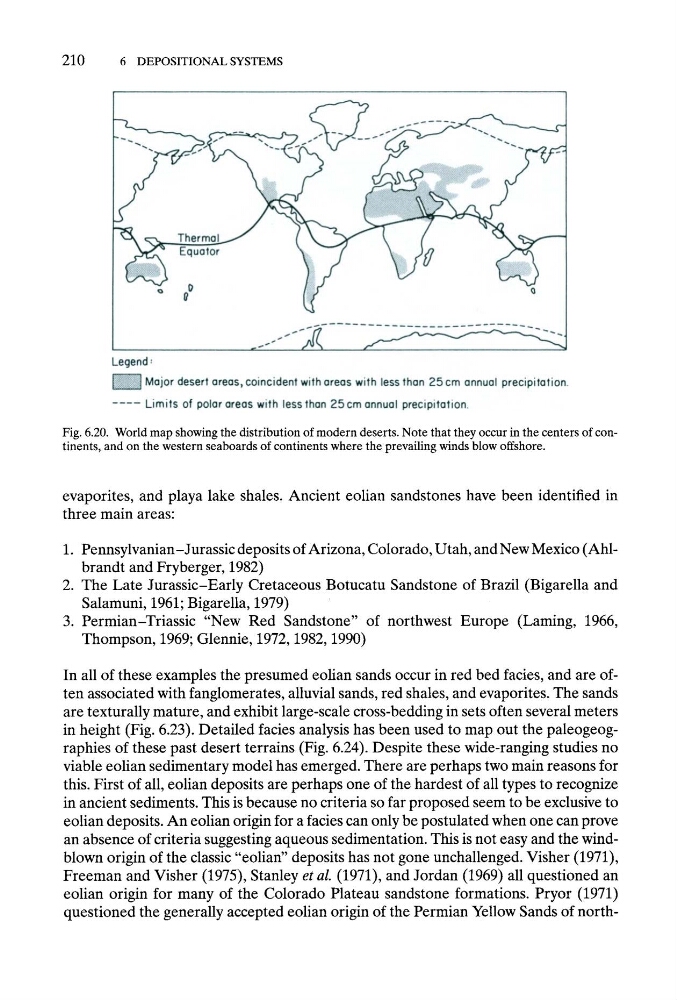
Fig. 6.20. World map showing the distribution of modern deserts. Note that they occur in the centers of continents, and on the western seaboards of continents where the prevailing winds blow offshore.
evaporites, and playa lake shales. Ancient eolian sandstones have been identified in
three main areas:
1. Pennsylvanian-Jurassic deposits of Arizona, Colorado, Utah, and New Mexico (Ahlbrandt and Fryberger, 1982)
2. The Late Jurassic-Early Cretaceous Botucatu Sandstone of Brazil (Bigarella and
Salamuni, 1961; Bigarella, 1979)
3. Permian-Triassic "New Red Sandstone" of northwest Europe (Laming, 1966,
Thompson, 1969; Glennie, 1972, 1982, 1990)
In all of these examples the presumed eolian sands occur in red bed facies, and are often associated with fanglomerates, alluvial sands, red shales, and evaporites. The sands
are texturally mature, and exhibit large-scale cross-bedding in sets often several meters
in height (Fig. 6.23). Detailed facies analysis has been used to map out the paleogeographies of these past desert terrains (Fig. 6.24). Despite these wide-ranging studies no
viable eolian sedimentary model has emerged. There are perhaps two main reasons for
this. First of all, eolian deposits are perhaps one of the hardest of all types to recognize
in ancient sediments. This is because no criteria so far proposed seem to be exclusive to
eolian deposits. An eolian origin for a facies can only be postulated when one can prove
an absence of criteria suggesting aqueous sedimentation. This is not easy and the windblown origin of the classic "eolian" deposits has not gone unchallenged. Visher (1971),
Freeman and Visher (1975), Stanley et al. (1971), and Jordan (1969) all questioned an
eolian origin for many of the Colorado Plateau sandstone formations. Pryor (1971)
questioned the generally accepted eolian origin of the Permian Yellow Sands of north-
6 DEPOSITIONAL SYSTEMS
Fig. 6.20. World map showing the distribution of modern deserts. Note that they occur in the centers of continents, and on the western seaboards of continents where the prevailing winds blow offshore.
evaporites, and playa lake shales. Ancient eolian sandstones have been identified in
three main areas:
1. Pennsylvanian-Jurassic deposits of Arizona, Colorado, Utah, and New Mexico (Ahlbrandt and Fryberger, 1982)
2. The Late Jurassic-Early Cretaceous Botucatu Sandstone of Brazil (Bigarella and
Salamuni, 1961; Bigarella, 1979)
3. Permian-Triassic "New Red Sandstone" of northwest Europe (Laming, 1966,
Thompson, 1969; Glennie, 1972, 1982, 1990)
In all of these examples the presumed eolian sands occur in red bed facies, and are often associated with fanglomerates, alluvial sands, red shales, and evaporites. The sands
are texturally mature, and exhibit large-scale cross-bedding in sets often several meters
in height (Fig. 6.23). Detailed facies analysis has been used to map out the paleogeographies of these past desert terrains (Fig. 6.24). Despite these wide-ranging studies no
viable eolian sedimentary model has emerged. There are perhaps two main reasons for
this. First of all, eolian deposits are perhaps one of the hardest of all types to recognize
in ancient sediments. This is because no criteria so far proposed seem to be exclusive to
eolian deposits. An eolian origin for a facies can only be postulated when one can prove
an absence of criteria suggesting aqueous sedimentation. This is not easy and the windblown origin of the classic "eolian" deposits has not gone unchallenged. Visher (1971),
Freeman and Visher (1975), Stanley et al. (1971), and Jordan (1969) all questioned an
eolian origin for many of the Colorado Plateau sandstone formations. Pryor (1971)
questioned the generally accepted eolian origin of the Permian Yellow Sands of north-