

6.3 SEDIMENTARY MODELS
209
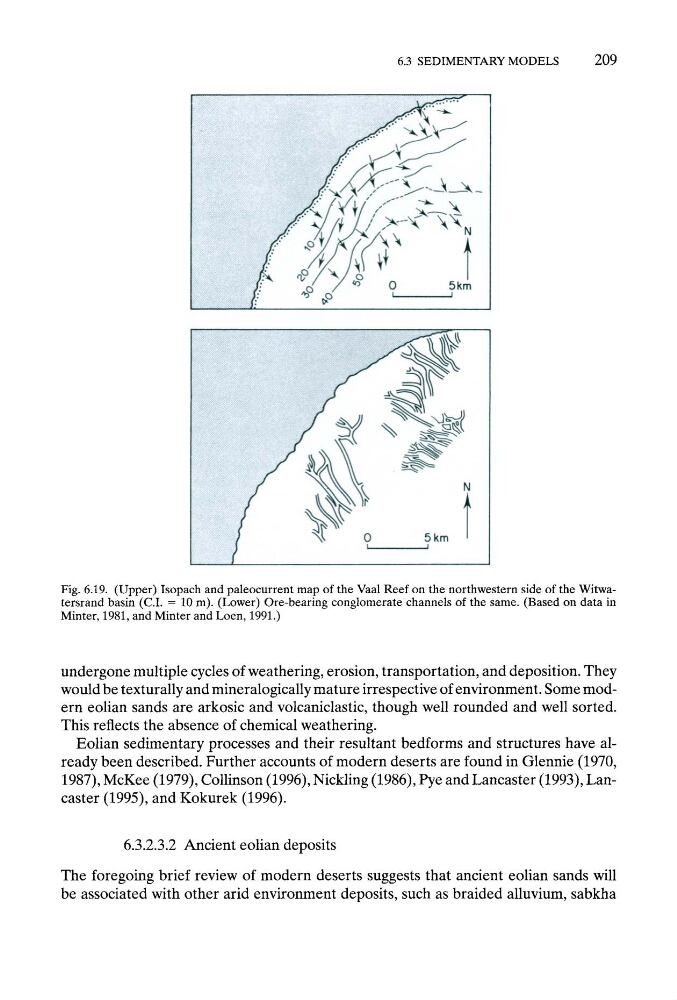
Fig. 6.19. (Upper) Isopach and paleocurrent map of the Vaal Reef on the northwestern side of the Witwatersrand basin (C.I. = 10 m). (Lower) Ore-bearing conglomerate channels of the same. (Based on data in
Minter, 1981, and Minter and Loen, 1991.)
undergone multiple cycles of weathering, erosion, transportation, and deposition. They
would be texturally and mineralogically mature irrespective of environment. Some modern eolian sands are arkosic and volcaniclastic, though well rounded and well sorted.
This reflects the absence of chemical weathering.
Eolian sedimentary processes and their resultant bedforms and structures have already been described. Further accounts of modern deserts are found in Glennie (1970,
1987), McKee (1979), Collinson (1996), Nickling (1986), Pye and Lancaster (1993), Lancaster (1995), and Kokurek (1996).
6.3.2.3.2 Ancient eolian deposits
The foregoing brief review of modern deserts suggests that ancient eolian sands will
be associated with other arid environment deposits, such as braided alluvium, sabkha
209
Fig. 6.19. (Upper) Isopach and paleocurrent map of the Vaal Reef on the northwestern side of the Witwatersrand basin (C.I. = 10 m). (Lower) Ore-bearing conglomerate channels of the same. (Based on data in
Minter, 1981, and Minter and Loen, 1991.)
undergone multiple cycles of weathering, erosion, transportation, and deposition. They
would be texturally and mineralogically mature irrespective of environment. Some modern eolian sands are arkosic and volcaniclastic, though well rounded and well sorted.
This reflects the absence of chemical weathering.
Eolian sedimentary processes and their resultant bedforms and structures have already been described. Further accounts of modern deserts are found in Glennie (1970,
1987), McKee (1979), Collinson (1996), Nickling (1986), Pye and Lancaster (1993), Lancaster (1995), and Kokurek (1996).
6.3.2.3.2 Ancient eolian deposits
The foregoing brief review of modern deserts suggests that ancient eolian sands will
be associated with other arid environment deposits, such as braided alluvium, sabkha