

6.3 SEDIMENTARY MODELS
205
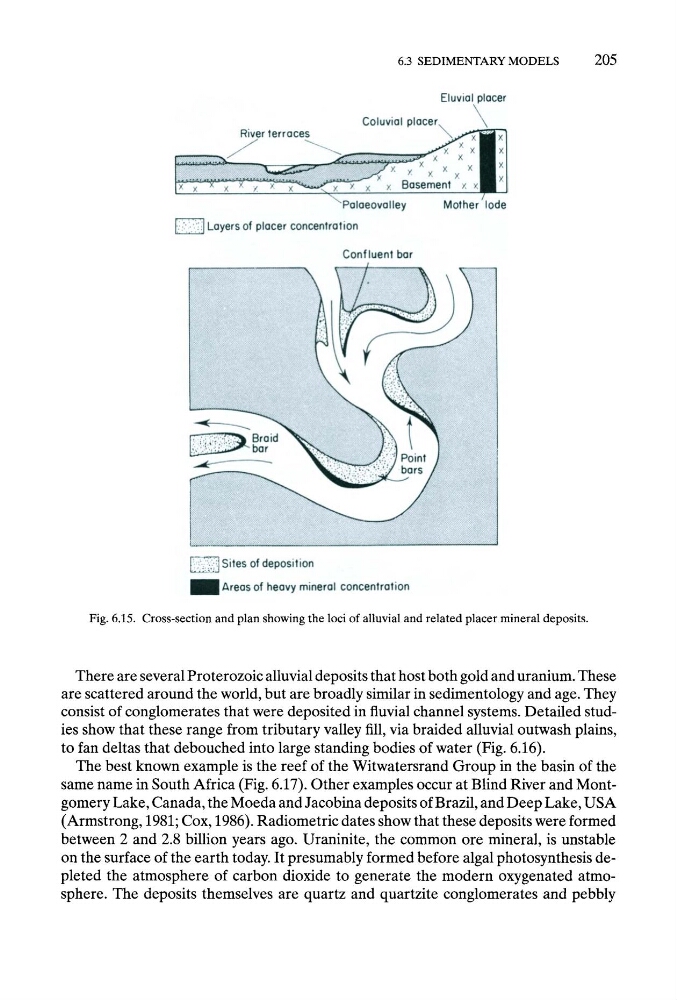
Fig. 6.15. Cross-section and plan showing the loci of alluvial and related placer mineral deposits.
There are several Proterozoic alluvial deposits that host both gold and uranium. These
are scattered around the world, but are broadly similar in sedimentology and age. They
consist of conglomerates that were deposited in fluvial channel systems. Detailed studies show that these range from tributary valley fill, via braided alluvial outwash plains,
to fan deltas that debouched into large standing bodies of water (Fig. 6.16).
The best known example is the reef of the Witwatersrand Group in the basin of the
same name in South Africa (Fig. 6.17). Other examples occur at Blind River and Montgomery Lake, Canada, the Moeda and Jacobina deposits of Brazil, and Deep Lake, USA
(Armstrong, 1981; Cox, 1986). Radiometric dates show that these deposits were formed
between 2 and 2.8 billion years ago. Uraninite, the common ore mineral, is unstable
on the surface of the earth today. It presumably formed before algal photosynthesis depleted the atmosphere of carbon dioxide to generate the modern oxygenated atmosphere. The deposits themselves are quartz and quartzite conglomerates and pebbly
205
Fig. 6.15. Cross-section and plan showing the loci of alluvial and related placer mineral deposits.
There are several Proterozoic alluvial deposits that host both gold and uranium. These
are scattered around the world, but are broadly similar in sedimentology and age. They
consist of conglomerates that were deposited in fluvial channel systems. Detailed studies show that these range from tributary valley fill, via braided alluvial outwash plains,
to fan deltas that debouched into large standing bodies of water (Fig. 6.16).
The best known example is the reef of the Witwatersrand Group in the basin of the
same name in South Africa (Fig. 6.17). Other examples occur at Blind River and Montgomery Lake, Canada, the Moeda and Jacobina deposits of Brazil, and Deep Lake, USA
(Armstrong, 1981; Cox, 1986). Radiometric dates show that these deposits were formed
between 2 and 2.8 billion years ago. Uraninite, the common ore mineral, is unstable
on the surface of the earth today. It presumably formed before algal photosynthesis depleted the atmosphere of carbon dioxide to generate the modern oxygenated atmosphere. The deposits themselves are quartz and quartzite conglomerates and pebbly