

204
6 DEPOSITIONAL SYSTEMS
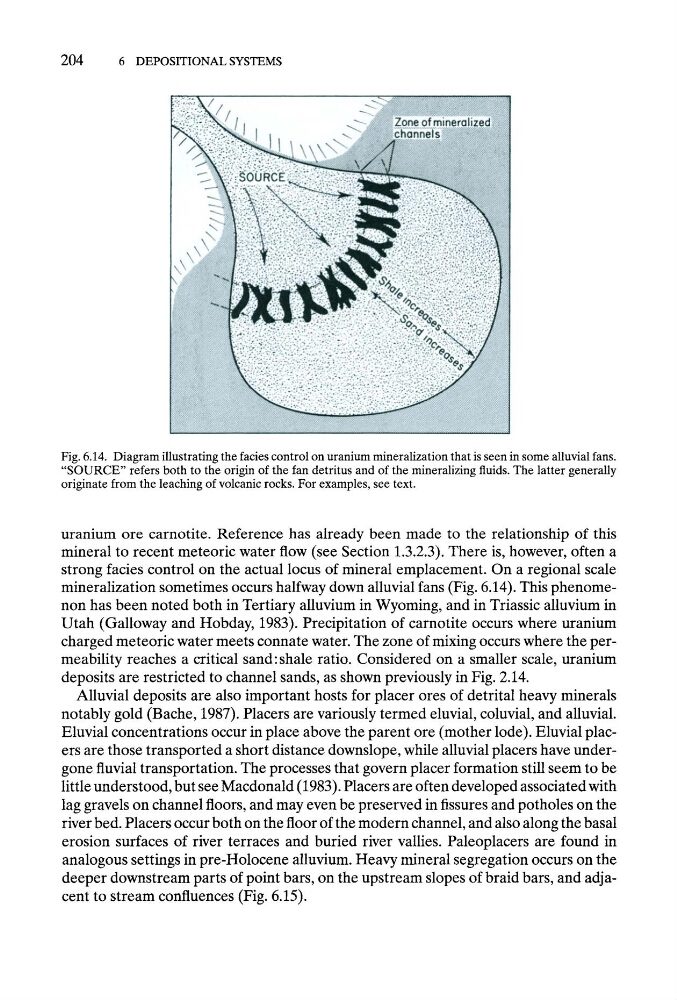
Fig. 6.14. Diagram illustrating the facies control on uranium mineralization that is seen in some alluvial fans.
"SOURCE" refers both to the origin of the fan detritus and of the mineralizing fluids. The latter generally
originate from the leaching of volcanic rocks. For examples, see text.
uranium ore carnotite. Reference has already been made to the relationship of this
mineral to recent meteoric water flow (see Section 1.3.2.3). There is, however, often a
strong facies control on the actual locus of mineral emplacement. On a regional scale
mineralization sometimes occurs halfway down alluvial fans (Fig. 6.14). This phenomenon has been noted both in Tertiary alluvium in Wyoming, and in Triassic alluvium in
Utah (Galloway and Hobday, 1983). Precipitation of carnotite occurs where uranium
charged meteoric water meets connate water. The zone of mixing occurs where the permeability reaches a critical sand'shale ratio. Considered on a smaller scale, uranium
deposits are restricted to channel sands, as shown previously in Fig. 2.14.
Alluvial deposits are also important hosts for placer ores of detrital heavy minerals
notably gold (Bache, 1987). Placers are variously termed eluvial, coluvial, and alluvial.
Eluvial concentrations occur in place above the parent ore (mother lode). Eluvial placers are those transported a short distance downslope, while alluvial placers have undergone fluvial transportation. The processes that govern placer formation still seem to be
little understood, but see Macdonald (1983). Placers are often developed associated with
lag gravels on channel floors, and may even be preserved in fissures and potholes on the
river bed. Placers occur both on the floor of the modern channel, and also along the basal
erosion surfaces of river terraces and buried river vallies. Paleoplacers are found in
analogous settings in pre-Holocene alluvium. Heavy mineral segregation occurs on the
deeper downstream parts of point bars, on the upstream slopes of braid bars, and adjacent to stream confluences (Fig. 6.15).
6 DEPOSITIONAL SYSTEMS
Fig. 6.14. Diagram illustrating the facies control on uranium mineralization that is seen in some alluvial fans.
"SOURCE" refers both to the origin of the fan detritus and of the mineralizing fluids. The latter generally
originate from the leaching of volcanic rocks. For examples, see text.
uranium ore carnotite. Reference has already been made to the relationship of this
mineral to recent meteoric water flow (see Section 1.3.2.3). There is, however, often a
strong facies control on the actual locus of mineral emplacement. On a regional scale
mineralization sometimes occurs halfway down alluvial fans (Fig. 6.14). This phenomenon has been noted both in Tertiary alluvium in Wyoming, and in Triassic alluvium in
Utah (Galloway and Hobday, 1983). Precipitation of carnotite occurs where uranium
charged meteoric water meets connate water. The zone of mixing occurs where the permeability reaches a critical sand'shale ratio. Considered on a smaller scale, uranium
deposits are restricted to channel sands, as shown previously in Fig. 2.14.
Alluvial deposits are also important hosts for placer ores of detrital heavy minerals
notably gold (Bache, 1987). Placers are variously termed eluvial, coluvial, and alluvial.
Eluvial concentrations occur in place above the parent ore (mother lode). Eluvial placers are those transported a short distance downslope, while alluvial placers have undergone fluvial transportation. The processes that govern placer formation still seem to be
little understood, but see Macdonald (1983). Placers are often developed associated with
lag gravels on channel floors, and may even be preserved in fissures and potholes on the
river bed. Placers occur both on the floor of the modern channel, and also along the basal
erosion surfaces of river terraces and buried river vallies. Paleoplacers are found in
analogous settings in pre-Holocene alluvium. Heavy mineral segregation occurs on the
deeper downstream parts of point bars, on the upstream slopes of braid bars, and adjacent to stream confluences (Fig. 6.15).