

6.3 SEDIMENTARY MODELS
203
Such petroleum accumulations are in marked contrast to those found in the alluvium
of meandering channels. These are normally small stratigraphic traps where the reservoir may be only several meters thick and extend for a few square kilometers (Fig. 6.11,
lower). The Little Creek field in the Tuscaloosa trend (Upper Cretaceous) of Mississippi
is an excellently documented example of a small field in a fluvial point bar stratigraphic
trap (Werren et al., 1990).
Finally, once a fluvial petroleum reservoir has been found, the production of petroleum from it can be quite challenging. Attention must be paid to the size and frequency
of channels, to establish their intercommunication (refer back to Fig. 6.10 to see the nature of the problem). Ideally one would hope to be able to use the depositional model
to correlate channels, but in many cases the problem is too complex, and necessitates
a shift from deterministic to probabilistic methods, such as stochastic modeling (e.g.,
Martin, 1993). Reservoir units must be defined and characterized for computer simulation (Fig. 6.12). On a smaller scale, recall that in Chapter 3, it was shown how channels
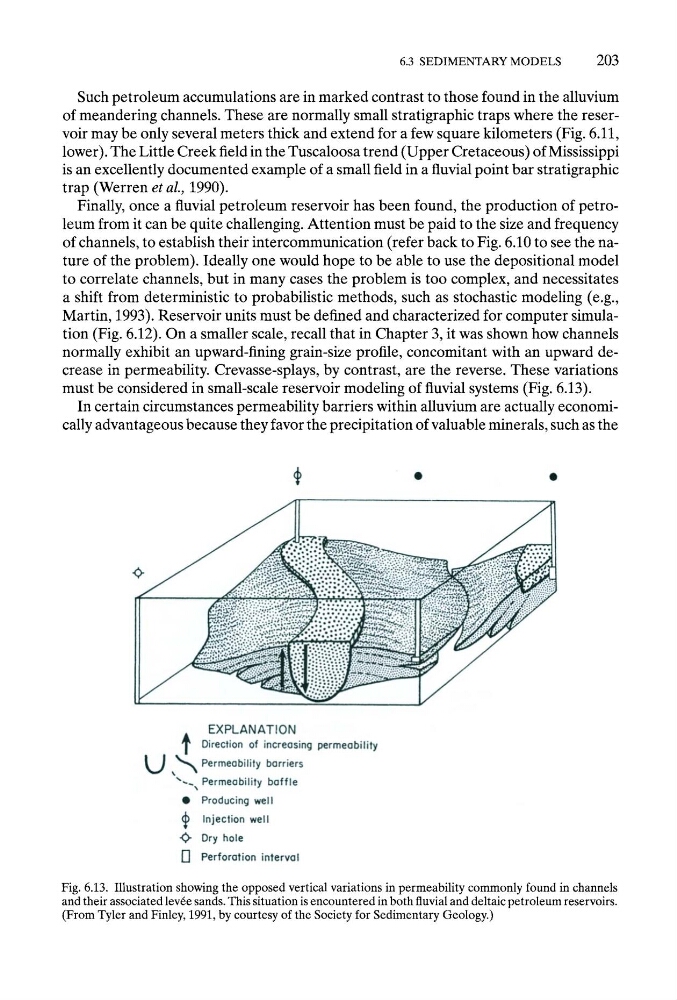
normally exhibit an upward-fining grain-size profile, concomitant with an upward decrease in permeability. Crevasse-splays, by contrast, are the reverse. These variations
must be considered in small-scale reservoir modeling of fluvial systems (Fig. 6.13).
In certain circumstances permeability barriers within alluvium are actually economically advantageous because they favor the precipitation of valuable minerals, such as the
Fig. 6.13. Illustration showing the opposed vertical variations in permeability commonly found in channels
and their associated lev6e sands. This situation is encountered in both fluvial and deltaic petroleum reservoirs.
(From Tyler and Finley, 1991, by courtesy of the Society for Sedimentary Geology.)
203
Such petroleum accumulations are in marked contrast to those found in the alluvium
of meandering channels. These are normally small stratigraphic traps where the reservoir may be only several meters thick and extend for a few square kilometers (Fig. 6.11,
lower). The Little Creek field in the Tuscaloosa trend (Upper Cretaceous) of Mississippi
is an excellently documented example of a small field in a fluvial point bar stratigraphic
trap (Werren et al., 1990).
Finally, once a fluvial petroleum reservoir has been found, the production of petroleum from it can be quite challenging. Attention must be paid to the size and frequency
of channels, to establish their intercommunication (refer back to Fig. 6.10 to see the nature of the problem). Ideally one would hope to be able to use the depositional model
to correlate channels, but in many cases the problem is too complex, and necessitates
a shift from deterministic to probabilistic methods, such as stochastic modeling (e.g.,
Martin, 1993). Reservoir units must be defined and characterized for computer simulation (Fig. 6.12). On a smaller scale, recall that in Chapter 3, it was shown how channels
normally exhibit an upward-fining grain-size profile, concomitant with an upward decrease in permeability. Crevasse-splays, by contrast, are the reverse. These variations
must be considered in small-scale reservoir modeling of fluvial systems (Fig. 6.13).
In certain circumstances permeability barriers within alluvium are actually economically advantageous because they favor the precipitation of valuable minerals, such as the
Fig. 6.13. Illustration showing the opposed vertical variations in permeability commonly found in channels
and their associated lev6e sands. This situation is encountered in both fluvial and deltaic petroleum reservoirs.
(From Tyler and Finley, 1991, by courtesy of the Society for Sedimentary Geology.)