

206
6 DEPOSITIONAL SYSTEMS
M~176 n e~ake r
Bl i nd "7,,~.n f
tRi ver ~' ~' ~' =]k r
anc Jao ~bina Source area
Blind
river
MoL ~
and
dacobi na
!
]/~ ~ Braided
/V ~J outwash
l
pl
_~___ . __~Wi t wat ersrand __ .~
~_
/F I ~\\\ Fan
l ake
Mont gomery
,~ /~ ~~~a
Open sea or l ake
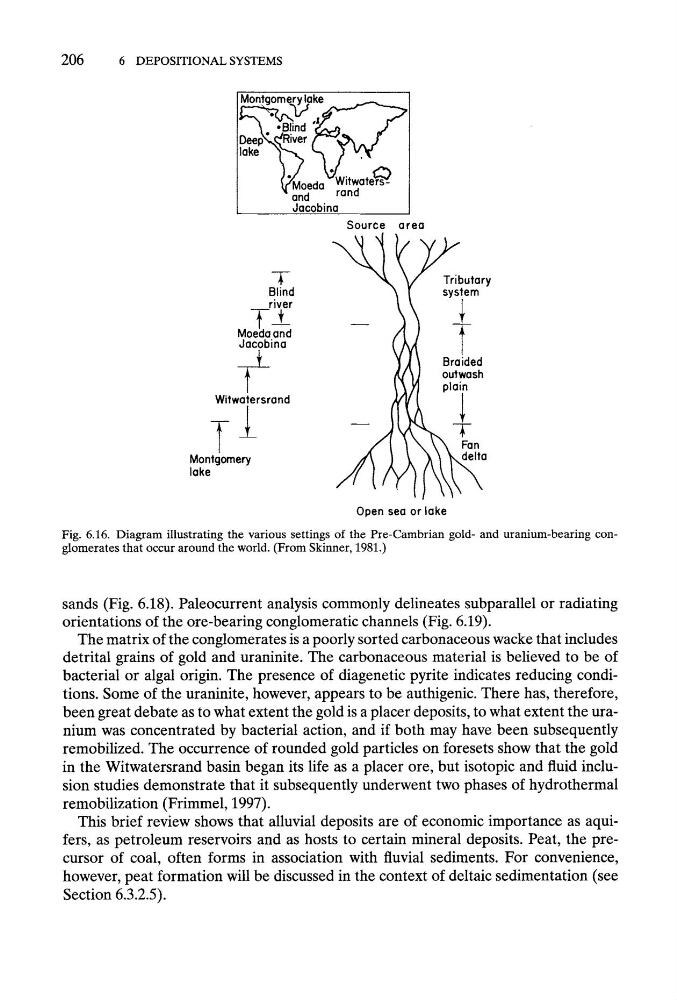
Fig. 6.16. Diagram illustrating the various settings of the Pre-Cambrian gold- and uranium-bearing conglomerates that occur around the world. (From Skinner, 1981.)
sands (Fig. 6.18). Paleocurrent analysis commonly delineates subparallel or radiating
orientations of the ore-bearing conglomeratic channels (Fig. 6.19).
The matrix of the conglomerates is a poorly sorted carbonaceous wacke that includes
detrital grains of gold and uraninite. The carbonaceous material is believed to be of
bacterial or algal origin. The presence of diagenetic pyrite indicates reducing conditions. Some of the uraninite, however, appears to be authigenic. There has, therefore,
been great debate as to what extent the gold is a placer deposits, to what extent the uranium was concentrated by bacterial action, and if both may have been subsequently
remobilized. The occurrence of rounded gold particles on foresets show that the gold
in the Witwatersrand basin began its life as a placer ore, but isotopic and fluid inclusion studies demonstrate that it subsequently underwent two phases of hydrothermal
remobilization (Frimmel, 1997).
This brief review shows that alluvial deposits are of economic importance as aquifers, as petroleum reservoirs and as hosts to certain mineral deposits. Peat, the precursor of coal, often forms in association with fluvial sediments. For convenience,
however, peat formation will be discussed in the context of deltaic sedimentation (see
Section 6.3.2.5).
6 DEPOSITIONAL SYSTEMS
M~176 n e~ake r
Bl i nd "7,,~.n f
tRi ver ~' ~' ~' =]k r
anc Jao ~bina Source area
Blind
river
MoL ~
and
dacobi na
!
]/~ ~ Braided
/V ~J outwash
l
pl
_~___ . __~Wi t wat ersrand __ .~
~_
/F I ~\\\ Fan
l ake
Mont gomery
,~ /~ ~~~a
Open sea or l ake
Fig. 6.16. Diagram illustrating the various settings of the Pre-Cambrian gold- and uranium-bearing conglomerates that occur around the world. (From Skinner, 1981.)
sands (Fig. 6.18). Paleocurrent analysis commonly delineates subparallel or radiating
orientations of the ore-bearing conglomeratic channels (Fig. 6.19).
The matrix of the conglomerates is a poorly sorted carbonaceous wacke that includes
detrital grains of gold and uraninite. The carbonaceous material is believed to be of
bacterial or algal origin. The presence of diagenetic pyrite indicates reducing conditions. Some of the uraninite, however, appears to be authigenic. There has, therefore,
been great debate as to what extent the gold is a placer deposits, to what extent the uranium was concentrated by bacterial action, and if both may have been subsequently
remobilized. The occurrence of rounded gold particles on foresets show that the gold
in the Witwatersrand basin began its life as a placer ore, but isotopic and fluid inclusion studies demonstrate that it subsequently underwent two phases of hydrothermal
remobilization (Frimmel, 1997).
This brief review shows that alluvial deposits are of economic importance as aquifers, as petroleum reservoirs and as hosts to certain mineral deposits. Peat, the precursor of coal, often forms in association with fluvial sediments. For convenience,
however, peat formation will be discussed in the context of deltaic sedimentation (see
Section 6.3.2.5).