

5.4 PALEOCURRENT ANALYSIS
173
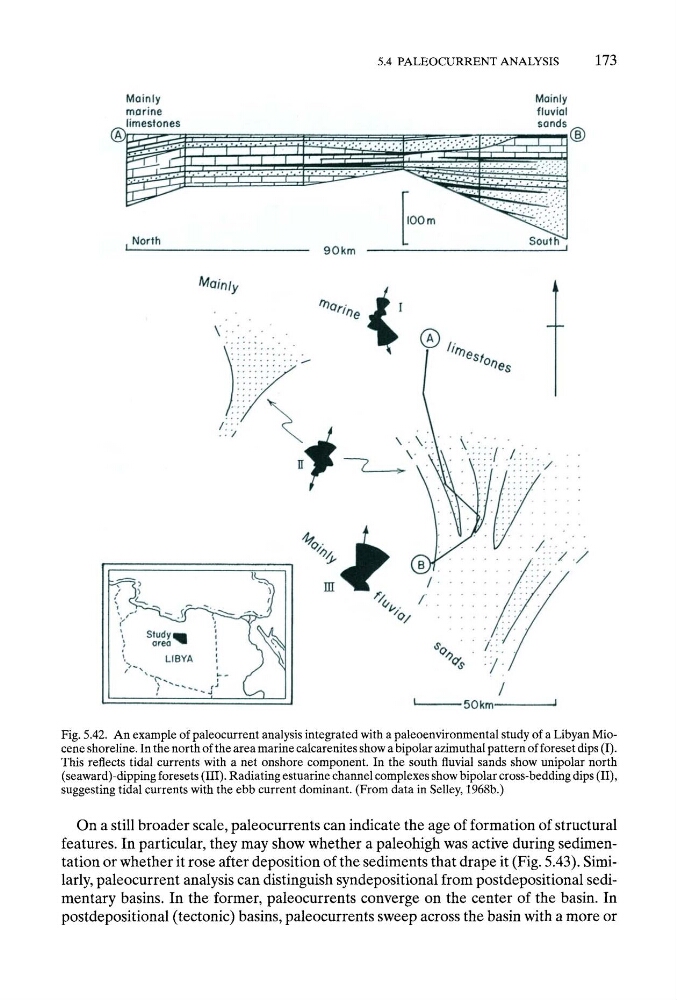
Fig. 5.42. An example of paleocurrent analysis integrated with a paleoenvironmental study of a Libyan Miocene shoreline. In the north of the area marine calcarenites show a bipolar azimuthal pattern of foreset dips (I).
This reflects tidal currents with a net onshore component. In the south fluvial sands show unipolar north
(seaward)-dipping foresets (III). Radiating estuarine channel complexes show bipolar cross-bedding dips (II),
suggesting tidal currents with the ebb current dominant. (From data in Selley, 1968b.)
On a still broader scale, paleocurrents can indicate the age of formation of structural
features. In particular, they may show whether a paleohigh was active during sedimentation or whether it rose after deposition of the sediments that drape it (Fig. 5.43). Similarly, paleocurrent analysis can distinguish syndepositional from postdepositional sedimentary basins. In the former, paleocurrents converge on the center of the basin. In
postdepositional (tectonic) basins, paleocurrents sweep across the basin with a more or
173
Fig. 5.42. An example of paleocurrent analysis integrated with a paleoenvironmental study of a Libyan Miocene shoreline. In the north of the area marine calcarenites show a bipolar azimuthal pattern of foreset dips (I).
This reflects tidal currents with a net onshore component. In the south fluvial sands show unipolar north
(seaward)-dipping foresets (III). Radiating estuarine channel complexes show bipolar cross-bedding dips (II),
suggesting tidal currents with the ebb current dominant. (From data in Selley, 1968b.)
On a still broader scale, paleocurrents can indicate the age of formation of structural
features. In particular, they may show whether a paleohigh was active during sedimentation or whether it rose after deposition of the sediments that drape it (Fig. 5.43). Similarly, paleocurrent analysis can distinguish syndepositional from postdepositional sedimentary basins. In the former, paleocurrents converge on the center of the basin. In
postdepositional (tectonic) basins, paleocurrents sweep across the basin with a more or