

174
5 SEDIMENTARY STRUCTURES
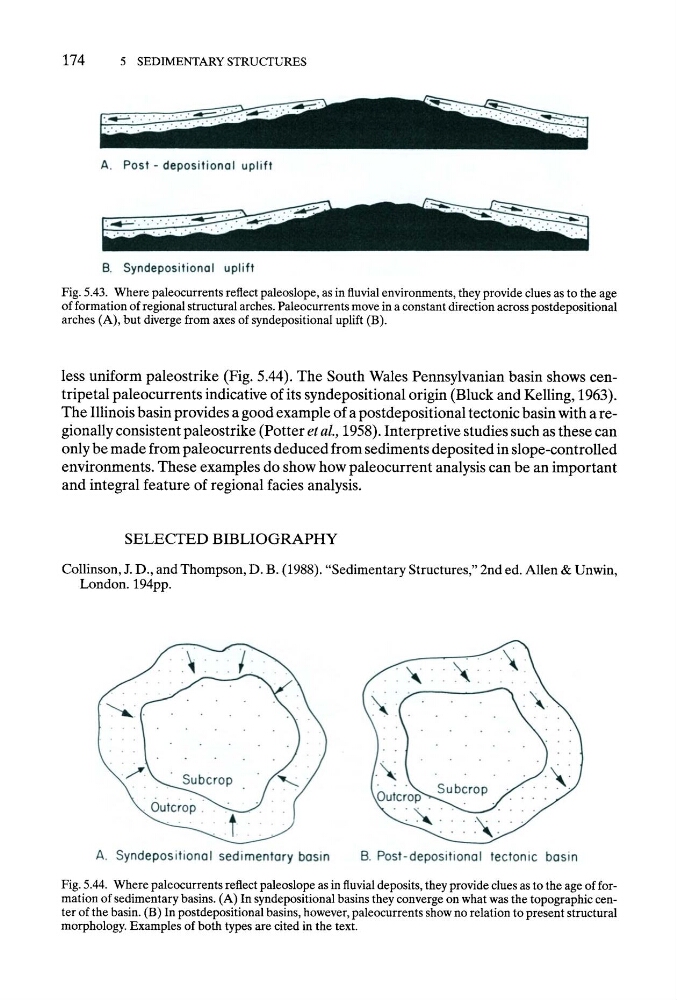
Fig. 5.43. Where paleocurrents reflect paleoslope, as in fluvial environments, they provide clues as to the age
of formation of regional structural arches. Paleocurrents move in a constant direction across postdepositional
arches (A), but diverge from axes of syndepositional uplift (B).
less uniform paleostrike (Fig. 5.44). The South Wales Pennsylvanian basin shows centripetal paleocurrents indicative of its syndepositional origin (Bluck and Kelling, 1963).
The Illinois basin provides a good example of a postdepositional tectonic basin with a regionally consistent paleostrike (Potter et al., 1958). Interpretive studies such as these can
only be made from paleocurrents deduced from sediments deposited in slope-controlled
environments. These examples do show how paleocurrent analysis can be an important
and integral feature of regional facies analysis.
SELECTED BIBLIOGRAPHY
Collinson, J. D., and Thompson, D. B. (1988). "Sedimentary Structures," 2nd ed. Allen & Unwin,
London. 194pp.
Fig. 5.44. Where paleocurrents reflect paleoslope as in fluvial deposits, they provide clues as to the age of formation of sedimentary basins. (A) In syndepositional basins they converge on what was the topographic center of the basin. (B) In postdepositional basins, however, paleocurrents show no relation to present structural
morphology. Examples of both types are cited in the text.
5 SEDIMENTARY STRUCTURES
Fig. 5.43. Where paleocurrents reflect paleoslope, as in fluvial environments, they provide clues as to the age
of formation of regional structural arches. Paleocurrents move in a constant direction across postdepositional
arches (A), but diverge from axes of syndepositional uplift (B).
less uniform paleostrike (Fig. 5.44). The South Wales Pennsylvanian basin shows centripetal paleocurrents indicative of its syndepositional origin (Bluck and Kelling, 1963).
The Illinois basin provides a good example of a postdepositional tectonic basin with a regionally consistent paleostrike (Potter et al., 1958). Interpretive studies such as these can
only be made from paleocurrents deduced from sediments deposited in slope-controlled
environments. These examples do show how paleocurrent analysis can be an important
and integral feature of regional facies analysis.
SELECTED BIBLIOGRAPHY
Collinson, J. D., and Thompson, D. B. (1988). "Sedimentary Structures," 2nd ed. Allen & Unwin,
London. 194pp.
Fig. 5.44. Where paleocurrents reflect paleoslope as in fluvial deposits, they provide clues as to the age of formation of sedimentary basins. (A) In syndepositional basins they converge on what was the topographic center of the basin. (B) In postdepositional basins, however, paleocurrents show no relation to present structural
morphology. Examples of both types are cited in the text.