

5.3 PRIMARY INORGANIC SEDIMENTARY STRUCTURES
157
Of more interest to geologists is not so much what initiates ripple formation, but what
can be learned from the resultant structure. One would like to gain information about
flow conditions, direction, water depth, and environment. Attempts to relate ripple type
to flow conditions have not been noticeably successful. Allen (1968a, 1986a,b) has, however, recognized a broad correlation between current ripples and decreasing depth and
concomitant increasing velocity. The sequence changes from straight-crested ripples to
sinuous crests, and so to lunate and linguoid trains. The water depth in which ripples
form has no effect on their height or wavelength except at extremely shallow depths.
Flow direction, on the other hand, can be very easily determined from ripples, both from
their strike and lee face in plan view, and from the dip direction of their internal crosslamination. This aspect of paleocurrent analysis is discussed later in the chapter. Ripples
occur today in many different environments, ranging from the backs of eolian sand
dunes, through rivers and deltas, to the ocean bed. It has already been pointed out that
ripples are closely related to a given set of flow conditions and that these may be encountered in diverse environments. One would not, therefore, expect to find a relationship between ripple morphology and environment, as opposed to process. Nevertheless, Tanner (1967, 1971) empirically developed several statistical indices that appear to
be capable of differentiating ripples from different sedimentary environments.
5.3.4 Postdepositional Sedimentary Structures
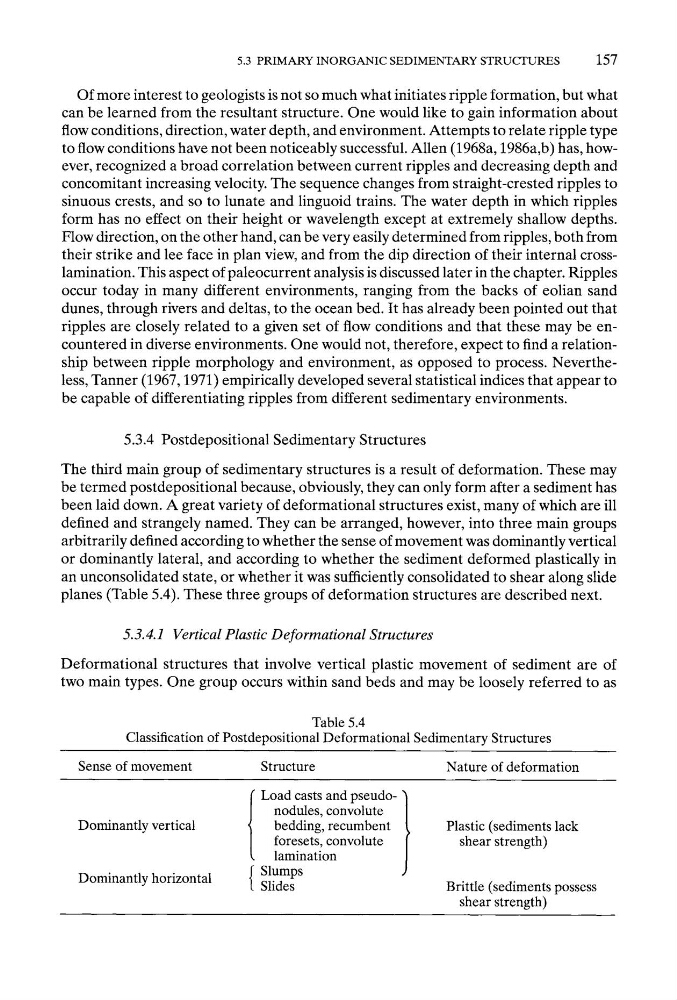
The third main group of sedimentary structures is a result of deformation. These may
be termed postdepositional because, obviously, they can only form after a sediment has
been laid down. A great variety of deformational structures exist, many of which are ill
defined and strangely named. They can be arranged, however, into three main groups
arbitrarily defined according to whether the sense of movement was dominantly vertical
or dominantly lateral, and according to whether the sediment deformed plastically in
an unconsolidated state, or whether it was sufficiently consolidated to shear along slide
planes (Table 5.4). These three groups of deformation structures are described next.
5.3.4.1 Vertical Plastic Deformational Structures
Deformational structures that involve vertical plastic movement of sediment are of
two main types. One group occurs within sand beds and may be loosely referred to as
Table 5.4
Classification of Postdepositional Deformational Sedimentary Structures
Sense of movement
Structure
Nature of deformation
Dominantly vertical
Dominantly horizontal
Load casts and pseudonodules, convolute
bedding, recumbent
foresets, convolute
lamination
Slumps
Slides
Plastic (sediments lack
shear strength)
Brittle (sediments possess
shear strength)
157
Of more interest to geologists is not so much what initiates ripple formation, but what
can be learned from the resultant structure. One would like to gain information about
flow conditions, direction, water depth, and environment. Attempts to relate ripple type
to flow conditions have not been noticeably successful. Allen (1968a, 1986a,b) has, however, recognized a broad correlation between current ripples and decreasing depth and
concomitant increasing velocity. The sequence changes from straight-crested ripples to
sinuous crests, and so to lunate and linguoid trains. The water depth in which ripples
form has no effect on their height or wavelength except at extremely shallow depths.
Flow direction, on the other hand, can be very easily determined from ripples, both from
their strike and lee face in plan view, and from the dip direction of their internal crosslamination. This aspect of paleocurrent analysis is discussed later in the chapter. Ripples
occur today in many different environments, ranging from the backs of eolian sand
dunes, through rivers and deltas, to the ocean bed. It has already been pointed out that
ripples are closely related to a given set of flow conditions and that these may be encountered in diverse environments. One would not, therefore, expect to find a relationship between ripple morphology and environment, as opposed to process. Nevertheless, Tanner (1967, 1971) empirically developed several statistical indices that appear to
be capable of differentiating ripples from different sedimentary environments.
5.3.4 Postdepositional Sedimentary Structures
The third main group of sedimentary structures is a result of deformation. These may
be termed postdepositional because, obviously, they can only form after a sediment has
been laid down. A great variety of deformational structures exist, many of which are ill
defined and strangely named. They can be arranged, however, into three main groups
arbitrarily defined according to whether the sense of movement was dominantly vertical
or dominantly lateral, and according to whether the sediment deformed plastically in
an unconsolidated state, or whether it was sufficiently consolidated to shear along slide
planes (Table 5.4). These three groups of deformation structures are described next.
5.3.4.1 Vertical Plastic Deformational Structures
Deformational structures that involve vertical plastic movement of sediment are of
two main types. One group occurs within sand beds and may be loosely referred to as
Table 5.4
Classification of Postdepositional Deformational Sedimentary Structures
Sense of movement
Structure
Nature of deformation
Dominantly vertical
Dominantly horizontal
Load casts and pseudonodules, convolute
bedding, recumbent
foresets, convolute
lamination
Slumps
Slides
Plastic (sediments lack
shear strength)
Brittle (sediments possess
shear strength)