

156
5 SEDIMENTARY STRUCTURES
Straight crested
) ).>
2}
Linguoid ripples
(in- phase variety )
O
7"7 [
Interference ripples
Sinuous crested
Lunate ripples
( out - of- phase variety )
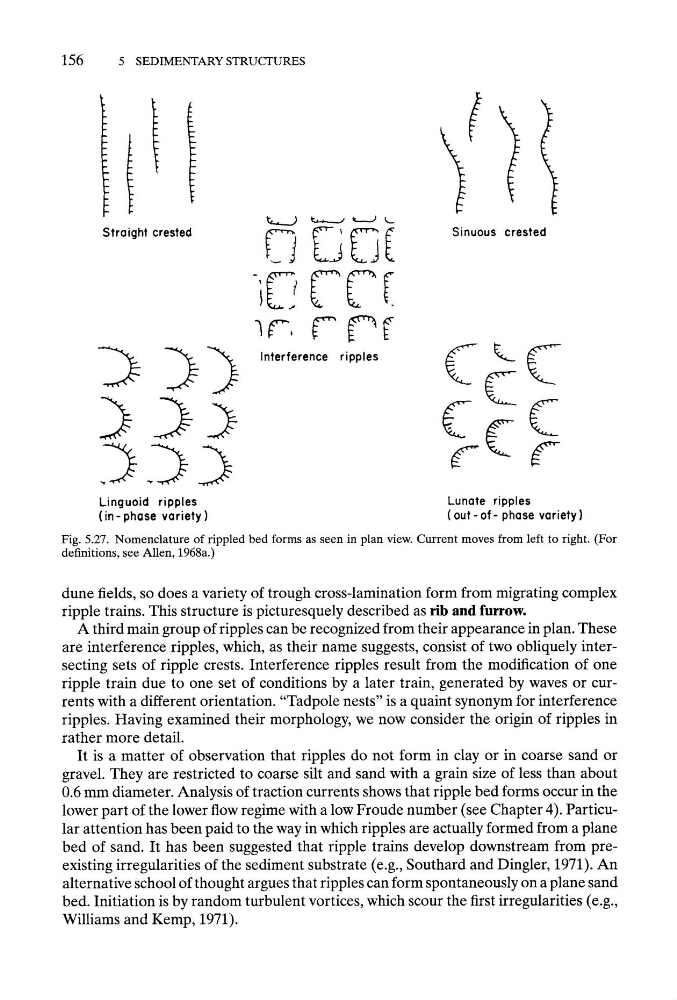
Fig. 5.27. Nomenclature of rippled bed forms as seen in plan view. Current moves from left to right. (For
definitions, see Allen, 1968a.)
dune fields, so does a variety of trough cross-lamination form from migrating complex
ripple trains. This structure is picturesquely described as rib and furrow.
A third main group of ripples can be recognized from their appearance in plan. These
are interference ripples, which, as their name suggests, consist of two obliquely intersecting sets of ripple crests. Interference ripples result from the modification of one
ripple train due to one set of conditions by a later train, generated by waves or currents with a different orientation. "Tadpole nests" is a quaint synonym for interference
ripples. Having examined their morphology, we now consider the origin of ripples in
rather more detail.
It is a matter of observation that ripples do not form in clay or in coarse sand or
gravel. They are restricted to coarse silt and sand with a grain size of less than about
0.6 mm diameter. Analysis of traction currents shows that ripple bed forms occur in the
lower part of the lower flow regime with a low Froude number (see Chapter 4). Particular attention has been paid to the way in which ripples are actually formed from a plane
bed of sand. It has been suggested that ripple trains develop downstream from preexisting irregularities of the sediment substrate (e.g., Southard and Dingler, 1971). An
alternative school of thought argues that ripples can form spontaneously on a plane sand
bed. Initiation is by random turbulent vortices, which scour the first irregularities (e.g.,
Williams and Kemp, 1971).
5 SEDIMENTARY STRUCTURES
Straight crested
) ).>
2}
Linguoid ripples
(in- phase variety )
O
7"7 [
Interference ripples
Sinuous crested
Lunate ripples
( out - of- phase variety )
Fig. 5.27. Nomenclature of rippled bed forms as seen in plan view. Current moves from left to right. (For
definitions, see Allen, 1968a.)
dune fields, so does a variety of trough cross-lamination form from migrating complex
ripple trains. This structure is picturesquely described as rib and furrow.
A third main group of ripples can be recognized from their appearance in plan. These
are interference ripples, which, as their name suggests, consist of two obliquely intersecting sets of ripple crests. Interference ripples result from the modification of one
ripple train due to one set of conditions by a later train, generated by waves or currents with a different orientation. "Tadpole nests" is a quaint synonym for interference
ripples. Having examined their morphology, we now consider the origin of ripples in
rather more detail.
It is a matter of observation that ripples do not form in clay or in coarse sand or
gravel. They are restricted to coarse silt and sand with a grain size of less than about
0.6 mm diameter. Analysis of traction currents shows that ripple bed forms occur in the
lower part of the lower flow regime with a low Froude number (see Chapter 4). Particular attention has been paid to the way in which ripples are actually formed from a plane
bed of sand. It has been suggested that ripple trains develop downstream from preexisting irregularities of the sediment substrate (e.g., Southard and Dingler, 1971). An
alternative school of thought argues that ripples can form spontaneously on a plane sand
bed. Initiation is by random turbulent vortices, which scour the first irregularities (e.g.,
Williams and Kemp, 1971).