

158
5 SEDIMENTARY STRUCTURES
Curren!
!
!
Im
L/
..84
-~..__ J
"--~-~
" .'
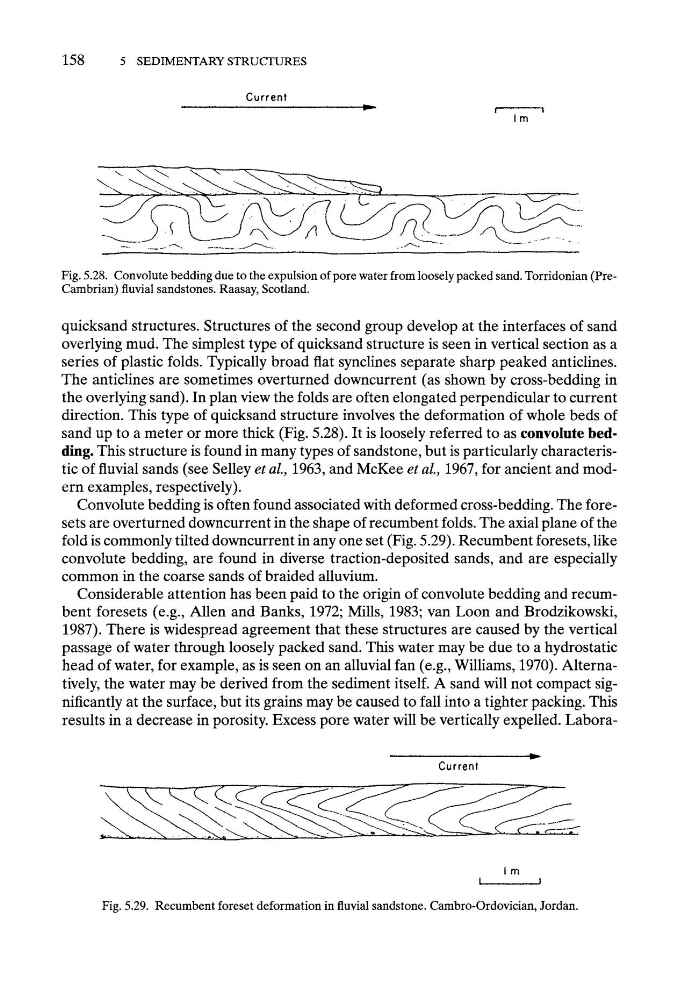
Fig. 5.28. Convolute bedding due to the expulsion of pore water from loosely packed sand. Torridonian (PreCambrian) fluvial sandstones. Raasay, Scotland.
quicksand structures. Structures of the second group develop at the interfaces of sand
overlying mud. The simplest type of quicksand structure is seen in vertical section as a
series of plastic folds. Typically broad flat synclines separate sharp peaked anticlines.
The anticlines are sometimes overturned downcurrent (as shown by cross-bedding in
the overlying sand). In plan view the folds are often elongated perpendicular to current
direction. This type of quicksand structure involves the deformation of whole beds of
sand up to a meter or more thick (Fig. 5.28). It is loosely referred to as convolute bedding. This structure is found in many types of sandstone, but is particularly characteristic of fluvial sands (see Selley et al., 1963, and McKee et al., 1967, for ancient and modern examples, respectively).
Convolute bedding is often found associated with deformed cross-bedding. The foresets are overturned downcurrent in the shape of recumbent folds. The axial plane of the
fold is commonly tilted downcurrent in any one set (Fig. 5.29). Recumbent foresets, like
convolute bedding, are found in diverse traction-deposited sands, and are especially
common in the coarse sands of braided alluvium.
Considerable attention has been paid to the origin of convolute bedding and recumbent foresets (e.g., Allen and Banks, 1972; Mills, 1983; van Loon and Brodzikowski,
1987). There is widespread agreement that these structures are caused by the vertical
passage of water through loosely packed sand. This water may be due to a hydrostatic
head of water, for example, as is seen on an alluvial fan (e.g., Williams, 1970). Alternatively, the water may be derived from the sediment itself. A sand will not compact significantly at the surface, but its grains may be caused to fall into a tighter packing. This
results in a decrease in porosity. Excess pore water will be vertically expelled. LaboraCurrent
Im
1
,
i
Fig. 5.29. Recumbent foreset deformation in fluvial sandstone. Cambro-Ordovician, Jordan.
5 SEDIMENTARY STRUCTURES
Curren!
!
!
Im
L/
..84
-~..__ J
"--~-~
" .'
Fig. 5.28. Convolute bedding due to the expulsion of pore water from loosely packed sand. Torridonian (PreCambrian) fluvial sandstones. Raasay, Scotland.
quicksand structures. Structures of the second group develop at the interfaces of sand
overlying mud. The simplest type of quicksand structure is seen in vertical section as a
series of plastic folds. Typically broad flat synclines separate sharp peaked anticlines.
The anticlines are sometimes overturned downcurrent (as shown by cross-bedding in
the overlying sand). In plan view the folds are often elongated perpendicular to current
direction. This type of quicksand structure involves the deformation of whole beds of
sand up to a meter or more thick (Fig. 5.28). It is loosely referred to as convolute bedding. This structure is found in many types of sandstone, but is particularly characteristic of fluvial sands (see Selley et al., 1963, and McKee et al., 1967, for ancient and modern examples, respectively).
Convolute bedding is often found associated with deformed cross-bedding. The foresets are overturned downcurrent in the shape of recumbent folds. The axial plane of the
fold is commonly tilted downcurrent in any one set (Fig. 5.29). Recumbent foresets, like
convolute bedding, are found in diverse traction-deposited sands, and are especially
common in the coarse sands of braided alluvium.
Considerable attention has been paid to the origin of convolute bedding and recumbent foresets (e.g., Allen and Banks, 1972; Mills, 1983; van Loon and Brodzikowski,
1987). There is widespread agreement that these structures are caused by the vertical
passage of water through loosely packed sand. This water may be due to a hydrostatic
head of water, for example, as is seen on an alluvial fan (e.g., Williams, 1970). Alternatively, the water may be derived from the sediment itself. A sand will not compact significantly at the surface, but its grains may be caused to fall into a tighter packing. This
results in a decrease in porosity. Excess pore water will be vertically expelled. LaboraCurrent
Im
1
,
i
Fig. 5.29. Recumbent foreset deformation in fluvial sandstone. Cambro-Ordovician, Jordan.