

140
5 SEDIMENTARY STRUCTURES
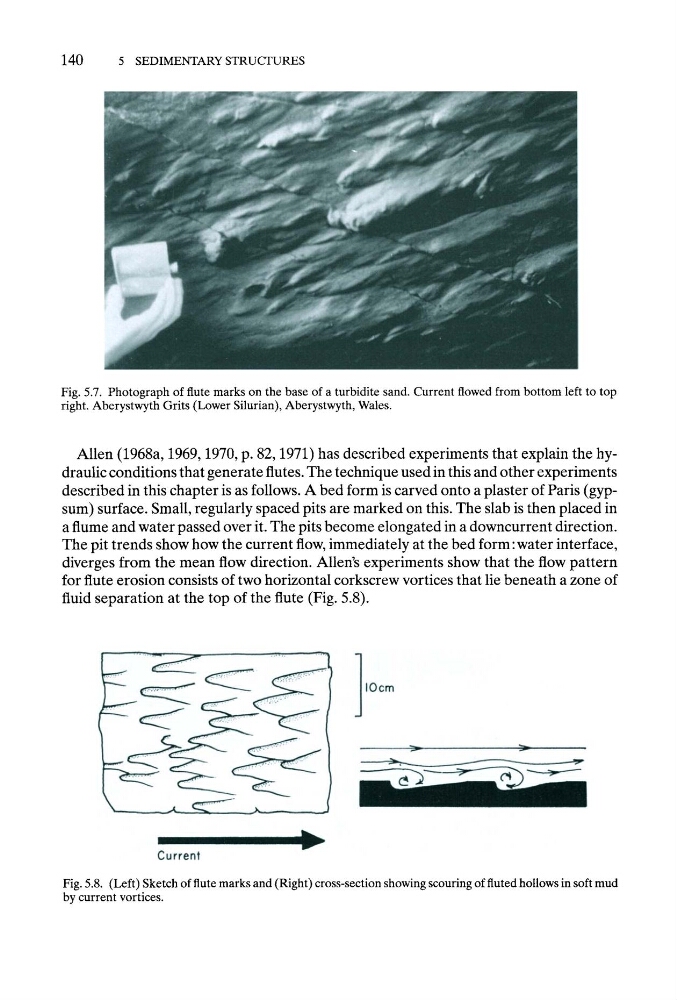
Fig. 5.7. Photograph of flute marks on the base of a turbidite sand. Current flowed from bottom left to top
right. Aberystwyth Grits (Lower Silurian), Aberystwyth, Wales.
Allen (1968a, 1969, 1970, p. 82, 1971) has described experiments that explain the hydraulic conditions that generate flutes. The technique used in this and other experiments
described in this chapter is as follows. A bed form is carved onto a plaster of Paris (gypsum) surface. Small, regularly spaced pits are marked on this. The slab is then placed in
a flume and water passed over it. The pits become elongated in a downcurrent direction.
The pit trends show how the current flow, immediately at the bed form:water interface,
diverges from the mean flow direction. Allen's experiments show that the flow pattern
for flute erosion consists of two horizontal corkscrew vortices that lie beneath a zone of
fluid separation at the top of the flute (Fig. 5.8).
Fig. 5.8. (Left) Sketch of flute marks and (Right) cross-section showing scouring of fluted hollows in soft mud
by current vortices.
5 SEDIMENTARY STRUCTURES
Fig. 5.7. Photograph of flute marks on the base of a turbidite sand. Current flowed from bottom left to top
right. Aberystwyth Grits (Lower Silurian), Aberystwyth, Wales.
Allen (1968a, 1969, 1970, p. 82, 1971) has described experiments that explain the hydraulic conditions that generate flutes. The technique used in this and other experiments
described in this chapter is as follows. A bed form is carved onto a plaster of Paris (gypsum) surface. Small, regularly spaced pits are marked on this. The slab is then placed in
a flume and water passed over it. The pits become elongated in a downcurrent direction.
The pit trends show how the current flow, immediately at the bed form:water interface,
diverges from the mean flow direction. Allen's experiments show that the flow pattern
for flute erosion consists of two horizontal corkscrew vortices that lie beneath a zone of
fluid separation at the top of the flute (Fig. 5.8).
Fig. 5.8. (Left) Sketch of flute marks and (Right) cross-section showing scouring of fluted hollows in soft mud
by current vortices.