

5.3 PRIMARY INORGANIC SEDIMENTARY STRUCTURES
141
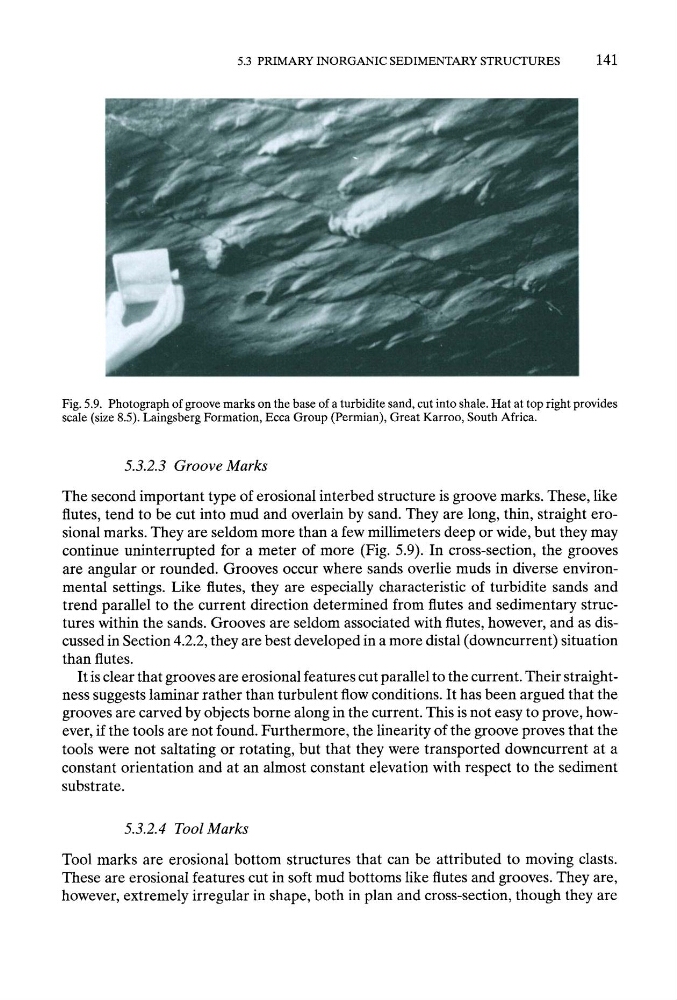
Fig. 5,9. Photograph of groove marks on the base of a turbidite sand, cut into shale. Hat at top right provides
scale (size 8.5). Laingsberg Formation, Ecca Group (Permian), Great Karroo, South Africa.
5.3.2.3 Groove Marks
The second important type of erosional interbed structure is groove marks. These, like
flutes, tend to be cut into mud and overlain by sand. They are long, thin, straight erosional marks. They are seldom more than a few millimeters deep or wide, but they may
continue uninterrupted for a meter of more (Fig. 5.9). In cross-section, the grooves
are angular or rounded. Grooves occur where sands overlie muds in diverse environmental settings. Like flutes, they are especially characteristic of turbidite sands and
trend parallel to the current direction determined from flutes and sedimentary structures within the sands. Grooves are seldom associated with flutes, however, and as discussed in Section 4.2.2, they are best developed in a more distal (downcurrent) situation
than flutes.
It is clear that grooves are erosional features cut parallel to the current. Their straightness suggests laminar rather than turbulent flow conditions. It has been argued that the
grooves are carved by objects borne along in the current. This is not easy to prove, however, if the tools are not found. Furthermore, the linearity of the groove proves that the
tools were not saltating or rotating, but that they were transported downcurrent at a
constant orientation and at an almost constant elevation with respect to the sediment
substrate.
5.3.2.4 ToolMarks
Tool marks are erosional bottom structures that can be attributed to moving clasts.
These are erosional features cut in soft mud bottoms like flutes and grooves. They are,
however, extremely irregular in shape, both in plan and cross-section, though they are
141
Fig. 5,9. Photograph of groove marks on the base of a turbidite sand, cut into shale. Hat at top right provides
scale (size 8.5). Laingsberg Formation, Ecca Group (Permian), Great Karroo, South Africa.
5.3.2.3 Groove Marks
The second important type of erosional interbed structure is groove marks. These, like
flutes, tend to be cut into mud and overlain by sand. They are long, thin, straight erosional marks. They are seldom more than a few millimeters deep or wide, but they may
continue uninterrupted for a meter of more (Fig. 5.9). In cross-section, the grooves
are angular or rounded. Grooves occur where sands overlie muds in diverse environmental settings. Like flutes, they are especially characteristic of turbidite sands and
trend parallel to the current direction determined from flutes and sedimentary structures within the sands. Grooves are seldom associated with flutes, however, and as discussed in Section 4.2.2, they are best developed in a more distal (downcurrent) situation
than flutes.
It is clear that grooves are erosional features cut parallel to the current. Their straightness suggests laminar rather than turbulent flow conditions. It has been argued that the
grooves are carved by objects borne along in the current. This is not easy to prove, however, if the tools are not found. Furthermore, the linearity of the groove proves that the
tools were not saltating or rotating, but that they were transported downcurrent at a
constant orientation and at an almost constant elevation with respect to the sediment
substrate.
5.3.2.4 ToolMarks
Tool marks are erosional bottom structures that can be attributed to moving clasts.
These are erosional features cut in soft mud bottoms like flutes and grooves. They are,
however, extremely irregular in shape, both in plan and cross-section, though they are