

138
5 SEDIMENTARY STRUCTURES
genesis of the various types of sedimentary structure in each of these four groupings are
described next.
5.3.2 Predepositional (Interbed) Structures
Predepositional sedimentary structures occur on surfaces between beds. They were
formed before the deposition of the overlying bed. The majority of this group of structures are erosional in origin. Before describing these structures, note two points. The
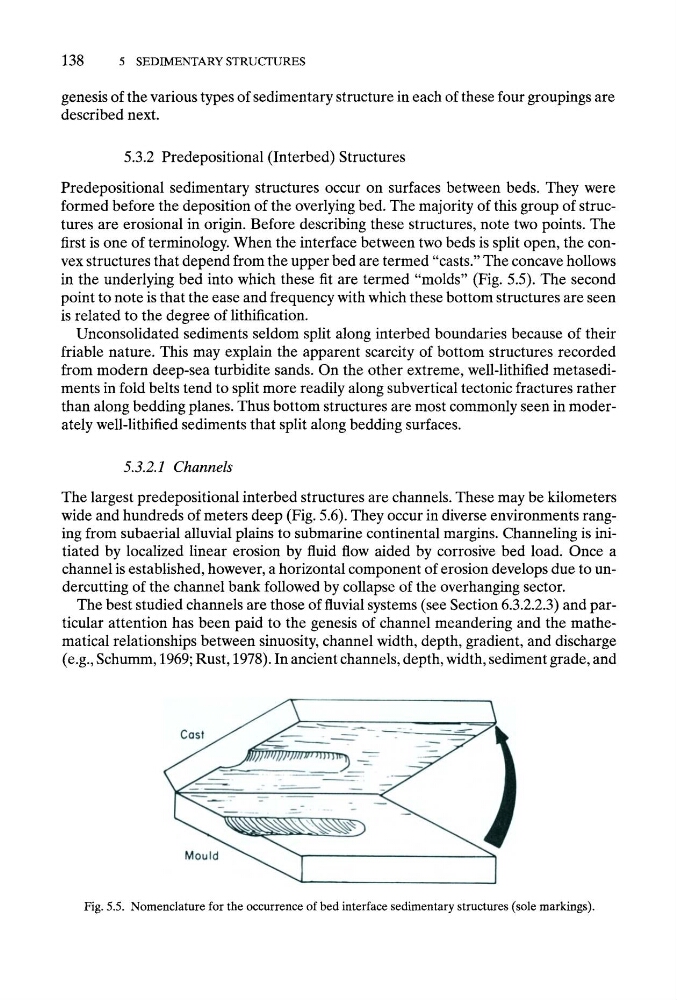
first is one of terminology. When the interface between two beds is split open, the convex structures that depend from the upper bed are termed "casts." The concave hollows
in the underlying bed into which these fit are termed "molds" (Fig. 5.5). The second
point to note is that the ease and frequency with which these bottom structures are seen
is related to the degree of lithification.
Unconsolidated sediments seldom split along interbed boundaries because of their
friable nature. This may explain the apparent scarcity of bottom structures recorded
from modern deep-sea turbidite sands. On the other extreme, well-lithified metasediments in fold belts tend to split more readily along subvertical tectonic fractures rather
than along bedding planes. Thus bottom structures are most commonly seen in moderately well-lithified sediments that split along bedding surfaces.
5.3.2.1 Channels
The largest predepositional interbed structures are channels. These may be kilometers
wide and hundreds of meters deep (Fig. 5.6). They occur in diverse environments ranging from subaerial alluvial plains to submarine continental margins. Channeling is initiated by localized linear erosion by fluid flow aided by corrosive bed load. Once a
channel is established, however, a horizontal component of erosion develops due to undercutting of the channel bank followed by collapse of the overhanging sector.
The best studied channels are those of fluvial systems (see Section 6.3.2.2.3) and particular attention has been paid to the genesis of channel meandering and the mathematical relationships between sinuosity, channel width, depth, gradient, and discharge
(e.g., Schumm, 1969; Rust, 1978). In ancient channels, depth, width, sediment grade, and
Fig. 5.5. Nomenclature for the occurrence of bed interface sedimentary structures (sole markings).
5 SEDIMENTARY STRUCTURES
genesis of the various types of sedimentary structure in each of these four groupings are
described next.
5.3.2 Predepositional (Interbed) Structures
Predepositional sedimentary structures occur on surfaces between beds. They were
formed before the deposition of the overlying bed. The majority of this group of structures are erosional in origin. Before describing these structures, note two points. The
first is one of terminology. When the interface between two beds is split open, the convex structures that depend from the upper bed are termed "casts." The concave hollows
in the underlying bed into which these fit are termed "molds" (Fig. 5.5). The second
point to note is that the ease and frequency with which these bottom structures are seen
is related to the degree of lithification.
Unconsolidated sediments seldom split along interbed boundaries because of their
friable nature. This may explain the apparent scarcity of bottom structures recorded
from modern deep-sea turbidite sands. On the other extreme, well-lithified metasediments in fold belts tend to split more readily along subvertical tectonic fractures rather
than along bedding planes. Thus bottom structures are most commonly seen in moderately well-lithified sediments that split along bedding surfaces.
5.3.2.1 Channels
The largest predepositional interbed structures are channels. These may be kilometers
wide and hundreds of meters deep (Fig. 5.6). They occur in diverse environments ranging from subaerial alluvial plains to submarine continental margins. Channeling is initiated by localized linear erosion by fluid flow aided by corrosive bed load. Once a
channel is established, however, a horizontal component of erosion develops due to undercutting of the channel bank followed by collapse of the overhanging sector.
The best studied channels are those of fluvial systems (see Section 6.3.2.2.3) and particular attention has been paid to the genesis of channel meandering and the mathematical relationships between sinuosity, channel width, depth, gradient, and discharge
(e.g., Schumm, 1969; Rust, 1978). In ancient channels, depth, width, sediment grade, and
Fig. 5.5. Nomenclature for the occurrence of bed interface sedimentary structures (sole markings).