

5.3 PRIMARY INORGANIC SEDIMENTARY STRUCTURES
137
Table 5.3
Classification of Inorganic Megascopic Primary Sedimentary Structures
Group
Examples
Origin
I. Predepositional
(interbed)
II. Syndepositional
(intrabed)
III. Postdepositional
(deform interbed
and intrabed
structures)
IV. Miscellaneous
Channels
Scour-and-fill
Flute marks
Groove marks
Tool marks
Massive
Flat-bedding (including
parting lineation)
Graded bedding
Cross-bedding
Lamination
Cross-lamination
Slump
Slide
Convolute lamination
Convolute bedding
Recumbent foresets
Load structures
Rain prints
Shrinkage cracks
Predominantly erosional
Predominantly depositional
Predominantly deformation
fication are already apparent from the preceding discussions. Atlases of sedimentary
structures, and attempts at their classification, have been made by Pettijohn and Potter
(1964), Gubler (1966), Conybeare and Crook (1968), Harms et al. (1982), Collinson and
Thompson (1988), and Ricci Lucchi (1995).
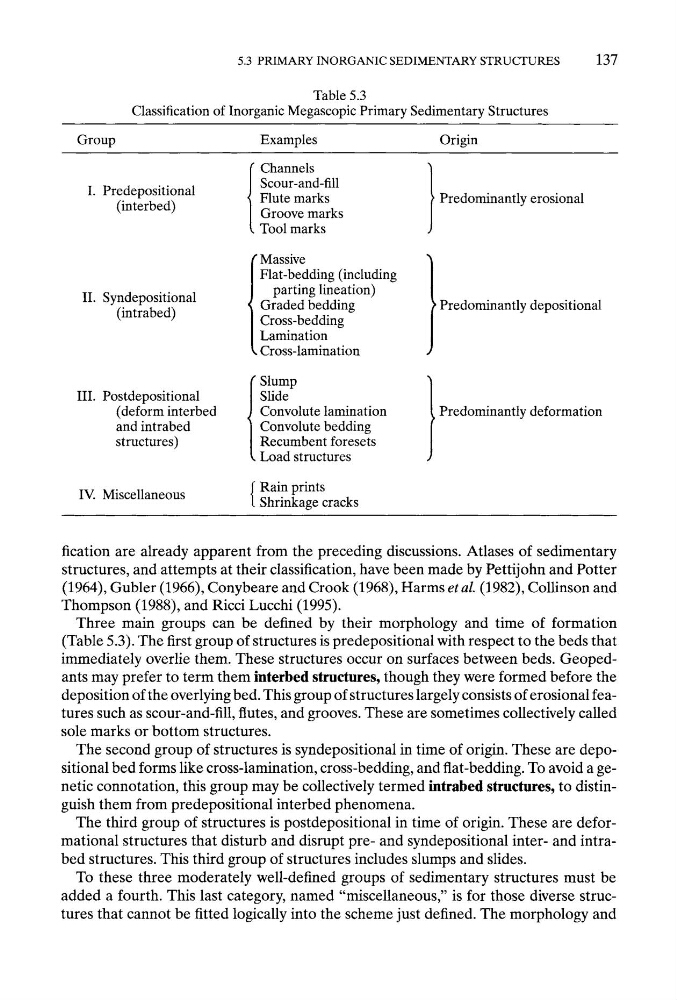
Three main groups can be defined by their morphology and time of formation
(Table 5.3). The first group of structures is predepositional with respect to the beds that
immediately overlie them. These structures occur on surfaces between beds. Geopedants may prefer to term them interbed structures, though they were formed before the
deposition of the overlying bed. This group of structures largely consists of erosional features such as scour-and-fill, flutes, and grooves. These are sometimes collectively called
sole marks or bottom structures.
The second group of structures is syndepositional in time of origin. These are depositional bed forms like cross-lamination, cross-bedding, and flat-bedding. To avoid a genetic connotation, this group may be collectively termed intrabed structures, to distinguish them from predepositional interbed phenomena.
The third group of structures is postdepositional in time of origin. These are deformational structures that disturb and disrupt pre- and syndepositional inter- and intrabed structures. This third group of structures includes slumps and slides.
To these three moderately well-defined groups of sedimentary structures must be
added a fourth. This last category, named "miscellaneous," is for those diverse structures that cannot be fitted logically into the scheme just defined. The morphology and
137
Table 5.3
Classification of Inorganic Megascopic Primary Sedimentary Structures
Group
Examples
Origin
I. Predepositional
(interbed)
II. Syndepositional
(intrabed)
III. Postdepositional
(deform interbed
and intrabed
structures)
IV. Miscellaneous
Channels
Scour-and-fill
Flute marks
Groove marks
Tool marks
Massive
Flat-bedding (including
parting lineation)
Graded bedding
Cross-bedding
Lamination
Cross-lamination
Slump
Slide
Convolute lamination
Convolute bedding
Recumbent foresets
Load structures
Rain prints
Shrinkage cracks
Predominantly erosional
Predominantly depositional
Predominantly deformation
fication are already apparent from the preceding discussions. Atlases of sedimentary
structures, and attempts at their classification, have been made by Pettijohn and Potter
(1964), Gubler (1966), Conybeare and Crook (1968), Harms et al. (1982), Collinson and
Thompson (1988), and Ricci Lucchi (1995).
Three main groups can be defined by their morphology and time of formation
(Table 5.3). The first group of structures is predepositional with respect to the beds that
immediately overlie them. These structures occur on surfaces between beds. Geopedants may prefer to term them interbed structures, though they were formed before the
deposition of the overlying bed. This group of structures largely consists of erosional features such as scour-and-fill, flutes, and grooves. These are sometimes collectively called
sole marks or bottom structures.
The second group of structures is syndepositional in time of origin. These are depositional bed forms like cross-lamination, cross-bedding, and flat-bedding. To avoid a genetic connotation, this group may be collectively termed intrabed structures, to distinguish them from predepositional interbed phenomena.
The third group of structures is postdepositional in time of origin. These are deformational structures that disturb and disrupt pre- and syndepositional inter- and intrabed structures. This third group of structures includes slumps and slides.
To these three moderately well-defined groups of sedimentary structures must be
added a fourth. This last category, named "miscellaneous," is for those diverse structures that cannot be fitted logically into the scheme just defined. The morphology and