

136
5 SEDIMENTARY STRUCTURES
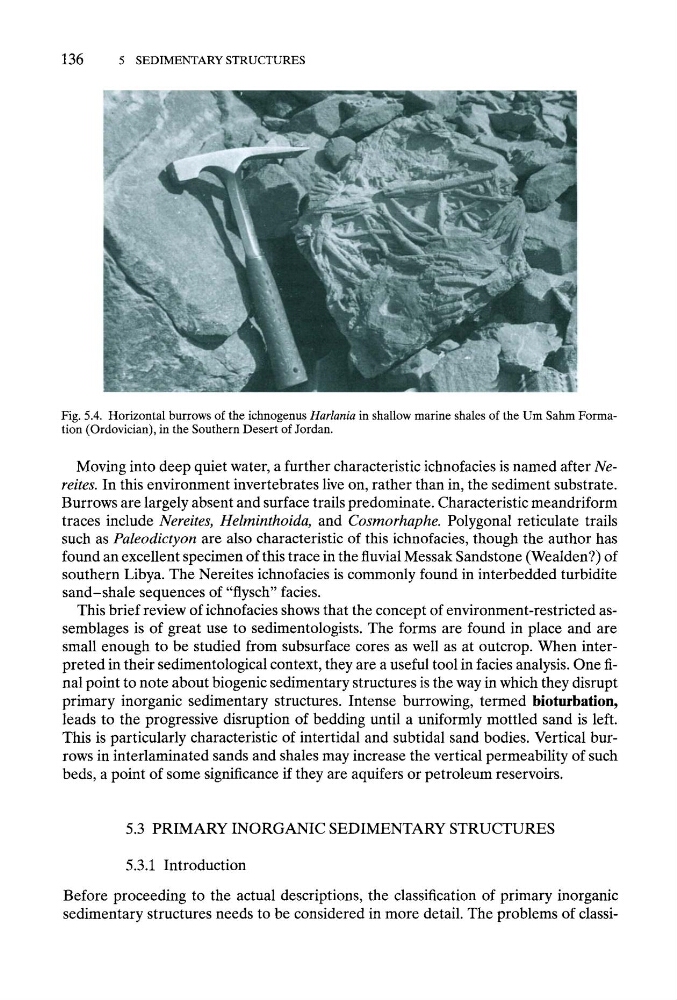
Fig. 5.4. Horizontal burrows of the ichnogenus Harlania in shallow marine shales of the Um Sahm Formation (Ordovician), in the Southern Desert of Jordan.
Moving into deep quiet water, a further characteristic ichnofacies is named after Nereites. In this environment invertebrates live on, rather than in, the sediment substrate.
Burrows are largely absent and surface trails predominate. Characteristic meandriform
traces include Nereites, Helminthoida, and Cosmorhaphe. Polygonal reticulate trails
such as Paleodictyon are also characteristic of this ichnofacies, though the author has
found an excellent specimen of this trace in the fluvial Messak Sandstone (Wealden?) of
southern Libya. The Nereites ichnofacies is commonly found in interbedded turbidite
sand-shale sequences of "flysch" facies.
This brief review of ichnofacies shows that the concept of environment-restricted assemblages is of great use to sedimentologists. The forms are found in place and are
small enough to be studied from subsurface cores as well as at outcrop. When interpreted in their sedimentological context, they are a useful tool in facies analysis. One final point to note about biogenic sedimentary structures is the way in which they disrupt
primary inorganic sedimentary structures. Intense burrowing, termed bioturbation,
leads to the progressive disruption of bedding until a uniformly mottled sand is left.
This is particularly characteristic of intertidal and subtidal sand bodies. Vertical burrows in interlaminated sands and shales may increase the vertical permeability of such
beds, a point of some significance if they are aquifers or petroleum reservoirs.
5.3 PRIMARY INORGANIC SEDIMENTARY STRUCTURES
5.3.1 Introduction
Before proceeding to the actual descriptions, the classification of primary inorganic
sedimentary structures needs to be considered in more detail. The problems of classi-
5 SEDIMENTARY STRUCTURES
Fig. 5.4. Horizontal burrows of the ichnogenus Harlania in shallow marine shales of the Um Sahm Formation (Ordovician), in the Southern Desert of Jordan.
Moving into deep quiet water, a further characteristic ichnofacies is named after Nereites. In this environment invertebrates live on, rather than in, the sediment substrate.
Burrows are largely absent and surface trails predominate. Characteristic meandriform
traces include Nereites, Helminthoida, and Cosmorhaphe. Polygonal reticulate trails
such as Paleodictyon are also characteristic of this ichnofacies, though the author has
found an excellent specimen of this trace in the fluvial Messak Sandstone (Wealden?) of
southern Libya. The Nereites ichnofacies is commonly found in interbedded turbidite
sand-shale sequences of "flysch" facies.
This brief review of ichnofacies shows that the concept of environment-restricted assemblages is of great use to sedimentologists. The forms are found in place and are
small enough to be studied from subsurface cores as well as at outcrop. When interpreted in their sedimentological context, they are a useful tool in facies analysis. One final point to note about biogenic sedimentary structures is the way in which they disrupt
primary inorganic sedimentary structures. Intense burrowing, termed bioturbation,
leads to the progressive disruption of bedding until a uniformly mottled sand is left.
This is particularly characteristic of intertidal and subtidal sand bodies. Vertical burrows in interlaminated sands and shales may increase the vertical permeability of such
beds, a point of some significance if they are aquifers or petroleum reservoirs.
5.3 PRIMARY INORGANIC SEDIMENTARY STRUCTURES
5.3.1 Introduction
Before proceeding to the actual descriptions, the classification of primary inorganic
sedimentary structures needs to be considered in more detail. The problems of classi-