

96
4 TRANSPORTATION AND SEDIMENTATION
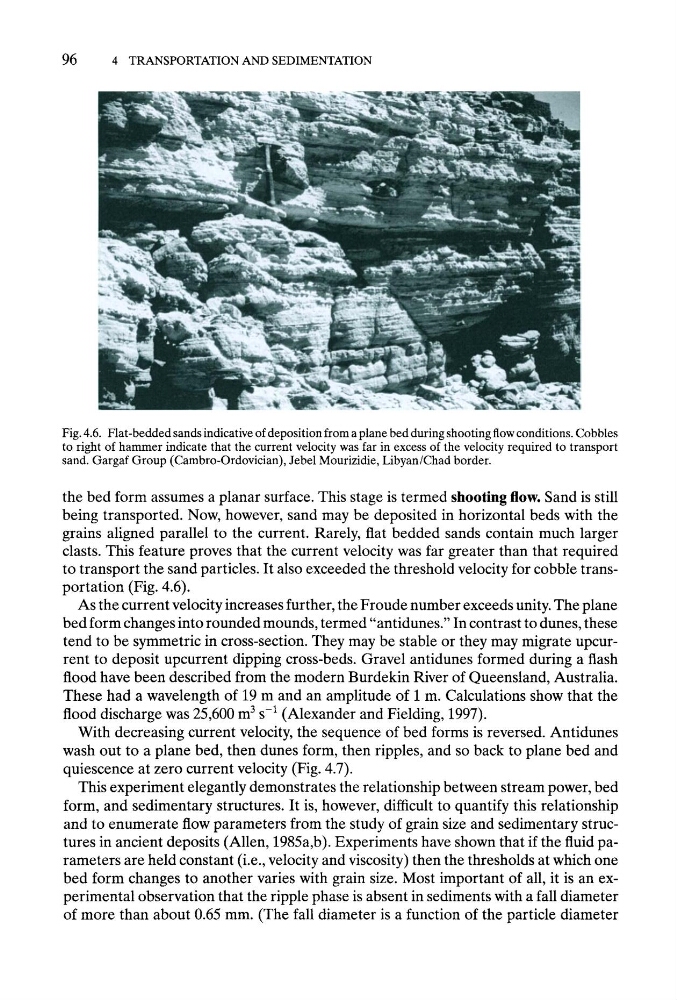
Fig. 4.6. Flat-bedded sands indicative of deposition from a plane bed during shooting flow conditions. Cobbles
to right of hammer indicate that the current velocity was far in excess of the velocity required to transport
sand. Gargaf Group (Cambro-Ordovician), Jebel Mourizidie, Libyan/Chad border.
the bed form assumes a planar surface. This stage is termed shooting flow. Sand is still
being transported. Now, however, sand may be deposited in horizontal beds with the
grains aligned parallel to the current. Rarely, flat bedded sands contain much larger
clasts. This feature proves that the current velocity was far greater than that required
to transport the sand particles. It also exceeded the threshold velocity for cobble transportation (Fig. 4.6).
As the current velocity increases further, the Froude number exceeds unity. The plane
bed form changes into rounded mounds, termed "antidunes." In contrast to dunes, these
tend to be symmetric in cross-section. They may be stable or they may migrate upcurrent to deposit upcurrent dipping cross-beds. Gravel antidunes formed during a flash
flood have been described from the modern Burdekin River of Queensland, Australia.
These had a wavelength of 19 m and an amplitude of 1 m. Calculations show that the
flood discharge was 25,600 m 3 s -1 (Alexander and Fielding, 1997).
With decreasing current velocity, the sequence of bed forms is reversed. Antidunes
wash out to a plane bed, then dunes form, then ripples, and so back to plane bed and
quiescence at zero current velocity (Fig. 4.7).
This experiment elegantly demonstrates the relationship between stream power, bed
form, and sedimentary structures. It is, however, difficult to quantify this relationship
and to enumerate flow parameters from the study of grain size and sedimentary structures in ancient deposits (Allen, 1985a,b). Experiments have shown that if the fluid parameters are held constant (i.e., velocity and viscosity) then the thresholds at which one
bed form changes to another varies with grain size. Most important of all, it is an experimental observation that the ripple phase is absent in sediments with a fall diameter
of more than about 0.65 mm. (The fall diameter is a function of the particle diameter
4 TRANSPORTATION AND SEDIMENTATION
Fig. 4.6. Flat-bedded sands indicative of deposition from a plane bed during shooting flow conditions. Cobbles
to right of hammer indicate that the current velocity was far in excess of the velocity required to transport
sand. Gargaf Group (Cambro-Ordovician), Jebel Mourizidie, Libyan/Chad border.
the bed form assumes a planar surface. This stage is termed shooting flow. Sand is still
being transported. Now, however, sand may be deposited in horizontal beds with the
grains aligned parallel to the current. Rarely, flat bedded sands contain much larger
clasts. This feature proves that the current velocity was far greater than that required
to transport the sand particles. It also exceeded the threshold velocity for cobble transportation (Fig. 4.6).
As the current velocity increases further, the Froude number exceeds unity. The plane
bed form changes into rounded mounds, termed "antidunes." In contrast to dunes, these
tend to be symmetric in cross-section. They may be stable or they may migrate upcurrent to deposit upcurrent dipping cross-beds. Gravel antidunes formed during a flash
flood have been described from the modern Burdekin River of Queensland, Australia.
These had a wavelength of 19 m and an amplitude of 1 m. Calculations show that the
flood discharge was 25,600 m 3 s -1 (Alexander and Fielding, 1997).
With decreasing current velocity, the sequence of bed forms is reversed. Antidunes
wash out to a plane bed, then dunes form, then ripples, and so back to plane bed and
quiescence at zero current velocity (Fig. 4.7).
This experiment elegantly demonstrates the relationship between stream power, bed
form, and sedimentary structures. It is, however, difficult to quantify this relationship
and to enumerate flow parameters from the study of grain size and sedimentary structures in ancient deposits (Allen, 1985a,b). Experiments have shown that if the fluid parameters are held constant (i.e., velocity and viscosity) then the thresholds at which one
bed form changes to another varies with grain size. Most important of all, it is an experimental observation that the ripple phase is absent in sediments with a fall diameter
of more than about 0.65 mm. (The fall diameter is a function of the particle diameter