

4.2 AQUEOUS PROCESSES
97
or"
o
U
F=--=>I
Dunes
~
Ripples
9 :..: .-~ ;....i~.......~
Plane bed
..
....._
U
F- r
Antidunes migrate
up-stream
-<1
Increasing current velocity
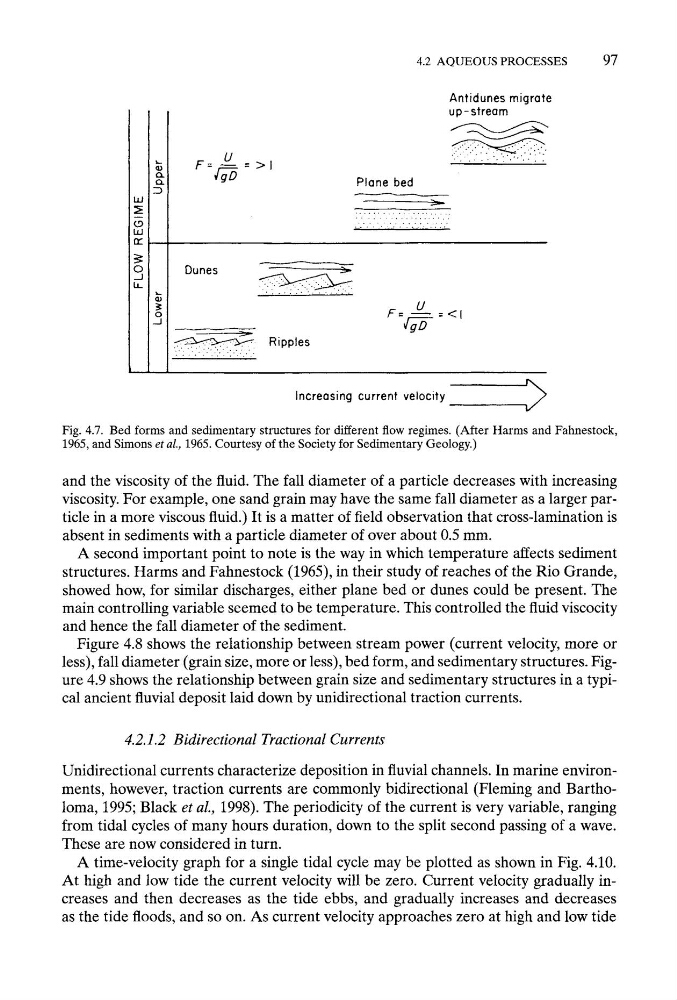
Fig. 4.7. Bed forms and sedimentary structures for different flow regimes. (After Harms and Fahnestock,
1965, and Simons et al., 1965. Courtesy of the Society for Sedimentary Geology.)
and the viscosity of the fluid. The fall diameter of a particle decreases with increasing
viscosity. For example, one sand grain may have the same fall diameter as a larger particle in a more viscous fluid.) It is a matter of field observation that cross-lamination is
absent in sediments with a particle diameter of over about 0.5 mm.
A second important point to note is the way in which temperature affects sediment
structures. Harms and Fahnestock (1965), in their study of reaches of the Rio Grande,
showed how, for similar discharges, either plane bed or dunes could be present. The
main controlling variable seemed to be temperature. This controlled the fluid viscocity
and hence the fall diameter of the sediment.
Figure 4.8 shows the relationship between stream power (current velocity, more or
less), fall diameter (grain size, more or less), bed form, and sedimentary structures. Figure 4.9 shows the relationship between grain size and sedimentary structures in a typical ancient fluvial deposit laid down by unidirectional traction currents.
4.2.1.2 Bidirectional Tractional Currents
Unidirectional currents characterize deposition in fluvial channels. In marine environments, however, traction currents are commonly bidirectional (Fleming and Bartholoma, 1995; Black et aL, 1998). The periodicity of the current is very variable, ranging
from tidal cycles of many hours duration, down to the split second passing of a wave.
These are now considered in turn.
A time-velocity graph for a single tidal cycle may be plotted as shown in Fig. 4.10.
At high and low tide the current velocity will be zero. Current velocity gradually increases and then decreases as the tide ebbs, and gradually increases and decreases
as the tide floods, and so on. As current velocity approaches zero at high and low tide
97
or"
o
U
F=--=>I
Dunes
~
Ripples
9 :..: .-~ ;....i~.......~
Plane bed
..
....._
U
F- r
Antidunes migrate
up-stream
-<1
Increasing current velocity
Fig. 4.7. Bed forms and sedimentary structures for different flow regimes. (After Harms and Fahnestock,
1965, and Simons et al., 1965. Courtesy of the Society for Sedimentary Geology.)
and the viscosity of the fluid. The fall diameter of a particle decreases with increasing
viscosity. For example, one sand grain may have the same fall diameter as a larger particle in a more viscous fluid.) It is a matter of field observation that cross-lamination is
absent in sediments with a particle diameter of over about 0.5 mm.
A second important point to note is the way in which temperature affects sediment
structures. Harms and Fahnestock (1965), in their study of reaches of the Rio Grande,
showed how, for similar discharges, either plane bed or dunes could be present. The
main controlling variable seemed to be temperature. This controlled the fluid viscocity
and hence the fall diameter of the sediment.
Figure 4.8 shows the relationship between stream power (current velocity, more or
less), fall diameter (grain size, more or less), bed form, and sedimentary structures. Figure 4.9 shows the relationship between grain size and sedimentary structures in a typical ancient fluvial deposit laid down by unidirectional traction currents.
4.2.1.2 Bidirectional Tractional Currents
Unidirectional currents characterize deposition in fluvial channels. In marine environments, however, traction currents are commonly bidirectional (Fleming and Bartholoma, 1995; Black et aL, 1998). The periodicity of the current is very variable, ranging
from tidal cycles of many hours duration, down to the split second passing of a wave.
These are now considered in turn.
A time-velocity graph for a single tidal cycle may be plotted as shown in Fig. 4.10.
At high and low tide the current velocity will be zero. Current velocity gradually increases and then decreases as the tide ebbs, and gradually increases and decreases
as the tide floods, and so on. As current velocity approaches zero at high and low tide