

4.2 AQUEOUS PROCESSES
95
4.2.1.1 Unidirectional Traction Currents
The basic approach to understanding traction-current sedimentation has been through
experimental studies of unidirectional flow in confined channels. These can be made in
artificial channels, termed flumes, which are now standard equipment in many geological laboratories. The phenomenon now to be described has been documented by Simons
et al. (1965) and is demonstrated as an integral part of many university courses on sedimentology. The experiment commences with the flume at rest. Sand on the flume floor
is fiat, current velocity is zero. Water is allowed to move down the flume at a gradually
increasing velocity. The sand grains begin to roll and saltate as the critical threshold velocity is crossed. The sand is sculpted into a rippled bed form. Steep slopes face downcurrent, gentle back slopes face upcurrent. Sand grains are eroded from the back slopes,
transported over the ripple crests to be deposited on the downstream slope or slip face.
Thus the ripples slowly move downstream depositing cross-laminated sand.
With increasing current velocity the bed form changes from ripples to dunes. These
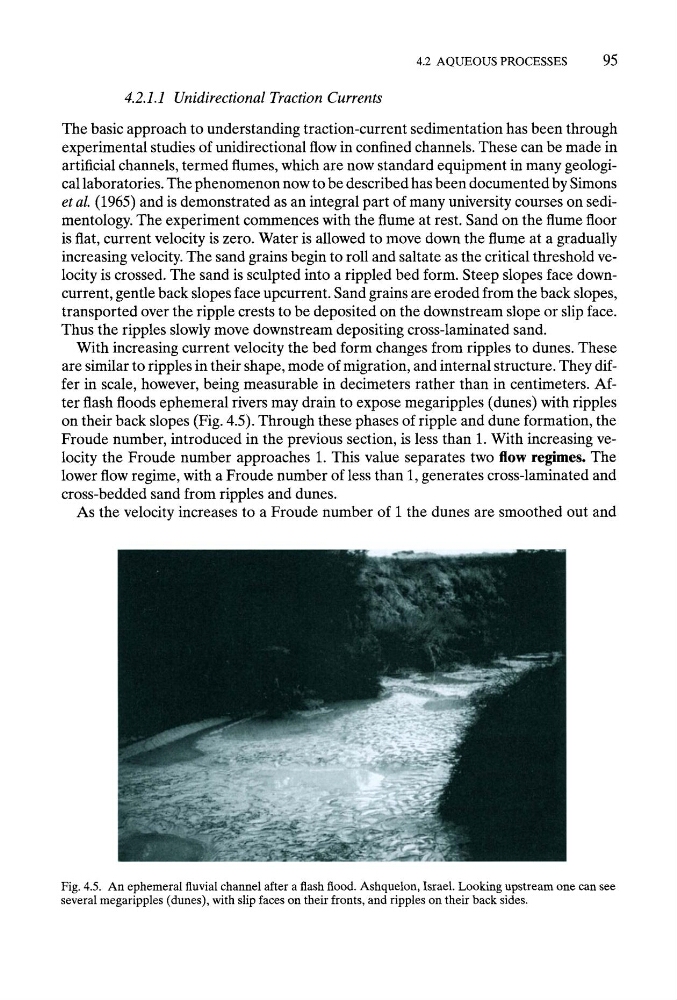
are similar to ripples in their shape, mode of migration, and internal structure. They differ in scale, however, being measurable in decimeters rather than in centimeters. After flash floods ephemeral rivers may drain to expose megaripples (dunes) with ripples
on their back slopes (Fig. 4.5). Through these phases of ripple and dune formation, the
Froude number, introduced in the previous section, is less than 1. With increasing velocity the Froude number approaches 1. This value separates two flow regimes. The
lower flow regime, with a Froude number of less than 1, generates cross-laminated and
cross-bedded sand from ripples and dunes.
As the velocity increases to a Froude number of 1 the dunes are smoothed out and
Fig. 4.5. An ephemeral fluvial channel after a flash flood. Ashquelon, Israel. Looking upstream one can see
several megaripples (dunes), with slip faces on their fronts, and ripples on their back sides.
95
4.2.1.1 Unidirectional Traction Currents
The basic approach to understanding traction-current sedimentation has been through
experimental studies of unidirectional flow in confined channels. These can be made in
artificial channels, termed flumes, which are now standard equipment in many geological laboratories. The phenomenon now to be described has been documented by Simons
et al. (1965) and is demonstrated as an integral part of many university courses on sedimentology. The experiment commences with the flume at rest. Sand on the flume floor
is fiat, current velocity is zero. Water is allowed to move down the flume at a gradually
increasing velocity. The sand grains begin to roll and saltate as the critical threshold velocity is crossed. The sand is sculpted into a rippled bed form. Steep slopes face downcurrent, gentle back slopes face upcurrent. Sand grains are eroded from the back slopes,
transported over the ripple crests to be deposited on the downstream slope or slip face.
Thus the ripples slowly move downstream depositing cross-laminated sand.
With increasing current velocity the bed form changes from ripples to dunes. These
are similar to ripples in their shape, mode of migration, and internal structure. They differ in scale, however, being measurable in decimeters rather than in centimeters. After flash floods ephemeral rivers may drain to expose megaripples (dunes) with ripples
on their back slopes (Fig. 4.5). Through these phases of ripple and dune formation, the
Froude number, introduced in the previous section, is less than 1. With increasing velocity the Froude number approaches 1. This value separates two flow regimes. The
lower flow regime, with a Froude number of less than 1, generates cross-laminated and
cross-bedded sand from ripples and dunes.
As the velocity increases to a Froude number of 1 the dunes are smoothed out and
Fig. 4.5. An ephemeral fluvial channel after a flash flood. Ashquelon, Israel. Looking upstream one can see
several megaripples (dunes), with slip faces on their fronts, and ripples on their back sides.