

94
4 TRANSPORTATION AND SEDIMENTATION
Table 4.1
Tabulation of Sedimentary Processes and Sediment Types Which They Generate
Subaerial
Subaqueous
Mass gravity transport
Glacial transport
Traction deposits
Density deposits
Suspension deposits
Traction deposits
Density (turbidity)
deposits
Suspension deposits
{ Subaerial }
Subaqueous
Predominantly cross-bedded sands
Nu~.es ardentes, etc.
Loess
Predominantly cross-bedded sands
Graded sands, silts and clays
Nepheloid clays
Generally unstratified poorly sorted
deposits of boulder to clay grade
(diamictites)
thermal layering, turbidity, or from differences in salinity in liquids. The result is for the
denser fluid to flow by gravity beneath the less dense fluid and to traverse the sediment
substrate. Geologically the most important density flow is the turbidity current, a predominantly subaqueous phenomenon. Eolian turbid flows include nudes ardentes and
certain types of high-velocity avalanches and mud flows. They are rare and not volumetrically significant depositional mechanisms. The fundamental differentiation of
many sediments into cross-bedded traction-current deposits and graded turbidites was
recognized by Bailey in 1930.
The third group of sedimentary deposits includes those that settle out from suspension. These are fine-grained silts and clays and include windblown silts, termed loess,
and the pelagic detrital muds or nepheloids of ocean basins.
A fourth major group of sediment types is the diamietites (Flint et al., 1960). These
are extremely poorly sorted rocks that show a complete range of grain size from boulders down to clay. Diamictites are formed both from glacial processes and also by mud
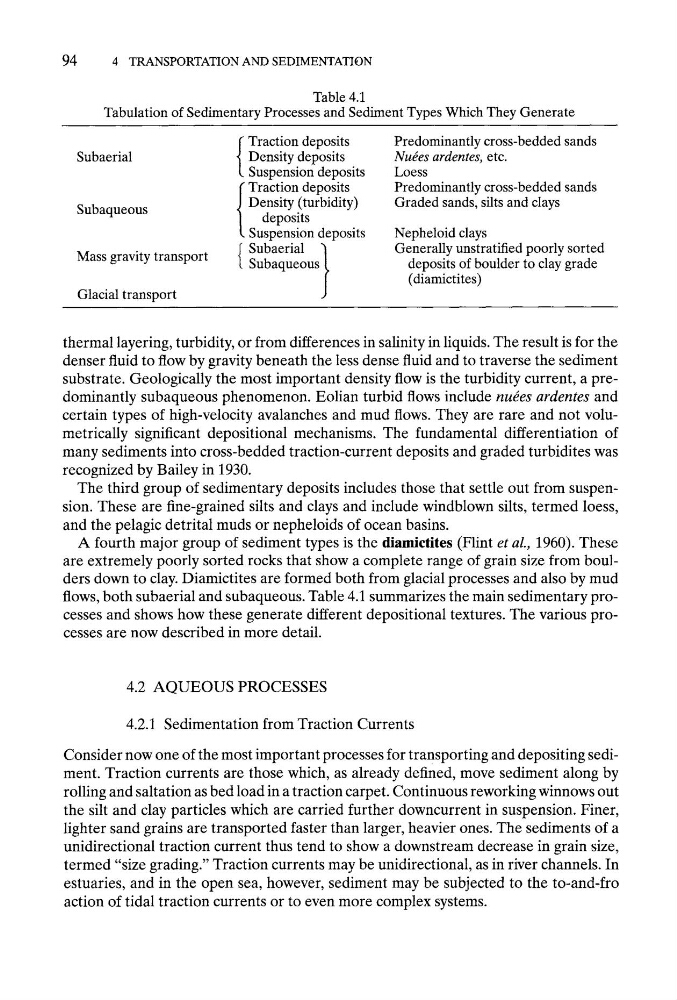
flows, both subaerial and subaqueous. Table 4.1 summarizes the main sedimentary processes and shows how these generate different depositional textures. The various processes are now described in more detail.
4.2 AQUEOUS PROCESSES
4.2.1 Sedimentation from Traction Currents
Consider now one of the most important processes for transporting and depositing sediment. Traction currents are those which, as already defined, move sediment along by
rolling and saltation as bed load in a traction carpet. Continuous reworking winnows out
the silt and clay particles which are carried further downcurrent in suspension. Finer,
lighter sand grains are transported faster than larger, heavier ones. The sediments of a
unidirectional traction current thus tend to show a downstream decrease in grain size,
termed "size grading." Traction currents may be unidirectional, as in river channels. In
estuaries, and in the open sea, however, sediment may be subjected to the to-and-fro
action of tidal traction currents or to even more complex systems.
4 TRANSPORTATION AND SEDIMENTATION
Table 4.1
Tabulation of Sedimentary Processes and Sediment Types Which They Generate
Subaerial
Subaqueous
Mass gravity transport
Glacial transport
Traction deposits
Density deposits
Suspension deposits
Traction deposits
Density (turbidity)
deposits
Suspension deposits
{ Subaerial }
Subaqueous
Predominantly cross-bedded sands
Nu~.es ardentes, etc.
Loess
Predominantly cross-bedded sands
Graded sands, silts and clays
Nepheloid clays
Generally unstratified poorly sorted
deposits of boulder to clay grade
(diamictites)
thermal layering, turbidity, or from differences in salinity in liquids. The result is for the
denser fluid to flow by gravity beneath the less dense fluid and to traverse the sediment
substrate. Geologically the most important density flow is the turbidity current, a predominantly subaqueous phenomenon. Eolian turbid flows include nudes ardentes and
certain types of high-velocity avalanches and mud flows. They are rare and not volumetrically significant depositional mechanisms. The fundamental differentiation of
many sediments into cross-bedded traction-current deposits and graded turbidites was
recognized by Bailey in 1930.
The third group of sedimentary deposits includes those that settle out from suspension. These are fine-grained silts and clays and include windblown silts, termed loess,
and the pelagic detrital muds or nepheloids of ocean basins.
A fourth major group of sediment types is the diamietites (Flint et al., 1960). These
are extremely poorly sorted rocks that show a complete range of grain size from boulders down to clay. Diamictites are formed both from glacial processes and also by mud
flows, both subaerial and subaqueous. Table 4.1 summarizes the main sedimentary processes and shows how these generate different depositional textures. The various processes are now described in more detail.
4.2 AQUEOUS PROCESSES
4.2.1 Sedimentation from Traction Currents
Consider now one of the most important processes for transporting and depositing sediment. Traction currents are those which, as already defined, move sediment along by
rolling and saltation as bed load in a traction carpet. Continuous reworking winnows out
the silt and clay particles which are carried further downcurrent in suspension. Finer,
lighter sand grains are transported faster than larger, heavier ones. The sediments of a
unidirectional traction current thus tend to show a downstream decrease in grain size,
termed "size grading." Traction currents may be unidirectional, as in river channels. In
estuaries, and in the open sea, however, sediment may be subjected to the to-and-fro
action of tidal traction currents or to even more complex systems.