

4.1 INTRODUCTION
93
1.00
E
tO
C
(o
o
m
Q;
> 0.1erosion and
suspension transport
no erosion
and suspension
transport
A,,
/,,,
no erosion and deposition
I
I
I
I
I
I
.01
.04
0.1
.4
1
4
1 0
Diameter in mm
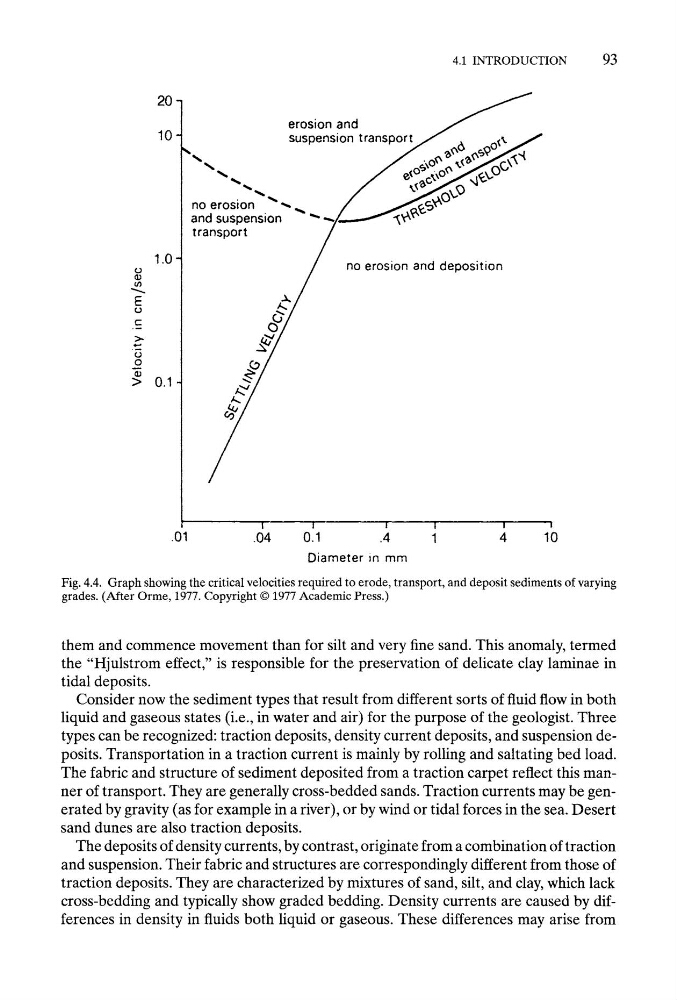
Fig. 4.4. Graph showing the critical velocities required to erode, transport, and deposit sediments of varying
grades. (After Orme, 1977. Copyright 9 1977 Academic Press.)
them and commence movement than for silt and very fine sand. This anomaly, termed
the "Hjulstrom effect," is responsible for the preservation of delicate clay laminae in
tidal deposits.
Consider now the sediment types that result from different sorts of fluid flow in both
liquid and gaseous states (i.e., in water and air) for the purpose of the geologist. Three
types can be recognized: traction deposits, density current deposits, and suspension deposits. Transportation in a traction current is mainly by rolling and saltating bed load.
The fabric and structure of sediment deposited from a traction carpet reflect this manner of transport. They are generally cross-bedded sands. Traction currents may be generated by gravity (as for example in a river), or by wind or tidal forces in the sea. Desert
sand dunes are also traction deposits.
The deposits of density currents, by contrast, originate from a combination of traction
and suspension. Their fabric and structures are correspondingly different from those of
traction deposits. They are characterized by mixtures of sand, silt, and clay, which lack
cross-bedding and typically show graded bedding. Density currents are caused by differences in density in fluids both liquid or gaseous. These differences may arise from
93
1.00
E
tO
C
(o
o
m
Q;
> 0.1erosion and
suspension transport
no erosion
and suspension
transport
A,,
/,,,
no erosion and deposition
I
I
I
I
I
I
.01
.04
0.1
.4
1
4
1 0
Diameter in mm
Fig. 4.4. Graph showing the critical velocities required to erode, transport, and deposit sediments of varying
grades. (After Orme, 1977. Copyright 9 1977 Academic Press.)
them and commence movement than for silt and very fine sand. This anomaly, termed
the "Hjulstrom effect," is responsible for the preservation of delicate clay laminae in
tidal deposits.
Consider now the sediment types that result from different sorts of fluid flow in both
liquid and gaseous states (i.e., in water and air) for the purpose of the geologist. Three
types can be recognized: traction deposits, density current deposits, and suspension deposits. Transportation in a traction current is mainly by rolling and saltating bed load.
The fabric and structure of sediment deposited from a traction carpet reflect this manner of transport. They are generally cross-bedded sands. Traction currents may be generated by gravity (as for example in a river), or by wind or tidal forces in the sea. Desert
sand dunes are also traction deposits.
The deposits of density currents, by contrast, originate from a combination of traction
and suspension. Their fabric and structures are correspondingly different from those of
traction deposits. They are characterized by mixtures of sand, silt, and clay, which lack
cross-bedding and typically show graded bedding. Density currents are caused by differences in density in fluids both liquid or gaseous. These differences may arise from