

17
However, its biology and basic ecology are still not fully understood (Archer et al.
1988 ; Van Auken and Bush 1989 , 1997 ; Bush and Van Auken 1991 , 1995 ; Archer
1994 ), although it has been extensively studied (see Browning and Archer 2011 ).
Various management strategies have been used to try to control it because it has
encroached into many C 4 grasslands, and there are a multitude of papers concerning
the results of control strategies (Scifres 1980 ; Heitschmidt and Struth 1991 ; Taylor
et al. 2012 ). Although Prosopis is worldwide in distribution and has been extensively studied, we will mostly compare it to Senegalia and Vachellia .
We will focus on the work done on V. farnesiana mainly from the southwestern
part of the USA and northern Mexico. The chronological appearance and function
of many of the woody legumes in these successional communities is still not completely understood. Vachellia , particularly V. farnesiana, and Prosopis glandulosa
look like early successional species that establishes on low nutrient or low nitrogen
soils (Van Auken et al. 1985 ; Archer et al. 1988 ) or in disturbances.
There are few studies that have demonstrated the presence of woody legumes
like V. farnesiana as pioneer or early successional species (Van Auken and Bush
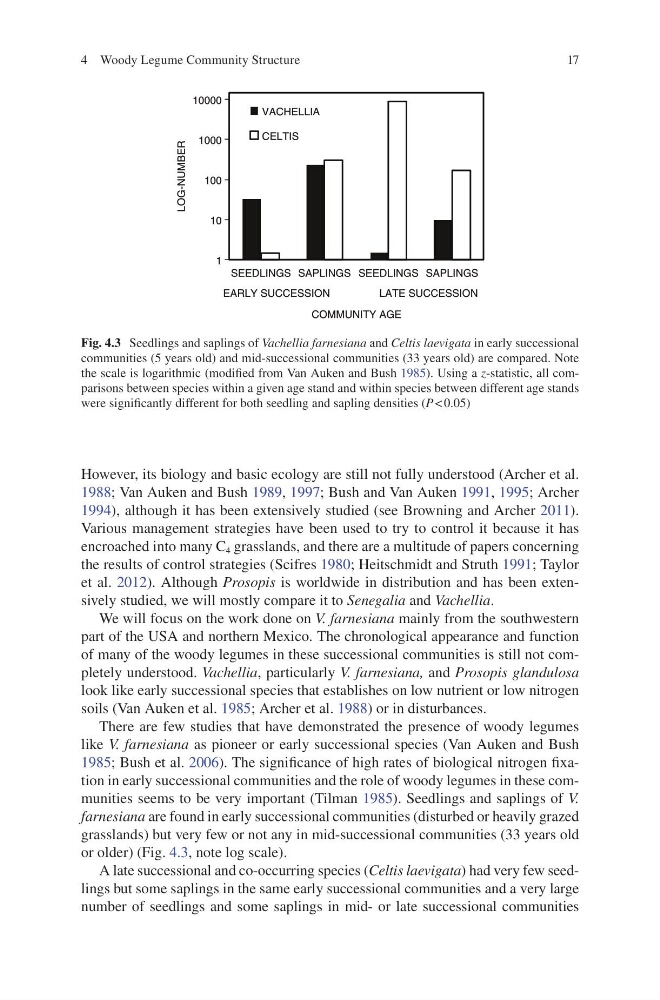
1985 ; Bush et al. 2006 ). The signifi cance of high rates of biological nitrogen fi xation in early successional communities and the role of woody legumes in these communities seems to be very important (Tilman 1985 ). Seedlings and saplings of V.
farnesiana are found in early successional communities (disturbed or heavily grazed
grasslands) but very few or not any in mid-successional communities (33 years old
or older) (Fig. 4.3 , note log scale).
A late successional and co-occurring species ( Celtis laevigata ) had very few seedlings but some saplings in the same early successional communities and a very large
number of seedlings and some saplings in mid- or late successional communities
1
10
100
1000
10000
SEEDLINGS SAPLINGS SEEDLINGS SAPLINGS
LOG-NUMBER
EARLY SUCCESSION
COMMUNITY AGE
VACHELLIA
CELTIS
LATE SUCCESSION
Fig. 4.3 Seedlings and saplings of Vachellia farnesiana and Celtis laevigata in early successional
communities (5 years old) and mid-successional communities (33 years old) are compared. Note
the scale is logarithmic (modifi ed from Van Auken and Bush 1985 ). Using a z -statistic, all comparisons between species within a given age stand and within species between different age stands
were signifi cantly different for both seedling and sapling densities ( P < 0.05)
4 Woody Legume Community Structure
However, its biology and basic ecology are still not fully understood (Archer et al.
1988 ; Van Auken and Bush 1989 , 1997 ; Bush and Van Auken 1991 , 1995 ; Archer
1994 ), although it has been extensively studied (see Browning and Archer 2011 ).
Various management strategies have been used to try to control it because it has
encroached into many C 4 grasslands, and there are a multitude of papers concerning
the results of control strategies (Scifres 1980 ; Heitschmidt and Struth 1991 ; Taylor
et al. 2012 ). Although Prosopis is worldwide in distribution and has been extensively studied, we will mostly compare it to Senegalia and Vachellia .
We will focus on the work done on V. farnesiana mainly from the southwestern
part of the USA and northern Mexico. The chronological appearance and function
of many of the woody legumes in these successional communities is still not completely understood. Vachellia , particularly V. farnesiana, and Prosopis glandulosa
look like early successional species that establishes on low nutrient or low nitrogen
soils (Van Auken et al. 1985 ; Archer et al. 1988 ) or in disturbances.
There are few studies that have demonstrated the presence of woody legumes
like V. farnesiana as pioneer or early successional species (Van Auken and Bush
1985 ; Bush et al. 2006 ). The signifi cance of high rates of biological nitrogen fi xation in early successional communities and the role of woody legumes in these communities seems to be very important (Tilman 1985 ). Seedlings and saplings of V.
farnesiana are found in early successional communities (disturbed or heavily grazed
grasslands) but very few or not any in mid-successional communities (33 years old
or older) (Fig. 4.3 , note log scale).
A late successional and co-occurring species ( Celtis laevigata ) had very few seedlings but some saplings in the same early successional communities and a very large
number of seedlings and some saplings in mid- or late successional communities
1
10
100
1000
10000
SEEDLINGS SAPLINGS SEEDLINGS SAPLINGS
LOG-NUMBER
EARLY SUCCESSION
COMMUNITY AGE
VACHELLIA
CELTIS
LATE SUCCESSION
Fig. 4.3 Seedlings and saplings of Vachellia farnesiana and Celtis laevigata in early successional
communities (5 years old) and mid-successional communities (33 years old) are compared. Note
the scale is logarithmic (modifi ed from Van Auken and Bush 1985 ). Using a z -statistic, all comparisons between species within a given age stand and within species between different age stands
were signifi cantly different for both seedling and sapling densities ( P < 0.05)
4 Woody Legume Community Structure