

18
(Fig. 4.3 ) (Van Auken and Bush 1985 ). Woody legumes like V. farnesiana that appear
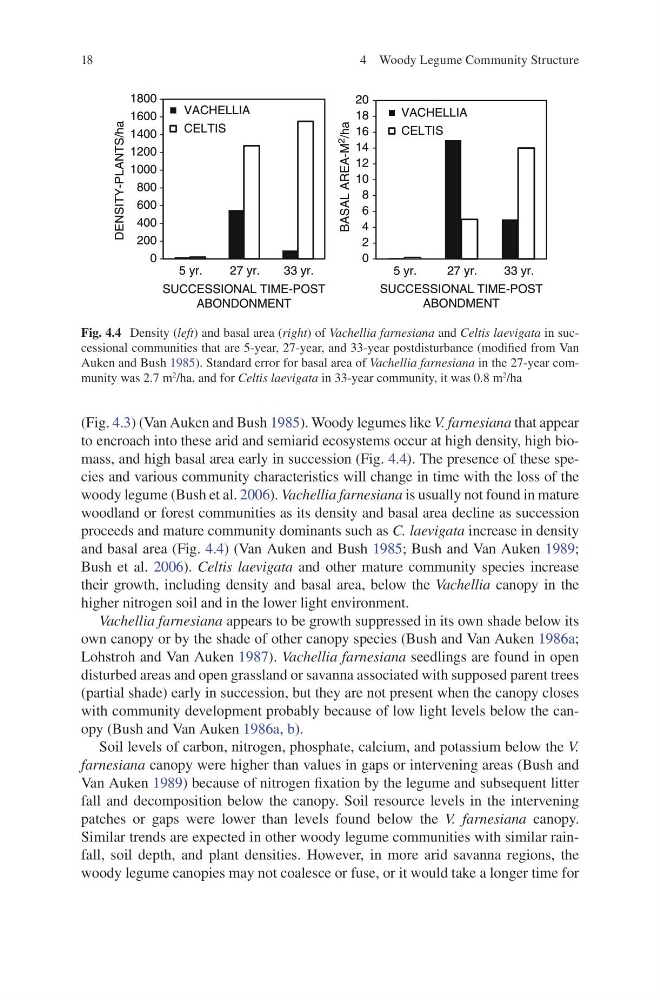
to encroach into these arid and semiarid ecosystems occur at high density, high biomass, and high basal area early in succession (Fig. 4.4 ). The presence of these species and various community characteristics will change in time with the loss of the
woody legume (Bush et al. 2006 ). Vachellia farnesiana is usually not found in mature
woodland or forest communities as its density and basal area decline as succession
proceeds and mature community dominants such as C. laevigata increase in density
and basal area (Fig. 4.4 ) (Van Auken and Bush 1985 ; Bush and Van Auken 1989 ;
Bush et al. 2006 ). Celtis laevigata and other mature community species increase
their growth, including density and basal area, below the Vachellia canopy in the
higher nitrogen soil and in the lower light environment.
Vachellia farnesiana appears to be growth suppressed in its own shade below its
own canopy or by the shade of other canopy species (Bush and Van Auken 1986a ;
Lohstroh and Van Auken 1987 ). Vachellia farnesiana seedlings are found in open
disturbed areas and open grassland or savanna associated with supposed parent trees
(partial shade) early in succession, but they are not present when the canopy closes
with community development probably because of low light levels below the canopy (Bush and Van Auken 1986a , b ).
Soil levels of carbon, nitrogen, phosphate, calcium, and potassium below the V.
farnesiana canopy were higher than values in gaps or intervening areas (Bush and
Van Auken 1989 ) because of nitrogen fi xation by the legume and subsequent litter
fall and decomposition below the canopy. Soil resource levels in the intervening
patches or gaps were lower than levels found below the V. farnesiana canopy.
Similar trends are expected in other woody legume communities with similar rainfall, soil depth, and plant densities. However, in more arid savanna regions, the
woody legume canopies may not coalesce or fuse, or it would take a longer time for
0
2
4
6
8
10
12
14
16
18
20
5 yr.
27 yr.
33 yr.
BASAL AREA-M
2
/ha
SUCCESSIONAL TIME-POST
ABONDMENT
VACHELLIA
CELTIS
0
200
400
600
800
1000
1200
1400
1600
1800
5 yr.
27 yr.
33 yr.
DENSITY-PLANTS/ha
SUCCESSIONAL TIME-POST
ABONDONMENT
VACHELLIA
CELTIS
Fig. 4.4 Density ( left ) and basal area ( right ) of Vachellia farnesiana and Celtis laevigata in successional communities that are 5-year, 27-year, and 33-year postdisturbance (modifi ed from Van
Auken and Bush 1985 ). Standard error for basal area of Vachellia farnesiana in the 27-year community was 2.7 m
2 /ha, and for Celtis laevigata in 33-year community, it was 0.8 m
2 /ha
4 Woody Legume Community Structure
(Fig. 4.3 ) (Van Auken and Bush 1985 ). Woody legumes like V. farnesiana that appear
to encroach into these arid and semiarid ecosystems occur at high density, high biomass, and high basal area early in succession (Fig. 4.4 ). The presence of these species and various community characteristics will change in time with the loss of the
woody legume (Bush et al. 2006 ). Vachellia farnesiana is usually not found in mature
woodland or forest communities as its density and basal area decline as succession
proceeds and mature community dominants such as C. laevigata increase in density
and basal area (Fig. 4.4 ) (Van Auken and Bush 1985 ; Bush and Van Auken 1989 ;
Bush et al. 2006 ). Celtis laevigata and other mature community species increase
their growth, including density and basal area, below the Vachellia canopy in the
higher nitrogen soil and in the lower light environment.
Vachellia farnesiana appears to be growth suppressed in its own shade below its
own canopy or by the shade of other canopy species (Bush and Van Auken 1986a ;
Lohstroh and Van Auken 1987 ). Vachellia farnesiana seedlings are found in open
disturbed areas and open grassland or savanna associated with supposed parent trees
(partial shade) early in succession, but they are not present when the canopy closes
with community development probably because of low light levels below the canopy (Bush and Van Auken 1986a , b ).
Soil levels of carbon, nitrogen, phosphate, calcium, and potassium below the V.
farnesiana canopy were higher than values in gaps or intervening areas (Bush and
Van Auken 1989 ) because of nitrogen fi xation by the legume and subsequent litter
fall and decomposition below the canopy. Soil resource levels in the intervening
patches or gaps were lower than levels found below the V. farnesiana canopy.
Similar trends are expected in other woody legume communities with similar rainfall, soil depth, and plant densities. However, in more arid savanna regions, the
woody legume canopies may not coalesce or fuse, or it would take a longer time for
0
2
4
6
8
10
12
14
16
18
20
5 yr.
27 yr.
33 yr.
BASAL AREA-M
2
/ha
SUCCESSIONAL TIME-POST
ABONDMENT
VACHELLIA
CELTIS
0
200
400
600
800
1000
1200
1400
1600
1800
5 yr.
27 yr.
33 yr.
DENSITY-PLANTS/ha
SUCCESSIONAL TIME-POST
ABONDONMENT
VACHELLIA
CELTIS
Fig. 4.4 Density ( left ) and basal area ( right ) of Vachellia farnesiana and Celtis laevigata in successional communities that are 5-year, 27-year, and 33-year postdisturbance (modifi ed from Van
Auken and Bush 1985 ). Standard error for basal area of Vachellia farnesiana in the 27-year community was 2.7 m
2 /ha, and for Celtis laevigata in 33-year community, it was 0.8 m
2 /ha
4 Woody Legume Community Structure