
 French

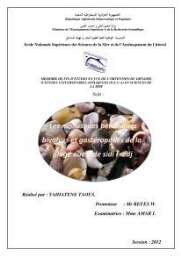
Les mollusques benthiques bivalves et gastéropodes de la plage ouest de Sidi-Fredj
Notice: Undefined property: stdClass::$Categories in /srv/www/limbgallery/current/public/themes/ENSSMAL_2/page-records/page-listing.php on line 190
Notice: Trying to get property 'title' of non-object in /srv/www/limbgallery/current/public/themes/ENSSMAL_2/page-records/page-listing.php on line 190
La plage ouest de sidi Fredj, à son tour, abrite elle aussi un nombre important d'espèces benthiques, parmi eux on retrouve un grand nombre de mollusques et particulièrement des bivalves et des gastéropodes qui font l'objectif de notre étude.
L'objectif de ce présent travail et de connaître et d'étudier les mollusques benthiques bivalves et gastéropodes des substrats meubles de la plage ouest de Sidi Fredj et de comparer leurs fréquences avec des résultats obtenus dans d'autres travaux réalisés anciennement sur différentes régions de la côte algérienne.
Lors de ce travail, les mollusques benthiques bivalves et gastéropodes des substrats meubles de la plage ouest de sidi Fredj ont été étudiés.
Les résultats obtenus dans cette étude montrent que les bivalves sont plus fréquents par rapport aux gastéropodes dans la plage ouest de sidi Fredj, ainsi que dans tous les milieux vus.
Une différence dans la répartition de ces espèces par station a également été remarquée.
Quelques stations ont une richesse spécifique très importante alors que dans d'autres stations une richesse moins importante a été calculée.
Le calcul de la fréquence et l'interprétation des résultats montre que dans la plage ouest de sidi Fredj c'est les espèces rares sont les plus fréquentes, et que la seule espèce constante vue dans ce milieu c'est l'espèce Chamelea gallina.
La comparaison des résultats obtenus dans ce travail avec des résultats obtenus dans d'autres travaux effectués sur des différentes régions de la cote algérienne a également été effectuée. Elle a fait apparaître 1p sensibilité de ces espèces benthiques aux variations des facteurs écologiques caractérisant chaque milieu.
Enfin, on dit que ces espèces étudiées, comme toutes les espèces benthiques ont des préférences pour le substrat, et que c'est les exigences écologiques des espèces benthiques qui définissent les limites de leur biotope.
Etudes de regime alimentaire de 03 raies ( Raia asterias, Dasyatis pastcnaca et Rhinobatos rhinobatos) du Golfe de Annaba
Notice: Undefined property: stdClass::$Categories in /srv/www/limbgallery/current/public/themes/ENSSMAL_2/page-records/page-listing.php on line 190
Notice: Trying to get property 'title' of non-object in /srv/www/limbgallery/current/public/themes/ENSSMAL_2/page-records/page-listing.php on line 190
Cet thèse est consacré a I'etude des diverses methode appliquees sur les contenus stomacaux des trois especes. Raja asterias et Dasyatis pas ten ac a et Rhinobatos rhinobatos nous permet de degagerplusieurs conclusions ;
. Le nombre d'estomacs vides est mil.
. Les resultats obtenus lors de Tetude des contenus stomacaux par la methode numerique, montrent que pour les trois especes etudier existe une variation qualitative.
. On peut decrire ces trois especes comme etant omnivore. II semblerait que Pasvatis pastenaca a un regime moins varie et nous pouvons constater que les poissons sont les proies prefcrentielles dans 1'alimentation de ces especes.
.la comparaison des differentes methodes permet de conclure que la methode numerique presente plusieurs avantages, car les resultats obtenus sont plus precis en effet:
- Elle nous permet de determiner des proies preferentielles et secondaires.
- Le nombre total des diverses proie de chaque estomac. Le nombre moyen de proie par estomac.
- Le taux d'evacuite des estomacs examines.
Etudes de regime alimentaire de 03 raies ( Raia asterias, Dasyatis pastcnaca et Rhinobatos rhinobatos) du Golfe de Annaba:
Notice: Undefined property: stdClass::$Categories in /srv/www/limbgallery/current/public/themes/ENSSMAL_2/page-records/page-listing.php on line 190
Notice: Trying to get property 'title' of non-object in /srv/www/limbgallery/current/public/themes/ENSSMAL_2/page-records/page-listing.php on line 190
Cet thèse est consacré a I'etude des diverses methode appliquees sur les contenus stomacaux des trois especes. Raja asterias et Dasyatis pas ten ac a et Rhinobatos rhinobatos nous permet de degagerplusieurs conclusions ;
. Le nombre d'estomacs vides est
Bulletin de la société d'histoire naturelle de l'Afrique du nord tome 26
Notice: Undefined property: stdClass::$Categories in /srv/www/limbgallery/current/public/themes/ENSSMAL_2/page-records/page-listing.php on line 190
Notice: Trying to get property 'title' of non-object in /srv/www/limbgallery/current/public/themes/ENSSMAL_2/page-records/page-listing.php on line 190
Le 15 décembre 1933, au cours d une excursion mycologique faite dans la forêt de Chênes lièges de l Alma, en compagnie de notre excellent
ami M. nous avons rencontré un très DOMABD, Champignon remarquable, ayant l aspect extérieur d un T1 chilom a, mais qui est, en réalité,, un
Hebeloma à spores incolores. Nous avons donc jugé utile d établir pour ce Champignon un genre nouveau,-Hebelomina, qui est aux Hebëloma ce
le Cor!inellus est aux Cortinarius. Duque genre diagnoses ,et de est inédite et nous avons le de dédier ' Du genre l espèce, qui que plaisir
51 M. DOMARD.Hebelomina R. Maire, n. gens. Habitus Tricholomaium; sporae haut in Hebelomatibzzs et Crassisulcelinae, amygdaliformes
mellarum acides pilis liformibus subclaviers exposais, ut in Hebelomaii bus,heteronmrpha. 'Hebèlomina Domardiana R. Maire, n. sp._ Carpophora solitaire ].
gregaria, Vix Nevis hydrophane; caro alba, [éviter amara, odore1n rapaceum laevem, intendum obsoletum, spirans. Spofae in cumulo tenui al
in cumulo crasso visae. terebae; non Stipes subaequalis, plus minusve exuosus, 3 4 cm longus, 5 6 crassus, cum pileo conuens, brososolidus sed niox ii1tus cute fibrillosocarnosus, plus minusve spongiosus,striata, sericea, adnata, sicca glabra ]. interdum léviter ocèoso-squamu- losa, sub lamellis valde pruinôs a, undique_ alba, vestitus, cum pileo vestigiis veli admodum carens. Pileus convexuS, demum applanatus,Obs'o -
lete 'unibonatus, 2,5 4 cm diam., praeter tennis, -discum crassiusculum_earn'osus, subfragilis; cutis léviter uisco_sa, 11sque ad discum plusnusve secernibilis, glabra, alba, in disco rufescens; margo in cùrVus, ])1'11iutrin Rosas, albus.*Lamellae c0nfertae, cum pileo conuentes, v<äntricosae,que plus milnùsve :rotundatae, adnatae leviter emarginatae, lat-iitsmtlae 'minusvedenticulata -interve (3 albae; acies plus p1 uinosa;
lamellulae adtenuatae,l. interdum subrotunda nulla; plus natio minusvetae.LamellarumaciesÏpilislongiSlif0rmibus,exuosis,apicesubcla- ,basi interdum inatis, permttis, 'confertis, 32 50 >< M= mem-braha tenui liyalina ,.--=interdùm apice mellezi et leviter.î11crassata,
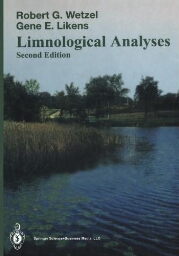
Limnological analyses
Notice: Undefined property: stdClass::$Categories in /srv/www/limbgallery/current/public/themes/ENSSMAL_2/page-records/page-listing.php on line 190
Notice: Trying to get property 'title' of non-object in /srv/www/limbgallery/current/public/themes/ENSSMAL_2/page-records/page-listing.php on line 190
In its third edition, this classic textbook is thoroughly updated with a series of carefully designed and tested field and laboratory exercises representing the full scope of limnology. Limn logical Analyses covers the physical, chemical, and biological characteristics of standing and running waters, and provides students with a solid foundation in this complex multidisciplinary field of ecology. The book illustrates accepted standard methods as well as modern metabolic and experimental approaches and their research applications, step-by-step exercises cover, at several levels of complexity, topics such as:
- major physical components of lakes and streams;
- important mineral and organic nutrients;
- cycling of organic matter;
- bacterial and fungal metabolism;
- benthic fauna;
- primary productivity of phytoplankton;
- protestant and zooplankton feeding and growth;
- quantitative methods in biotic analyses;
- diurnal changes;
- experimental manipulation of model ecosystems;
- effects of sewage outfall and other human activities;
- whole ecosystem and community analyses..
Each exercise is preceded by an introductory section and concludes with questions for the student and a selection of suggested readings. Instructors and students of limnology will value Limn logical Analyses for its highly structured, concise presentation and its research oriented approach that invites active participation. The methodology presented here will also be useful to aquatic resource managers, pollution and water-quality researchers, and all biologists studying the response of aquatic organisms to environmental changes.
Ecosystems of the deep oceans
Notice: Undefined property: stdClass::$Categories in /srv/www/limbgallery/current/public/themes/ENSSMAL_2/page-records/page-listing.php on line 190
Notice: Trying to get property 'title' of non-object in /srv/www/limbgallery/current/public/themes/ENSSMAL_2/page-records/page-listing.php on line 190
This volume is a review of where our knowledge stands at this point. All the chapters are written by authors on their respective subjects, all of whom are still practicing deep-sea biologists. The volume is divided into sections covering the environment of the deep sea, specific deep-water seas and oceans, and lastly a review of the processes that occur there. All the chapters have been peer-reviewed by the experts in deep-sea biology, to all of whom I extend my thanks for their care and advice. wish to say a special thank you to all authors. As I have said above, all are active research scientists, often working for extended periods at sea. I know their scientific lives are full, and I am delighted they were willing to write chapters and put up with my impatient prodding. I would also like to thank the series editor David good all for his advice, enthusiasm, patience and his unremitting courtesy when I failed to answer his requests! Lastly, I would like to express my sincere thanks to Lida de Maaijer Hoek of isys prepress services for her patience, good humor and sectional car in the desk dating of this volume.
Histological techniques for electron microscopy
Notice: Undefined property: stdClass::$Categories in /srv/www/limbgallery/current/public/themes/ENSSMAL_2/page-records/page-listing.php on line 190
Notice: Trying to get property 'title' of non-object in /srv/www/limbgallery/current/public/themes/ENSSMAL_2/page-records/page-listing.php on line 190
This is intended to be a very practical book for those who would study cells or tissues with an electron microscope. Although all the tools have been at hand for this sort of work for more than five years, effective work has been done in relatively few laboratories. In general this is because of the complexity of the techniques and the consequent lack of fully trained investigators; yet there is no one aspect of the problem that is particularly difficult in itself. But success depends upon attention to much detail, as well as knowledge and competence in widely diversified fields. The adage that "a chain is no stronger than its weakest link" is quite pertinent. To make successful electron micrographs of tissues one must preserve the specimens with skill, section them with art, use an electron microscope with understanding, and do photography with facility.
Except for a few "old timers" who grew up with the subject, most senior investigators who are doing effective work today apprenticed themselves at one of two laboratories, in the United States, at the Rockefeller Institute, in Europe, at the Karolinska Instituter. Of course with time new clones have been established, and there are now a number of "teaching laboratories" to which one can go for instruction and experience. No doubt, a year's apprenticeship in such laboratory can be the most efficient, effective, and stimulating way of becoming established in this field. But there are many who are interested, for various reasons find it impractical or impossible to serve this apprenticeship. It is to this group in particular that this volume is directed.
It should be possible for a novice to gain reasonable competence through his own ingenuity if he has a guidebook to help with the maze of detail. It will assist the beginner immensely if he can arrange to spend two or three days with someone competent in this field who will systematically go through all of the steps involved with him while he takes notes. This will, in essence, be a survey which will get the novice started. He should then go back to his own laboratory and work for a few weeks, or even months, as best he can with books and with whatever local help is available.
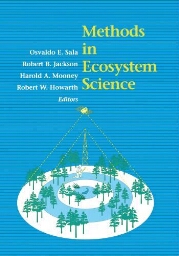
Methods in ecosystem science
Notice: Undefined property: stdClass::$Categories in /srv/www/limbgallery/current/public/themes/ENSSMAL_2/page-records/page-listing.php on line 190
Notice: Trying to get property 'title' of non-object in /srv/www/limbgallery/current/public/themes/ENSSMAL_2/page-records/page-listing.php on line 190
The present book entitled "methods in ecosystem science" consist of 26 chapters presented by 51 authors which are chemists, hydrologists, limnologists, soil scientists and other associated with ecology and environmental and resource sciences departments and schools rather than biology departments.
Ecology at the ecosystem level has both necessitated and benefited from new methods and technologies as well as those adapted from other disciplines. With the ascendancy of ecosystem science and management, the need has arisen for a comprehensive treatment of techniques used in this rapidly-growing field. Methods in ecosystem science answers that need by synthesizing the advantages, disadvantages and tradeoffs associated with the most commonly used techniques in both aquatic and terrestrial research.The book is divided into sections addressing carbon and energy dynamics, nutrient and water dynamics, manipulative ecosystem experiements and tools to synthesize our understanding of ecosystems. Detailed information about various methods will help researchers choose the most appropriate methods for their particular studies. Prominent scientists discuss how tools from a variety of disciplines can be used in ecosystem science at different scales.
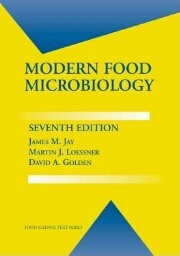
Modern food microbiology
Notice: Undefined property: stdClass::$Categories in /srv/www/limbgallery/current/public/themes/ENSSMAL_2/page-records/page-listing.php on line 190
Notice: Trying to get property 'title' of non-object in /srv/www/limbgallery/current/public/themes/ENSSMAL_2/page-records/page-listing.php on line 190
With 30 revised and updated chapters, the new edition of this classic text brings benefits to professors and students alike who will find new sections on proteobacteria, bottled water, food sanitizers (eletrolyzed oxidating water, ozone, chlorine, activin, chitosans, endolysins, etc.), bicontrol, biosensors quorum sensing, molecular genetic methods of analysis, food safety objectives, noroviruses, and prions. The book builds on the trusted and established sections on food preservation by modified atmosphere, high pressure and pulsed electric field processing, food-borne pathogens, food regulations, fresh-cut produce, new food products, and risk assessment and analysis. In-depth references, appendixes, illustrations, index and thorough updating of taxonomies make this an essential for every food
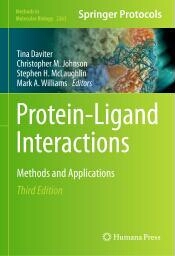
Protein-Ligand Interactions : Methods and Applications
Notice: Undefined property: stdClass::$Categories in /srv/www/limbgallery/current/public/themes/ENSSMAL_2/page-records/page-listing.php on line 190
Notice: Trying to get property 'title' of non-object in /srv/www/limbgallery/current/public/themes/ENSSMAL_2/page-records/page-listing.php on line 190
This third edition provides new and updated chapters detailing a complete introduction to common and emerging procedures for characterizing the interactions of individual proteins with their natural ligands, drugs or other binding partners. Chapters detail natural substrates, potential drug leads, quantitative understanding of the mechanism of interaction, and different techniques. Written in the highly successful Methods in Molecular Biology series format, chapters include introductions to their respective topics, lists of the necessary materials and reagents, step-by-step, readily reproducible laboratory protocols, and tips on troubleshooting and avoiding known pitfalls. Authoritative and accessible, Protein Ligand Interactions: Methods and Applications, Third Edition serves as an ideal guide for researchers new to the field of biophysical characterization of protein interactions.
Les mollusques benthiques bivalves et gastéropodes de la plage ouest de Sidi-Fredj
- Sujet
- Les mollusques benthiques bivalves et gastéropodes de la plage ouest de Sidi Fredj
- Cote
- 594.326 53 YAH/M
- Date_TXT
- 2012-01-01
- Type de document
- Thèse
- Ville
- Dely-Brahim - Alger
- Lieu de soutennance
- ENSSMAL
Etudes de regime alimentaire de 03 raies ( Raia asterias, Dasyatis pastcnaca et Rhinobatos rhinobatos) du Golfe de Annaba
- Sujet
- Etudes de regime alimentaire de 03 raies Raia asterias Dasyatis pastcnaca et Rhinobatos rhinobatos du Golfe de Annaba
- Cote
- 597.356 55 IDD/M
- Date_TXT
- 2012-01-01
- Type de document
- Thèse
- Ville
- Dely-Brahim - Alger
- Lieu de soutennance
- ENSSMAL
Etudes de regime alimentaire de 03 raies ( Raia asterias, Dasyatis pastcnaca et Rhinobatos rhinobatos) du Golfe de Annaba:
- Auteur
- Idder, Abdalekader
- Sujet
- Etudes de regime alimentaire de 03 raies Raia asterias Dasyatis pastcnaca et Rhinobatos rhinobatos du Golfe de Annaba
- Cote
- 597.356 55 IDD/M
- Type de document
- Thèse
- Lieu de soutennance
- Alger
Bulletin de la société d'histoire naturelle de l'Afrique du nord tome 26
- Auteur
- Feldmann, J.
- Sujet
- Histoire naturelle ; Bulletin ; Afrique du Nord
- Cote
- 590 FEL
- Date_TXT
- 1935
- Type de document
- Livre
Limnological analyses
- Auteur
- Robert G. Wetzel, Gene E. Likens
- Sujet
- Analyses ; Limnologie
- Cote
- 551.48 WET
- Date_TXT
- New york : Springer , 2000
- Type de document
- Livre
Ecosystems of the deep oceans
- Auteur
- Tyler, P. A
- Sujet
- Ocean primitif ; Ecosystems
- Cote
- 577.1 TYL
- Date_TXT
- London :London , 2003
- Type de document
- Livre
Histological techniques for electron microscopy
- Auteur
- Pease, Daniel C
- Sujet
- Techniques ; Microscopie ; Histologie
- Cote
- 571.59 PEA
- Date_TXT
- New York : Academic press inc , 1964
- Type de document
- Livre
Methods in ecosystem science
- Auteur
- Jackson, B. Robert
- Sujet
- Carbon ; Nutrient ; Energy dynamics ; Water dynamics ; Manipulative ecosystem experiments
- Cote
- 577.1 JAC
- Date_TXT
- USA : Springer , 2000
- Type de document
- Livre
Modern food microbiology
- Auteur
- Jay James Monroe
- Sujet
- Food; Microbiology ; Microbiologie alimentaire
- Date_TXT
- New York : Springer ,2005
- Type de document
- Livre
Protein-Ligand Interactions : Methods and Applications
- Auteur
- Daviter Tina
- Sujet
- Biologie cellulaire ; Biologie cellulaire
- Date_TXT
- New York, NY : Springer US, 2021
- Type de document
- Livre