

confirm that CAL is constituted mostly by Ca, C and O. Although other
elements, such as Mg, Si, Al, and Fe are detected, accounting for very
small amounts compared to the primary elements. For CAL/TiO 2
system, in addition to the previous primary elements (i.e. Ca, C and O)
and other elements found in the raw material, EDX analysis confirmed
the presence of TiO 2 . We can also notice an increase in TiO 2 content
incorporated into the raw material according to synthesis parameters;
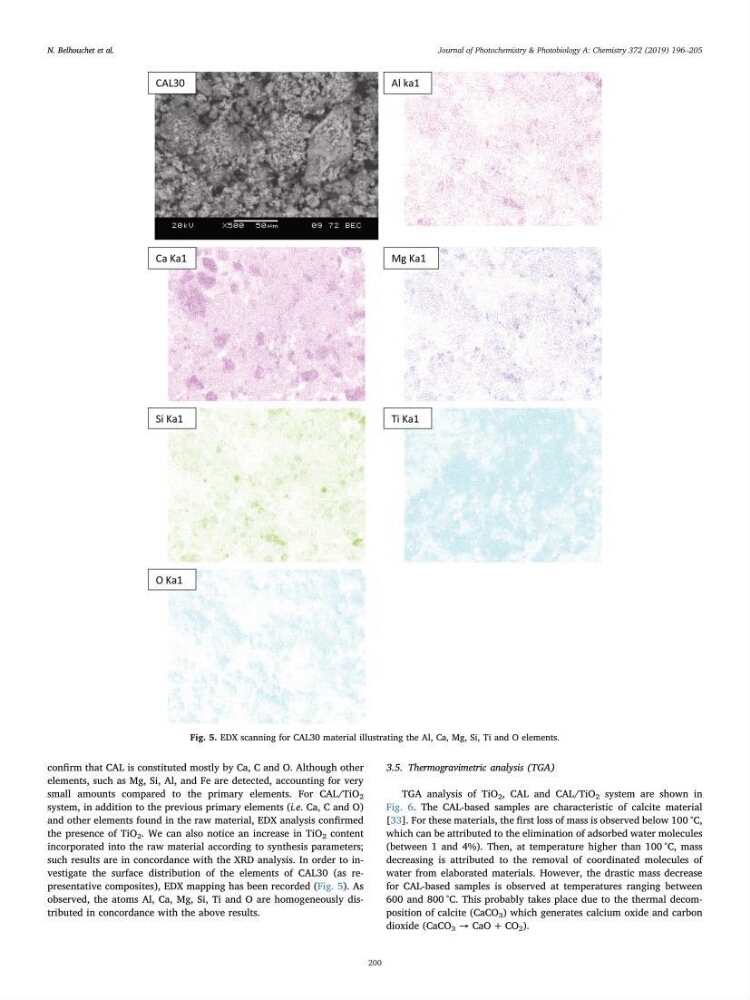
such results are in concordance with the XRD analysis. In order to investigate the surface distribution of the elements of CAL30 (as representative composites), EDX mapping has been recorded (Fig. 5). As
observed, the atoms Al, Ca, Mg, Si, Ti and O are homogeneously distributed in concordance with the above results.
3.5. Thermogravimetric analysis (TGA)
TGA analysis of TiO 2 , CAL and CAL/TiO 2 system are shown in
Fig. 6. The CAL-based samples are characteristic of calcite material
[33]. For these materials, the first loss of mass is observed below 100 °C,
which can be attributed to the elimination of adsorbed water molecules
(between 1 and 4%). Then, at temperature higher than 100 °C, mass
decreasing is attributed to the removal of coordinated molecules of
water from elaborated materials. However, the drastic mass decrease
for CAL-based samples is observed at temperatures ranging between
600 and 800 °C. This probably takes place due to the thermal decomposition of calcite (CaCO 3 ) which generates calcium oxide and carbon
dioxide (CaCO 3 → CaO + CO 2 ).
Fig. 5. EDX scanning for CAL30 material illustrating the Al, Ca, Mg, Si, Ti and O elements.
N. Belhouchet et al.
Journal of Photochemistry & Photobiology A: Chemistry 372 (2019) 196–205
200
elements, such as Mg, Si, Al, and Fe are detected, accounting for very
small amounts compared to the primary elements. For CAL/TiO 2
system, in addition to the previous primary elements (i.e. Ca, C and O)
and other elements found in the raw material, EDX analysis confirmed
the presence of TiO 2 . We can also notice an increase in TiO 2 content
incorporated into the raw material according to synthesis parameters;
such results are in concordance with the XRD analysis. In order to investigate the surface distribution of the elements of CAL30 (as representative composites), EDX mapping has been recorded (Fig. 5). As
observed, the atoms Al, Ca, Mg, Si, Ti and O are homogeneously distributed in concordance with the above results.
3.5. Thermogravimetric analysis (TGA)
TGA analysis of TiO 2 , CAL and CAL/TiO 2 system are shown in
Fig. 6. The CAL-based samples are characteristic of calcite material
[33]. For these materials, the first loss of mass is observed below 100 °C,
which can be attributed to the elimination of adsorbed water molecules
(between 1 and 4%). Then, at temperature higher than 100 °C, mass
decreasing is attributed to the removal of coordinated molecules of
water from elaborated materials. However, the drastic mass decrease
for CAL-based samples is observed at temperatures ranging between
600 and 800 °C. This probably takes place due to the thermal decomposition of calcite (CaCO 3 ) which generates calcium oxide and carbon
dioxide (CaCO 3 → CaO + CO 2 ).
Fig. 5. EDX scanning for CAL30 material illustrating the Al, Ca, Mg, Si, Ti and O elements.
N. Belhouchet et al.
Journal of Photochemistry & Photobiology A: Chemistry 372 (2019) 196–205
200