

4
Haddadi et al. - Growth and assessment parameters of Calappa granulata in Algerian coast
Table 3. Asymptotic weight and calculated parameters from the
ELEFAN program.
Parameters SS
SL
(mm)
L∞
(mm)
K
(yr
-1
)
Esp/Asp
W∞
(g)
Values
1
84
102.5 0.31
0.495
406.7
SS : Starting sample ; SL : Starting length
The K-scan label provides a starting length of 84mm and
a starting sample numbered 1. The L∞/K couple with the
highest score “Rn” is (L∞ = 102.5 mm and K = 0.31yr
-1
)
with a score of 0.495. This implies a W∞ valued 406.7g. Von
Bertalanffy’s linear equation of growth for this species is
presented as follows : Lc = 102.5 * (1 – e
-0,31 (t + 0,38)
)
Mortality parameters
Growth parameters for this species were used as a basis for
the calculation of mortality parameters. All of ; the natural
mortality M calculated by Pauly’s empirical equation (1980),
the total mortality estimated by the Pauly’s method (1984),
and the fishing mortality deduced from these two indices, are
shown in table 4.
Table 4. Calculated mortality parameters for the studied C. granulata.
Parameters
M (yr
-1
)
Z (yr
-1
)
F (yr
-1
)
F/Z
Values
0.41
1.94
1.53
0.78
None of these parameters related to the studied species has
been carried out before, so it is impossible to make any
comparison. The values mentioned in the table are specific
to the studied area. They may vary from one area to another,
and there are several factors that affect this variation such as
fishing activities, predation and nutrition.
Selection parameters
The selection parameters of C. granulata are also estimated
with the aim of having a view of the different lengths of
captures probability.
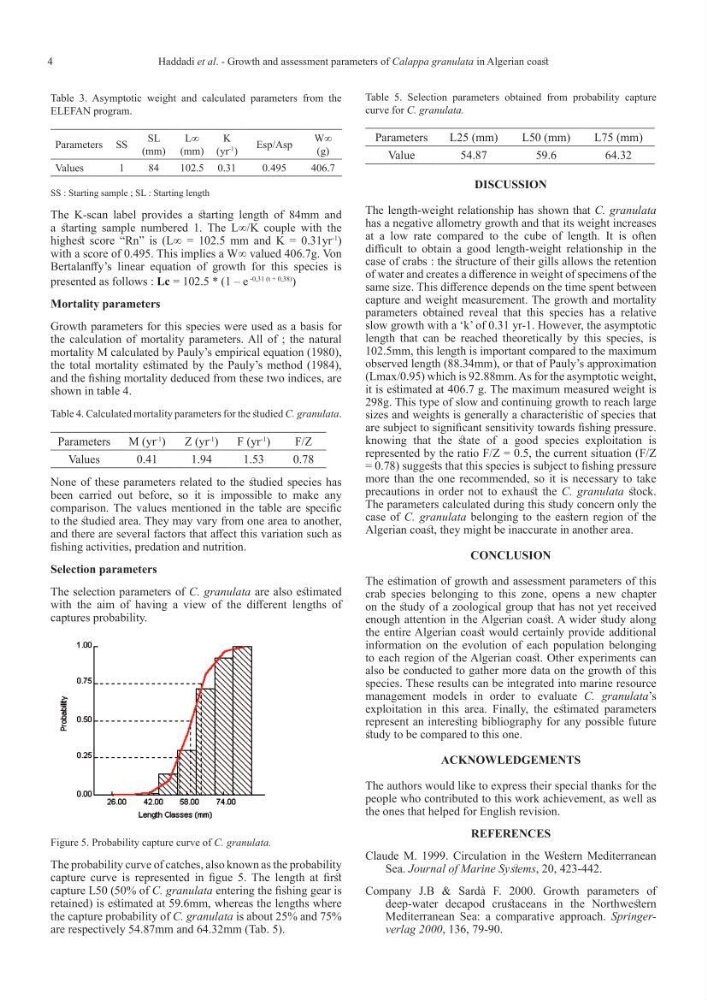
Figure 5. Probability capture curve of C. granulata.
The probability curve of catches, also known as the probability
capture curve is represented in figue 5. The length at first
capture L50 (50% of C. granulata entering the fishing gear is
retained) is estimated at 59.6mm, whereas the lengths where
the capture probability of C. granulata is about 25% and 75%
are respectively 54.87mm and 64.32mm (Tab. 5).
Table 5. Selection parameters obtained from probability capture
curve for C. granulata.
Parameters
L25 (mm)
L50 (mm)
L75 (mm)
Value
54.87
59.6
64.32
DISCUSSION
The length-weight relationship has shown that C. granulata
has a negative allometry growth and that its weight increases
at a low rate compared to the cube of length. It is often
difficult to obtain a good length-weight relationship in the
case of crabs : the structure of their gills allows the retention
of water and creates a difference in weight of specimens of the
same size. This difference depends on the time spent between
capture and weight measurement. The growth and mortality
parameters obtained reveal that this species has a relative
slow growth with a ‘k’ of 0.31 yr-1. However, the asymptotic
length that can be reached theoretically by this species, is
102.5mm, this length is important compared to the maximum
observed length (88.34mm), or that of Pauly’s approximation
(Lmax/0.95) which is 92.88mm. As for the asymptotic weight,
it is estimated at 406.7 g. The maximum measured weight is
298g. This type of slow and continuing growth to reach large
sizes and weights is generally a characteristic of species that
are subject to significant sensitivity towards fishing pressure.
knowing that the state of a good species exploitation is
represented by the ratio F/Z = 0.5, the current situation (F/Z
= 0.78) suggests that this species is subject to fishing pressure
more than the one recommended, so it is necessary to take
precautions in order not to exhaust the C. granulata stock.
The parameters calculated during this study concern only the
case of C. granulata belonging to the eastern region of the
Algerian coast, they might be inaccurate in another area.
CONCLUSION
The estimation of growth and assessment parameters of this
crab species belonging to this zone, opens a new chapter
on the study of a zoological group that has not yet received
enough attention in the Algerian coast. A wider study along
the entire Algerian coast would certainly provide additional
information on the evolution of each population belonging
to each region of the Algerian coast. Other experiments can
also be conducted to gather more data on the growth of this
species. These results can be integrated into marine resource
management models in order to evaluate C. granulata’s
exploitation in this area. Finally, the estimated parameters
represent an interesting bibliography for any possible future
study to be compared to this one.
ACKNOWLEDGEMENTS
The authors would like to express their special thanks for the
people who contributed to this work achievement, as well as
the ones that helped for English revision.
REFERENCES
Claude M. 1999. Circulation in the Western Mediterranean
Sea. Journal of Marine Systems, 20, 423-442.
Company J.B & Sardà F. 2000. Growth parameters of
deep-water decapod crustaceans in the Northwestern
Mediterranean Sea: a comparative approach. Springerverlag 2000, 136, 79-90.
Haddadi et al. - Growth and assessment parameters of Calappa granulata in Algerian coast
Table 3. Asymptotic weight and calculated parameters from the
ELEFAN program.
Parameters SS
SL
(mm)
L∞
(mm)
K
(yr
-1
)
Esp/Asp
W∞
(g)
Values
1
84
102.5 0.31
0.495
406.7
SS : Starting sample ; SL : Starting length
The K-scan label provides a starting length of 84mm and
a starting sample numbered 1. The L∞/K couple with the
highest score “Rn” is (L∞ = 102.5 mm and K = 0.31yr
-1
)
with a score of 0.495. This implies a W∞ valued 406.7g. Von
Bertalanffy’s linear equation of growth for this species is
presented as follows : Lc = 102.5 * (1 – e
-0,31 (t + 0,38)
)
Mortality parameters
Growth parameters for this species were used as a basis for
the calculation of mortality parameters. All of ; the natural
mortality M calculated by Pauly’s empirical equation (1980),
the total mortality estimated by the Pauly’s method (1984),
and the fishing mortality deduced from these two indices, are
shown in table 4.
Table 4. Calculated mortality parameters for the studied C. granulata.
Parameters
M (yr
-1
)
Z (yr
-1
)
F (yr
-1
)
F/Z
Values
0.41
1.94
1.53
0.78
None of these parameters related to the studied species has
been carried out before, so it is impossible to make any
comparison. The values mentioned in the table are specific
to the studied area. They may vary from one area to another,
and there are several factors that affect this variation such as
fishing activities, predation and nutrition.
Selection parameters
The selection parameters of C. granulata are also estimated
with the aim of having a view of the different lengths of
captures probability.
Figure 5. Probability capture curve of C. granulata.
The probability curve of catches, also known as the probability
capture curve is represented in figue 5. The length at first
capture L50 (50% of C. granulata entering the fishing gear is
retained) is estimated at 59.6mm, whereas the lengths where
the capture probability of C. granulata is about 25% and 75%
are respectively 54.87mm and 64.32mm (Tab. 5).
Table 5. Selection parameters obtained from probability capture
curve for C. granulata.
Parameters
L25 (mm)
L50 (mm)
L75 (mm)
Value
54.87
59.6
64.32
DISCUSSION
The length-weight relationship has shown that C. granulata
has a negative allometry growth and that its weight increases
at a low rate compared to the cube of length. It is often
difficult to obtain a good length-weight relationship in the
case of crabs : the structure of their gills allows the retention
of water and creates a difference in weight of specimens of the
same size. This difference depends on the time spent between
capture and weight measurement. The growth and mortality
parameters obtained reveal that this species has a relative
slow growth with a ‘k’ of 0.31 yr-1. However, the asymptotic
length that can be reached theoretically by this species, is
102.5mm, this length is important compared to the maximum
observed length (88.34mm), or that of Pauly’s approximation
(Lmax/0.95) which is 92.88mm. As for the asymptotic weight,
it is estimated at 406.7 g. The maximum measured weight is
298g. This type of slow and continuing growth to reach large
sizes and weights is generally a characteristic of species that
are subject to significant sensitivity towards fishing pressure.
knowing that the state of a good species exploitation is
represented by the ratio F/Z = 0.5, the current situation (F/Z
= 0.78) suggests that this species is subject to fishing pressure
more than the one recommended, so it is necessary to take
precautions in order not to exhaust the C. granulata stock.
The parameters calculated during this study concern only the
case of C. granulata belonging to the eastern region of the
Algerian coast, they might be inaccurate in another area.
CONCLUSION
The estimation of growth and assessment parameters of this
crab species belonging to this zone, opens a new chapter
on the study of a zoological group that has not yet received
enough attention in the Algerian coast. A wider study along
the entire Algerian coast would certainly provide additional
information on the evolution of each population belonging
to each region of the Algerian coast. Other experiments can
also be conducted to gather more data on the growth of this
species. These results can be integrated into marine resource
management models in order to evaluate C. granulata’s
exploitation in this area. Finally, the estimated parameters
represent an interesting bibliography for any possible future
study to be compared to this one.
ACKNOWLEDGEMENTS
The authors would like to express their special thanks for the
people who contributed to this work achievement, as well as
the ones that helped for English revision.
REFERENCES
Claude M. 1999. Circulation in the Western Mediterranean
Sea. Journal of Marine Systems, 20, 423-442.
Company J.B & Sardà F. 2000. Growth parameters of
deep-water decapod crustaceans in the Northwestern
Mediterranean Sea: a comparative approach. Springerverlag 2000, 136, 79-90.